
Michelin Plate · We're Smart World 2 Radishes · Tabelog 100 #20
Our verdict
A Jingumae address where French technique meets Vietnamese tradition, Ăn Ði threads seasonal Japanese produce through bánh xèo, raw spring rolls, and phở to map Vietnam's regional register across Japan's four seasons. Chef Chihiro Naito holds a Michelin Plate and consecutive Opinionated About Dining recognition, while a sommelier-led programme pairs each course with wine, sake, or shochu.

Pearl is the En Primeur Club membership app, where members save venues, book tables and use the concierge.
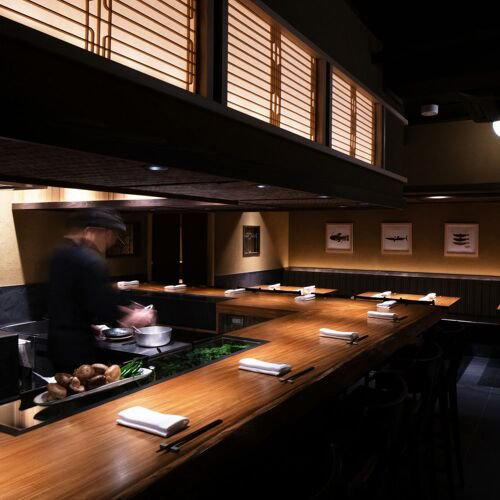
Where Vietnamese Regionalism Meets Japanese Seasonality
Tokyo has spent the last decade building one of the world's most internationally layered restaurant scenes, yet Vietnamese cuisine has occupied a narrow slice of it: casual pho counters, banh mi shops, and a handful of mid-range family restaurants clustered around Shinjuku and Shibuya. The arrival of a serious, technique-driven Vietnamese table in Jingumae marks a shift in that pattern. At ¥¥¥ price positioning, Ăn Ði sits below the ¥¥¥¥ tier occupied by counters like Harutaka or kaiseki rooms like RyuGin, but it operates with an ambition that belongs in the same conversation about cross-cultural precision dining.
The framing here is deliberately seasonal and Japanese in its sourcing logic: Vietnamese dishes are rendered through whatever the domestic market is producing at a given moment, producing a menu that shifts four times a year. That structural choice aligns Ăn Ði more closely with the kaiseki calendar than with how Vietnamese restaurants typically operate, where consistency of flavour profile across the year is the standard expectation.
The North-South Argument on a Single Menu
Vietnamese cuisine carries an internal geography that most international diners never fully encounter. Northern cooking, rooted in Hanoi and the Red River Delta, runs cool and restrained: broths are clear, aromatics are precise, and the heat register is low. Southern cooking, shaped by Saigon and the Mekong Delta, runs warmer and more assertive, with palm sugar rounding sauces, fresh chilli entering dishes at multiple points, and coconut milk appearing in both savoury and sweet contexts. The bánh xèo, the sizzling crepe that anchors much of southern Vietnamese street food, is a useful marker: in Hội An it runs thin and crisp; in Saigon it runs larger and richer; in the north it barely exists at all.
Chef Chihiro Naito, trained in French cuisine, has brought both registers onto one menu rather than committing to a single regional identity. That decision is editorially significant. It allows the kitchen to exploit Japanese seasonal produce in both directions: the restraint and precision of northern Vietnamese aromatics map naturally onto the washoku sensibility of letting a single ingredient speak; the boldness of southern preparations gives the kitchen room to contrast, to sweeten lightly with domestic produce, and to introduce a southern chilli warmth where the season calls for it. Whether that balancing act holds across all courses is the central question a diner brings to the table at Ăn Ði.
The raw spring rolls that appear on the menu occupy northern Vietnamese territory by nature: fresh herbs, uncooked vegetables, rice paper, dipping sauce. Phở, though its origins are debated, arrived in its canonical form in Hanoi. The bánh xèo is the southern counterweight. Running all three in a single tasting format is, in effect, an argument about Vietnamese culinary breadth delivered through Japanese seasonal materials.
French Technique as Infrastructure
The trajectory of Asian fine dining in Tokyo over the past fifteen years has tracked a consistent pattern: a chef trains in a European kitchen, absorbs classical technique and mise en place discipline, then returns to build something that uses those tools in service of an Asian culinary logic. L'Effervescence and Sézanne both represent the French end of that continuum. Crony represents an innovative middle ground. Ăn Ði belongs to a different branch: French training deployed not to refine French cooking but to sharpen Vietnamese cooking from the inside.
What French technique offers a Vietnamese kitchen is largely structural: the capacity to clarify stocks to an aromatic transparency that Vietnamese broth already prizes, the precision to manage emulsification in dipping sauces, the temperature control to handle protein at the exactness that pho's beef demands. The visible outcome of that training is not fusion in the blending sense but rather a heightened technical fluency applied to a cuisine that already rewards restraint and detail.
Beverages: A Programme That Takes Position
The drinks programme at Ăn Ði is sommelier-led and takes an explicit position: wine is the primary pairing vehicle, with sake and shochu offered as a deliberate secondary register. That hierarchy is itself a statement. Most Japanese fine dining rooms of this calibre default to sake as the anchor and wine as the supporting cast. Inverting that order signals that the kitchen is reading its own food as more aligned with European pairing logic than with the traditional Japanese framework, which makes sense given the French training background and the intensity of fermented fish sauce, lemongrass, and southern sugar that Vietnamese dishes carry. Acidic whites and skin-contact orange wines tend to cut through those flavour profiles in ways that can outperform the more delicate, umami-led sake pairings.
That said, the inclusion of sake and shochu is not decorative. Vietnamese cuisine's herb-forward, relatively low-fat profile creates pairing space for junmai and ginjo styles in ways that heavier, cream-sauce-driven European cuisine does not. A kitchen that has mapped Japan's four seasons onto Vietnamese structure has presumably thought about when sake makes better sense than Burgundy.
Recognition and Where It Sits
Ăn Ði holds a Michelin Plate for both 2024 and 2025, a recognition that places it firmly in the considered-dining category without yet reaching the star tier. The Opinionated About Dining rankings provide a more granular picture: Highly Recommended in 2023, ranked 188th in Japan in 2024, and 289th in 2025. The movement between those two years deserves a note. OAD rankings reflect repeated diner visits, and year-on-year changes in a large market like Japan often track menu evolution or shifting reviewer attention rather than quality decline. The 2025 position still represents a top-300 ranking in one of the world's most competitive restaurant markets.
The We're Smart Green Guide recognition adds a separate dimension: Ăn Ði has been acknowledged for its plant-forward approach, a natural fit given Vietnamese cuisine's structural reliance on herbs, vegetables, and rice. The guide's note that fish and meat retain a significant presence reads as useful calibration for diners expecting a primarily vegetable-driven format.
For comparison, fine dining addresses using cross-cultural technique at the ¥¥¥¥ level include HAJIME in Osaka, Gion Sasaki in Kyoto, and akordu in Nara. Outside Japan, the cross-cultural precision dining model has produced rooms like Atomix in New York City, where Korean culinary logic is filtered through French technique, and Le Bernardin, which sets the standard for disciplined European technique applied to a single protein category. Ăn Ði operates in a comparable intellectual space at a lower price tier. Further across Japan, Goh in Fukuoka, 1000 in Yokohama, and 6 in Okinawa each demonstrate how regional Japanese cities are producing comparable cross-cultural precision work.
Planning Your Visit
The restaurant is located at 3 Chome-42-12 Jingumae, Shibuya, placing it within the Omotesando grid where mid-to-upper-tier dining has concentrated over the past decade. Dinner service runs Tuesday through Sunday from 6 pm to 11 pm. Saturday and Sunday add a lunch sitting from noon to 1:30 pm; Monday is closed. At ¥¥¥ pricing, Ăn Ði represents a more accessible entry point than the ¥¥¥¥ counter dining dominant in this neighbourhood, while operating at a format level where advance booking is the reasonable assumption. Our full Tokyo restaurants guide provides broader context on where this address fits within the city's dining tiers, and our guides to Tokyo hotels, bars, wineries, and experiences cover the rest of the city's premium offering.
Frequently asked questions
What days is Ăn Ði closed?
Hours at Ăn Ði: Hours: Monday Closed Tuesday 6–11 pm Wednesday 6–11 pm Thursday 6–11 pm Friday 6–11 pm Saturday 12–1:30 pm, 6–11 pm Sunday 12–1:30 pm, 6–11 pm.
What distinctions does Ăn Ði have?
Ăn Ði has received recognition including: Modern Vietnamese food from a chef trained in French cuisine. Ăn Ði combines seasonal Japanese ingredients with bánh xèo, raw spring rolls and phở to express the four seasons of Japan with Vietnamese cuisine. With a skilled sommelier at the….
What's the must-try dish at Ăn Ði?
The menu rotates with Japanese seasons, so no single dish is fixed across visits. The bánh xèo and raw spring rolls are structural anchors of the concept, appearing consistently as expressions of Vietnamese regional cooking reframed through local Japanese produce. Given that the drinks programme is sommelier-led with deliberate wine, sake, and shochu pairings, ordering with the pairing in mind tends to define the experience more than any single plate.
What cuisine category does Ăn Ði fall under?
What should I budget for a meal at Ăn Ði?
Pricing at Ăn Ði is listed as ¥¥¥.
Where is Ăn Ði located?
Ăn Ði is located at 3 Chome-42-12 Jingumae, Shibuya, Tokyo 150-0001, Japan, Tokyo.
Who is the chef or culinary lead at Ăn Ði?
The chef associated with Ăn Ði is Chihiro Naito.
The Essentials
A compact comparison to help you place this venue among nearby peers.
| Venue | Cuisine | Price | Awards | Notes |
|---|---|---|---|---|
| Ăn ÐiThis venue (the venue you are viewing) | Modern Vietnamese with Japanese seasonal ingredients | $50–100 | Michelin Plate · We're Smart World 2 Radishes | Not listed |
| Harutaka | Edo-Style Omakase Sushi | $200–300 | 3 Michelin Stars · World's 50 Best #76 | Sushi |
| RyuGin | Modern Kaiseki | $500+ | 3 Michelin Stars · World's 50 Best #41 | Kaiseki, Japanese |
| L'Effervescence | Modern French with Japanese Influences | $200–300 | 3 Michelin Stars · World's 50 Best #69 | French |
| HOMMAGE | Modern French with Japanese Influences | $150–200 | 2 Michelin Stars · World's 50 Best #78 | Innovtive French, French |
| MAZ | Innovative Peruvian-Japanese Fusion | $150–200 | 2 Michelin Stars · World's 50 Best #28 | Innovative |
Recognition history
Dated appearances from independent guides and award organizations, with the underlying list record or original source where available.
Michelin Plate
Michelin
Opinionated About Dining Top Restaurants in Japan Recommended
Opinionated About Dining
We're Smart World 2 Radishes
We're Smart World
Tabelog 100 #20 · No. 20
Tabelog · Tabelog 100 - Asian cuisine / Ethnic cuisine - TOKYO - 2024
Full recognition history (9 entries)
Michelin Plate
Michelin
Opinionated About Dining Top Restaurants in Japan Ranked #289
Opinionated About Dining
Michelin Plate
Michelin
Opinionated About Dining Top Restaurants in Japan Ranked #188
Opinionated About Dining
Opinionated About Dining Top Restaurants in Japan Highly Recommended
Opinionated About Dining