
Muromachi Sunaba Nihonbashi hon ten is a Tokyo soba address for readers who care about Edo-style craft rather than ceremony. Its Tabelog 100 Soba EAST 2025 selection, 100-seat table-and-parlor format, Sarashina and Ichiban flour focus, and tempura-zaru lineage place it in a traditional category that remains distinct from Tokyo’s counter-led luxury dining culture.
Pearl is the En Primeur Club membership app — saves, bookings, and concierge access live there. Same editors, same standards.
- Address
- 4 Chome-1-13 Nihonbashimuromachi, Chuo City, Tokyo 103-0022, Japan
- Phone
- +81 3-3241-4038
- Website
- muromachi-sunaba.co.jp
 Saves & bookings on Pearl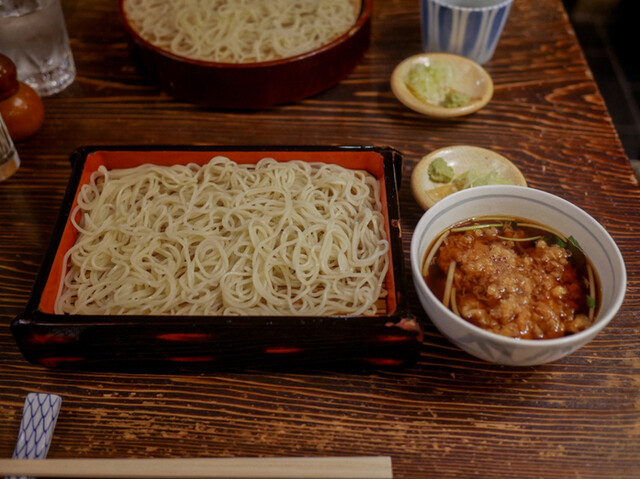
Nihonbashi’s older eating rooms have a different rhythm from Tokyo’s trophy counters. The cues are quieter: noren at the entrance, a room built for repeat meals rather than performance, and the steady sound of soba being ordered by people who know exactly what they want. In this part of Chuo, lunch can still mean a bowl, a tray, a pour of dipping sauce, and a pace that belongs to the mercantile city rather than the reservation economy.
That context matters at Muromachi Sunaba Nihonbashi hon ten because soba in Tokyo is not a consolation category beneath sushi, tempura, or kaiseki. It is one of the city’s sharper tests of restraint. The difference between a casual noodle stop and a serious soba house is often measured in flour choice, sauce balance, tempura handling, and the room’s ability to serve regulars without turning tradition into theatre.
Two Edo soba registers: Sarashina polish and Ichiban depth
Edo-style soba is built on small distinctions. Sarashina flour gives a paler, smoother expression; Ichiban flour brings a more pronounced buckwheat character. The point is not abundance but calibration, which is why soba houses can feel austere to diners trained by tasting menus. The pleasure sits in temperature, texture, and the way dipping sauce frames the noodle rather than overwhelms it.
Muromachi Sunaba Nihonbashi hon ten is useful because it keeps both registers in view. Its public description highlights Sarashina for zaru and first flour for mori, making the meal less about novelty and more about choosing between refinement and grain. That distinction is central to Tokyo soba culture: a diner can read a house by how clearly those two moods are separated.
The tempura side of the tradition gives the room its larger historical weight. Tempura Zaru and Tempura Mori are tied to this address in the restaurant’s own account, with shrimp and small clam tempura served in a rich dipping sauce. That claim matters less as a museum label than as a reminder that many dishes now treated as standard soba-shop vocabulary began as specific house practice before becoming citywide convention.
The sensory center is therefore not a parade of named dishes. It is the meeting point of buckwheat, sauce, oil, and speed. Soba rewards attention because it punishes delay; the room’s scale and pace suggest a format designed for turnover without surrendering the older gestures of table service and parlor seating.
A 100-seat soba house in a city of small counters
Tokyo’s prestige dining conversation often favors scarcity: eight-seat sushi counters, chef-led kappo rooms, omakase formats priced for international demand. Soba belongs to another register. A serious soba house can be democratic in price and still carry deep technical expectations, which is why recognition in the Tabelog 100 Soba EAST 2025 list is a stronger signal here than luxury cues would be.
The room’s 100-seat capacity, split across table and parlor seating, also changes the experience. This is not the hush of a chef’s counter where every movement is staged for a handful of guests. It is closer to Tokyo’s older restaurant infrastructure: larger, multi-generational, practical, and comfortable with families, friends, office workers, and solo diners occupying the same category of meal. Private rooms for small groups add another layer, placing soba within everyday social dining rather than pure quick-service eating.
Compared with nearby peer categories, the value proposition is clear. Hongoku Tei sits in a similar modest Tokyo price band, while Budouya stretches from casual lunch into higher dinner spend; Kuzushi Teppan AVAGURA Kanda ten and Hicho Kurata belong to far more expensive dining brackets. Muromachi Sunaba Nihonbashi hon ten sits apart from that escalation. Its appeal is not that it competes with luxury formats, but that it preserves a serious traditional category at a scale and price level Tokyo increasingly struggles to protect.
That makes the sensory experience more grounded than grand. The setting is a house restaurant rather than a design statement; tatami-room and parlor elements point to older Japanese dining habits. Drinks are framed around sake and shochu, sensible companions for soba and tempura rather than a sommelier-led spectacle. The second-floor smoking policy will matter to some diners, but it also signals a room shaped by long-standing local habits rather than imported fine-dining norms.
How to read this meal in Nihonbashi
Nihonbashi and nearby Kanda reward diners who understand daytime eating as part of the city’s cultural machinery. Department stores, old wholesalers, offices, shrines, and railway nodes all feed a style of restaurant that has to work for regular use. Soba fits that ecosystem because it can be quick without being careless, traditional without demanding ceremony, and seasonal without needing a long explanation.
The editorial stance is simple: this is a Tokyo address for diners who want to understand soba as craft, not as a side trip between bigger reservations. The Tabelog score of 3.66 and repeated Soba 100 selections in 2021, 2024, and 2025 give it public recognition, but the stronger reason to go is category literacy. Order with the flour distinction in mind, treat tempura as part of the house lineage rather than an add-on, and let the room’s tempo do its work.
For a broader Tokyo dining map, compare this traditional soba stop with casual and specialist addresses across the city: . 鮪と炭火焼き うお炭 秋葉原店, 12/10 Shinjuku ten, 124. KAGURAZAKA (Yakitori), 2D Cafe, and 3 Chome no Curry Ya San. The wider city rails are also useful for planning: Our full Tokyo restaurants guide, Our full Tokyo hotels guide, Our full Tokyo bars guide, Our full Tokyo wineries guide, and Our full Tokyo experiences guide.
For readers extending the same lens beyond central Tokyo, EP Club also tracks regional and overseas Japanese dining references including -Grilled beef Sukiyaki- KAMAKURA TANUKIAN 鎌倉 たぬき庵 in Kamakura.cafe in Osaka.know in Kumamoto, (Shoku) Vietnam in Kawasaki, [Curry Senmon Ten] Maruyama Kyoju. in Sapporo, [ki:] in Kyoto, Jōdo Saké Bar in Los Angeles, and Onigiri Time in Pasadena.
Quick Comparison
Comparable venues side-by-side for orientation.
| Venue | Cuisine | Price | Notes |
|---|---|---|---|
| Muromachi Sunaba Nihonbashi hon tenThis venue — the venue you are viewing | Traditional Edo-style soba | $$ | Not listed |
| Nonokura | Chuutakansuimen Ramen | $$ | Kameari |
| Sanmalo Toukyou ten | Specialty ramen (shoyu, niboshi & seasonal chilled bowls) | $$ | Chiyoda |
| . 鮪と炭火焼き うお炭 秋葉原店 | Maguro and Charcoal-Grilled Fish Izakaya | $$ | Chiyoda |
| Yakiniku Akira Hongou honten | Japanese Yakiniku (BBQ Beef) | $$ | Bunkyō |
| Kuya | Traditional Japanese Wagashi & Monaka | $$ | Chūō |
Recognition history
Dated appearances from independent guides and award organizations, with the underlying list record or original source where available.
Tabelog 100 #67 · No. 67
Tabelog · Tabelog 100 - Soba - EAST - 2025







At a Glance
- Classic
- Well Known
- Cozy
- Solo
- After Work
- Group Dining
- Casual Hangout
- Business Dinner
- Private Dining
- Historic Building
- Standalone
- Sake Program
- Beer Program
Current opening hours
- Monday
- 11:30 AM–3:30 PM, 4:30–9 PM
- Tuesday
- 11:30 AM–3:30 PM, 4:30–9 PM
- Wednesday
- 11:30 AM–3:30 PM, 4:30–9 PM
- Thursday
- 11:30 AM–3:30 PM, 4:30–9 PM
- Friday
- 11:30 AM–3:30 PM, 4:30–9 PM
- Saturday
- 11:30 AM–4 PM
- Sunday
- Closed
Hours can change for holidays and private events. Last verified .
Traditional soba-ya atmosphere with a spacious main floor and tatami-style banquet space upstairs, feeling like a classic neighborhood institution rather than a modern designer restaurant; bright, simple, and bustling at peak hours but relaxed enough for lingering over soba and sake.