At Viktualienmarkt 3, Munich Soup Kitchen occupies one of the city's most storied market addresses, placing it at the centre of a centuries-old food culture that predates any restaurant trend. A counter stop in the shadow of the market's maypole, it represents the kind of everyday eating that Munich's fine-dining circuit quietly depends on for contrast and context.
Pearl is the En Primeur Club membership app — saves, bookings, and concierge access live there. Same editors, same standards.
- Address
- Viktualienmarkt 3, 80331 München, Germany
- Phone
- +4949892609599
- Website
- muenchner-suppenkueche.de
- Directions
- Get directions
 Saves & bookings on Pearl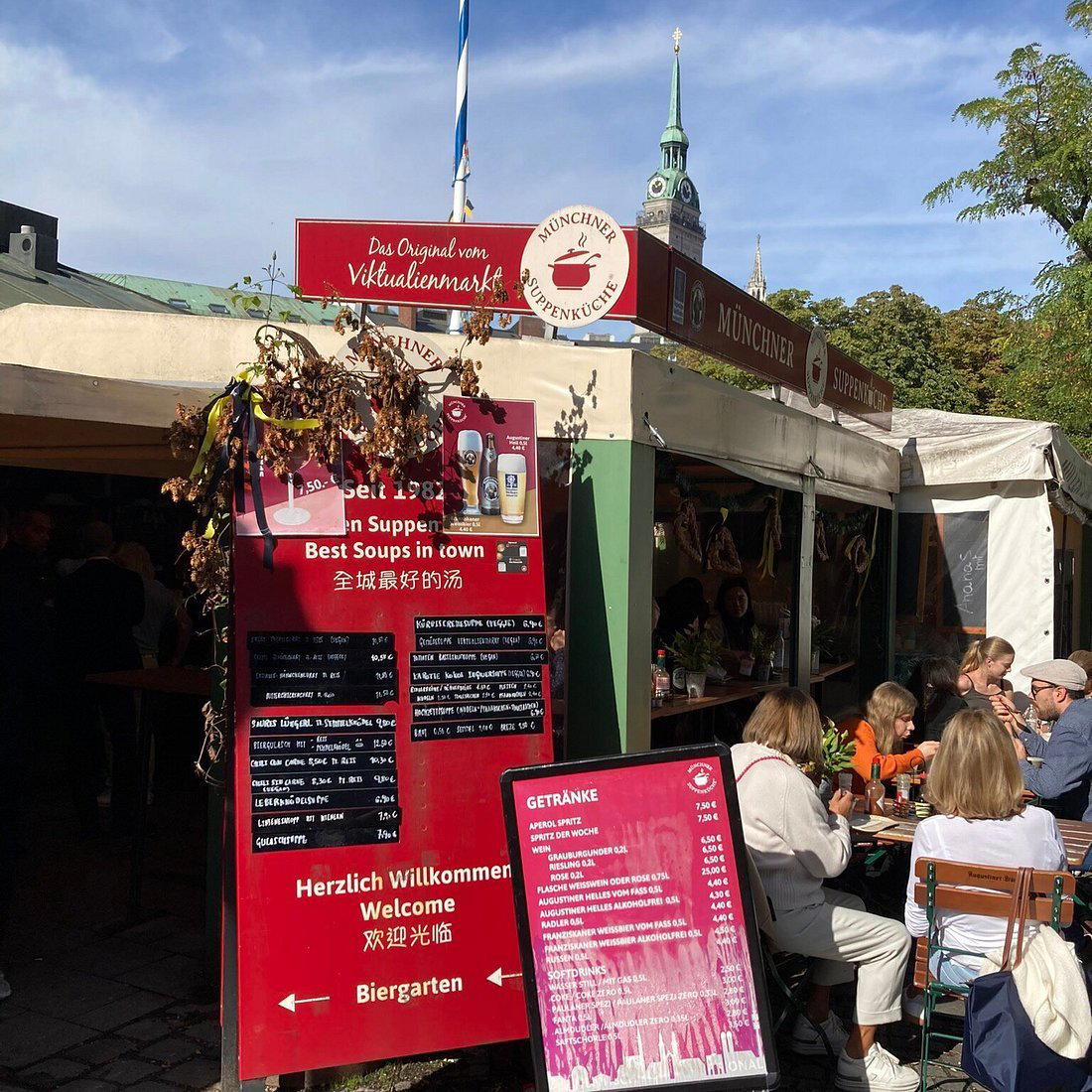
A Market Address That Does the Talking
Viktualienmarkt is not a backdrop. Munich's open-air provisions market, trading continuously since 1807, is one of the few food spaces in Germany where a visitor can read the city's appetite directly, without mediation from a maître d' or a tasting menu. The stalls, the butchers, the cheese traders, and the prepared-food counters that ring the market's cobbled footprint form a working index of Bavarian food culture as it actually functions, not as it is presented for export. Munich Soup Kitchen, addressed at Viktualienmarkt 3, sits inside this context.
In a city where fine-dining coordinates are spread across Maxvorstadt, Schwabing, and the hotel dining rooms of the city centre, Viktualienmarkt operates on a different register entirely. The comparison set here is not Tantris or Atelier, both of which anchor Munich's €€€€ bracket with multi-course formats and formal room design. It is not the tasting-counter precision of Tohru in der Schreiberei or the creative provocation of Alois at Dallmayr, directly overhead in one of Munich's most storied delicatessen buildings. The market's food counters exist in a separate economy of eating, fast, direct, daily, and rooted in the logic of what the surrounding stalls are selling that morning.
The Scene at Viktualienmarkt
What defines eating at or around Viktualienmarkt is the absence of ceremony. The market draws Münchners on their lunch break, tourists navigating between the Residenz and the Marienplatz, local traders doing their rounds, and the kind of regulars who have been coming to the same counter for years without once consulting a review. Soup, in this context, is not a starter or an amuse-bouche signal; it is a complete act of eating, shaped by the season and the logic of the market economy that surrounds it. The tradition of market soup in German-speaking cities stretches back to the Markthallen era of the nineteenth century, when covered and open-air markets provided cooked food to urban populations who often lacked domestic kitchen facilities. That structural history gives market soup counters a different lineage than the restaurant, even as the two have increasingly converged in contemporary urban food culture.
Munich's food scene has split along increasingly clear lines in recent years. On one side sit the formal dining operations, JAN and its creative tasting format, the decades-long authority of Tantris, and a constellation of Michelin-tracked addresses that position Munich inside Germany's serious fine-dining conversation. On the other sits the city's appetite for direct, unfussy eating that reflects Bavaria's own food culture: broths, market produce, bread, and prepared foods bought and consumed without theatre. Viktualienmarkt is the institutional home of that second tradition, and any counter operating there inherits the weight of the address.
Munich's Broader Soup Tradition
Soup occupies a more central role in Bavarian daily eating than its counterpart in many other European food cultures. Leberknödelsuppe (liver dumpling broth), Hochzeitssuppe (wedding soup with semolina dumplings), and Flädlesuppe (clear broth with sliced pancake strips) are not curiosities or heritage museum pieces; they appear on weekday menus across the city and are consumed without comment by locals who would find the question of their significance slightly puzzling. The market context amplifies this ordinariness into something more layered: when the soup is made from produce sourced metres away, the distance between field and bowl collapses in a way that no tasting-menu narrative about provenance can fully replicate.
Germany's wider fine-dining circuit, which includes addresses from Aqua in Wolfsburg to Schwarzwaldstube in Baiersbronn and Vendôme in Bergisch Gladbach, has spent the last decade building toward a kind of technical intensity that places it in conversation with Le Bernardin in New York or Atomix. That circuit is real, and Munich participates in it. But it is not the only way Germany eats, and it is not the tradition that a market soup counter represents. The two exist in productive tension, and any honest account of Munich's food character has to hold both.
What the Location Means for the Visit
Viktualienmarkt is a five-minute walk south of Marienplatz and accessible from multiple U-Bahn and S-Bahn lines. The market itself operates on fixed hours tied to the trading day. The pace is market pace: quick, sociable, standing or perching rather than seated, and oriented around the transaction of food rather than the performance of hospitality. For visitors coming from the direction of the formal Munich dining circuit, from evenings at JAN or afternoons at the Dallmayr building, the market offers a useful recalibration of what the city actually eats on a Tuesday.
The wider German dining map rewards this kind of register-shifting. A trip that takes in ES:SENZ in Grassau, Schanz in Piesport, or CODA Dessert Dining in Berlin will be richer for also including time at market counters that operate outside the review economy entirely. The contrast is instructive. See also Restaurant Haerlin in Hamburg, Bagatelle in Trier, Waldhotel Sonnora in Dreis, and Victor's Fine Dining by Christian Bau in Perl for the full spread of what serious eating in Germany looks like. Our full Munich restaurants guide maps the formal and informal tiers across the city.
Planning Your Visit
| Venue | Format | Price Tier | Booking Required |
|---|---|---|---|
| Munich Soup Kitchen | Market counter, casual | € | No |
| Tantris | Formal tasting menu | €€€€ | Yes, well in advance |
| Alois at Dallmayr | Fine dining, creative | €€€€ | Yes |
| Tohru in der Schreiberei | Counter tasting menu | €€€€ | Yes |
Cost and Credentials
Comparable venues nearby, for context on price, style, and recognition.
| Venue | Cuisine | Price | Notes |
|---|---|---|---|
| Munich Soup KitchenThis venue — the venue you are viewing | Altstadt, Bavarian Soup Kitchen | $ | Not listed |
| Zunfthaus | Not listed | $$ | Theresienwiese, Traditional Bavarian & Austrian |
| Leib und Seele | Lehel, Traditional Bavarian | $$ | Not listed |
| Michaeligarten Restaurant | Not listed | $$ | Rammersdorf, Traditional Bavarian Beer Garden |
| Gaststätte Großmarkthalle | Not listed | $$ | Ludwigsvorstadt, Traditional Bavarian Gaststätte |
| Wirtshaus Rechthaler Hof | Theresienwiese, Traditional Bavarian | $$ | Not listed |
At a Glance
- Casual
- Cozy
- Casual Hangout
- Standalone
- Street Scene
Current opening hours
- Monday
- 10 AM–6 PM
- Tuesday
- 10 AM–6 PM
- Wednesday
- 10 AM–6 PM
- Thursday
- 10 AM–6 PM
- Friday
- 10 AM–6 PM
- Saturday
- 10 AM–6 PM
- Sunday
- Closed
Hours can change for holidays and private events. Last verified .
Casual market stall atmosphere with quick service and bustling energy from diverse crowds.