
We're Smart World 2 Radishes
Our verdict
Muni brings the Alain Ducasse group's French discipline to Arashiyama, working with Kyoto's celebrated kyo-yasai vegetables in a format that sits apart from the kaiseki tradition dominating the city's premium dining tier. Chef Hugues Gérard leads the kitchen, translating the region's exceptional organic produce through a French lens at a property near Tenryu-ji temple.

Pearl is the En Primeur Club membership app, where members save venues, book tables and use the concierge.
The menu
What to order
- Wagyu steak
- Omurice
- Whiskey barrel grilled dishes
Where French Technique Meets Kyoto's Vegetable Culture
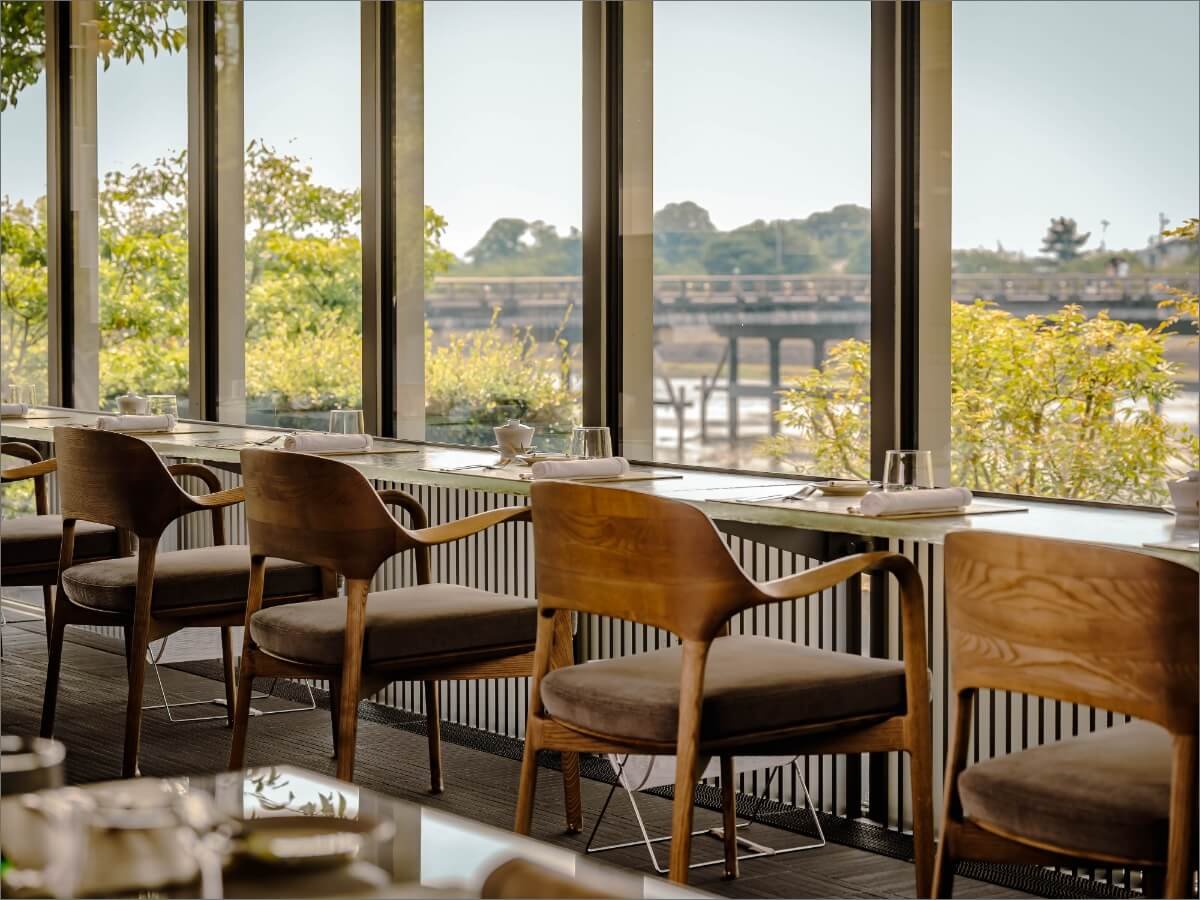
Arashiyama arrives before the meal does. The address, Sagatenryuji Susukinobabacho in Ukyo Ward, places Muni within walking distance of Tenryu-ji, one of Kyoto's great Zen gardens, and the bamboo-lined paths that draw visitors to the city's western fringe. That geography is not incidental. Arashiyama has long operated as a quieter counterpoint to Gion and Higashiyama, where the density of premium kaiseki counters runs highest. Here, the approach to serious dining feels more deliberate, less trafficked, and the setting shapes the meal before a single dish appears.
Kyoto's claim on Japanese vegetable culture is well-documented. The city's surrounding farmland produces kyo-yasai, a category of heritage vegetables, Kamo eggplant, Kujo green onions, Shishigatani pumpkin among them, that carry protected regional status and anchor the kaiseki tradition's seasonal vocabulary. That agricultural identity has made Kyoto a reference point not just for Japanese fine dining but for any serious kitchen working with produce as a primary creative material. Muni operates inside that context, using the region's organic vegetable cultivation as its ingredient base while bringing a different culinary grammar to the table entirely.
The Ducasse Framework in a Japanese Setting
The Alain Ducasse group's global footprint spans Monaco, Paris, London, and Tokyo, among other cities. Muni represents the group's engagement with Kyoto specifically, and the organizational discipline that characterises Ducasse operations abroad, consistency of format, sourcing rigour, service architecture, carries through here. This is not a loose franchise arrangement. The group's standards are visible in the dining room's structure and in the way the kitchen positions itself relative to the ingredient sourcing that Kyoto makes possible.
Chef Hugues Gérard runs the kitchen on site. Within the Ducasse network, on-the-ground chefs function as interpreters of the group's French technical tradition, applying it to local conditions rather than importing a fixed menu wholesale. At Muni, that means French cooking methods applied to kyo-yasai and other regional produce, a dialogue between two culinary traditions with strong opinions about vegetables. The French classical approach, its saucing techniques, temperature control, course sequencing, meets ingredients whose quality the kaiseki tradition has spent centuries refining. The outcome sits in a competitive tier occupied by Kyoto's Western-influenced fine dining addresses, a smaller category than the city's kaiseki hierarchy but one with its own internal logic.
For context on where Muni fits relative to Kyoto's dominant fine dining mode, the kaiseki houses at venues like Gion Sasaki, Hyotei, Kikunoi Honten, Mizai, and Isshisoden Nakamura define the city's premium Japanese dining tier. Muni does not compete with that category; it occupies a distinct lane, where French culinary vocabulary operates as the primary organising principle rather than as an occasional reference point. Among Western-inflected fine dining in the Kansai region, comparable addresses include HAJIME in Osaka and akordu in Nara, each working at the intersection of European technique and Japanese ingredient culture.
The Arc of a Meal at Muni
French fine dining at this tier is structured as a progression, and the tasting format is where the Ducasse influence is most directly felt. The meal moves through a sequence in which vegetables drive the content of multiple courses rather than appearing as supporting elements to protein. This is a meaningful distinction in French cooking, where the hierarchy of ingredients has traditionally placed meat and fish at the centre. Kyoto's agricultural context shifts that balance, and a kitchen working seriously with kyo-yasai will allow those ingredients to carry courses independently.
The early stages of the meal tend to establish the seasonal register, what is in peak condition, what the kitchen has chosen to highlight in a given week or month. Kyoto's growing calendar gives chefs a precise seasonal vocabulary: spring bamboo shoots, summer Manganji sweet peppers, autumn chestnuts and root vegetables, winter turnips. A French kitchen reading that calendar produces different results than a kaiseki kitchen reading the same ingredients, and that contrast is part of what Muni offers for a diner already familiar with Kyoto's traditional dining forms.
Mid-meal courses at French tasting menus of this type typically involve the kitchen's most technically demanding preparations, reductions, emulsions, composed plates where temperature and timing are tightly controlled. The later courses shift register toward richer preparations before dessert re-introduces lighter, often fruit-led elements. At a Ducasse-group restaurant, the pastry section operates at the same level of technical seriousness as the savoury kitchen, a house standard that applies whether the address is in Paris or Arashiyama.
The wine program at restaurants in this network is typically structured around French appellations, though serious French kitchens operating in Japan increasingly hold Japanese wines alongside Burgundy and Bordeaux to meet a domestic audience that has developed genuine interest in domestic viticulture. For those exploring wine further across the region, our full Kyoto wineries guide covers regional options.
Planning a Visit
Muni's Arashiyama address, 3 Sagatenryuji Susukinobabacho, Ukyo Ward, is accessible from central Kyoto by train via the Sagano Line to Saga-Arashiyama station. The area is worth building time around: Tenryu-ji and its gardens operate independently of restaurant hours, and the early morning in Arashiyama, before tourist traffic builds, offers the area at its quietest. A restaurant at this tier, operating under an international group's standards, functions on a reservation basis. Walk-in dining is not a realistic expectation at a Ducasse-network address anywhere in the world, and Kyoto's premium dining calendar fills well in advance, particularly during the peak autumn foliage season in November and the cherry blossom window in late March and early April. Booking ahead is the operating assumption, not an optional precaution.
For those building a wider Kyoto dining itinerary, our full Kyoto restaurants guide maps the city's dining options across categories and price points. Kyoto's bar scene and hotel options are covered in our full Kyoto bars guide and our full Kyoto hotels guide. For experiences and activities in the region, our full Kyoto experiences guide provides further options.
Muni also invites comparison with French fine dining operating at the highest level elsewhere in Japan. Harutaka in Tokyo represents a different expression of Japanese fine dining at the top tier, while across Japan's regional cities, addresses like Goh in Fukuoka, Bleston Court Yukawatan in Nagano, and giueme in Akita demonstrate the geographic spread of serious cooking outside Tokyo and Osaka. For reference points within the Ducasse group's global French dining tradition, Le Bernardin in New York City and Emeril's in New Orleans illustrate the range of French-influenced fine dining operating at the international level, each with distinct relationships to their local ingredient culture.
Frequently asked questions
Has Muni won any awards?
Muni has received recognition including: Kyoto is the culinary city par excellence in Japan, and the vegetables are in it for something. The region is also called the center of high-quality organic vegetable cultivation. As a vegetable fan, there are many discoveries to be made he….
What's Muni's location?
Muni is located at 3 Sagatenryuji Susukinobabacho, Ukyo Ward, Kyoto, 616-8385, Japan, Kyoto.
What should I eat at Muni?
Muni's kitchen centres on kyo-yasai, the heritage vegetable varieties that define Kyoto's agricultural identity and give the region its reputation as Japan's foremost organic vegetable cultivation zone. Chef Hugues Gérard, operating under the Alain Ducasse group's framework, builds the tasting progression around those seasonal vegetables rather than treating them as accompaniment. That orientation makes the tasting menu the logical format, ordering à la carte, if available, would work against the meal's internal logic.
Do they take walk-ins at Muni?
Muni operates within the Alain Ducasse group's international standards, and serious dining at that tier in Kyoto runs on reservations. Arashiyama draws significant visitor traffic year-round, particularly during cherry blossom and autumn foliage seasons, which compounds demand. Securing a booking in advance is the practical approach; arriving without one at a restaurant of this standing is a reliable way to spend the evening elsewhere in Ukyo Ward.
Comparable Options
Comparable venues nearby, for context on price, style, and recognition.
| Venue | Cuisine | Price | Awards | Notes |
|---|---|---|---|---|
| MuniThis venue (the venue you are viewing) | French-Japanese Fusion | $50–100 | We're Smart World 2 Radishes | Not listed |
| ラ ブッシュ | Wood-Fired French with Ohara Terroir | $100–150 | 1 Michelin Star · Tabelog 100 #92 | Ohara |
| Les champs d'or | Classic French Fine Dining | Not listed | Tabelog Bronze | Nakagyō |
| PTISSERIE.S salon | Modern French patisserie salon | $10–20 | Tabelog 100 #46 | Nakagyō |
| ドロワ | Michelin-Star French Fine Dining | $200–300 | Not listed | 左京区 |
| Benoit | Modern French Bistro | $50–100 | Michelin Plate | Higashiyama |
Recognition history
Dated appearances from independent guides and award organizations, with the underlying list record or original source where available.
We're Smart World 2 Radishes
We're Smart World
Continue exploring
More in Kyoto
Restaurants in Kyoto
All restaurants in Kyoto →
Bars in Kyoto
All bars in Kyoto →

Hotels in Kyoto
All hotels in Kyoto →
Wineries in Kyoto
Browse all →
Details
- Cozy
- Intimate
- Date Night
- Special Occasion
- Chefs Counter
- Open Kitchen
- Sake Program
- Local Sourcing
- A La Carte
- Counter Dining
- Sake Program
- Vegetarian Friendly
Warm, welcoming, and cozy with a focus on conversational intimacy and culinary theater.