Our verdict
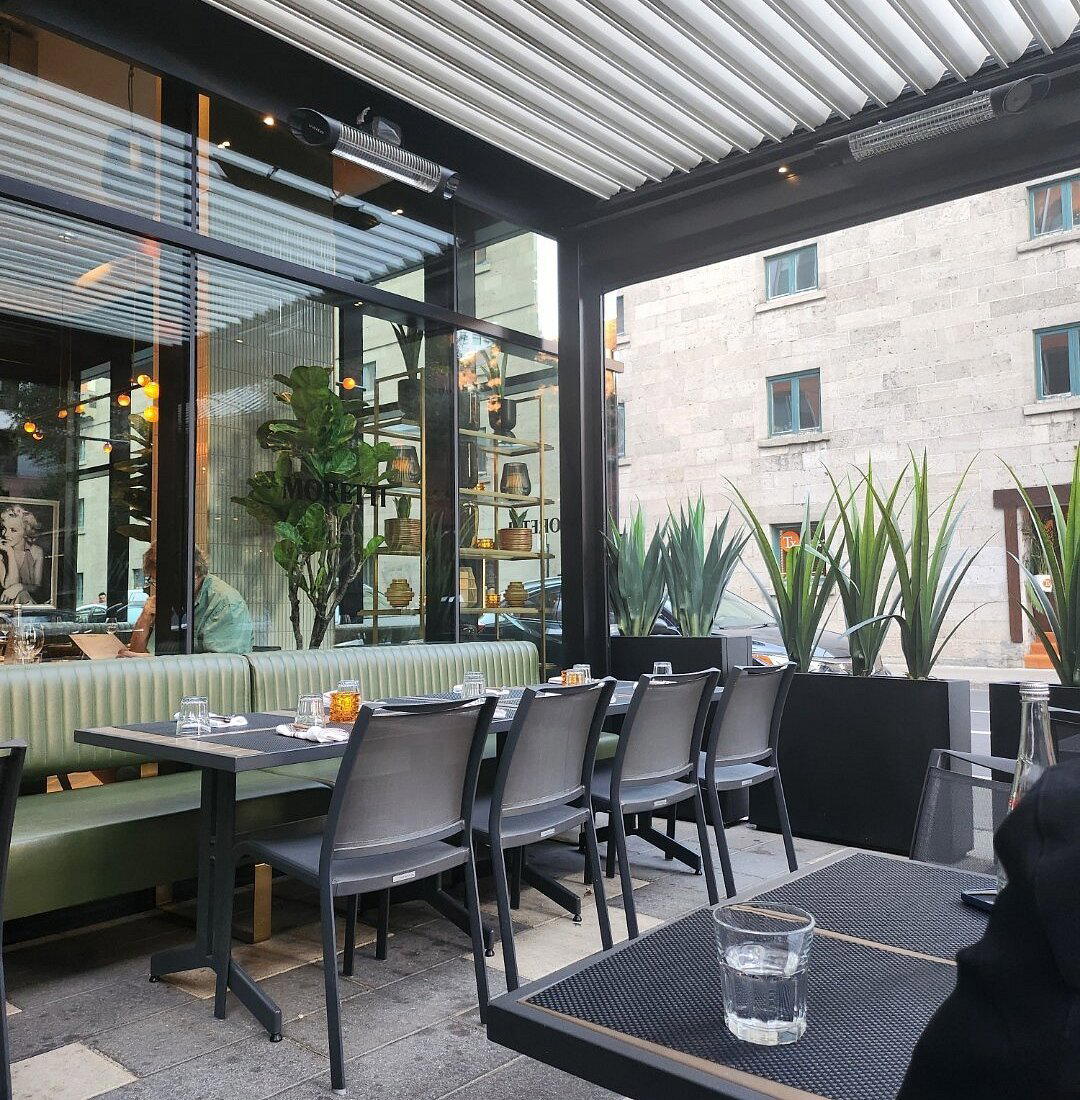
On Montreal's William Street in Griffintown, Moretti William sits at the intersection of the neighbourhood's industrial past and its current dining momentum. The address places it among a generation of restaurants reshaping a corridor once defined by warehouses and rail yards. For visitors and locals tracking where Montreal's restaurant scene is moving next, this is a useful reference point.

Pearl is the En Primeur Club membership app — saves, bookings, and concierge access live there. Same editors, same standards.
- Address
- 699 William St, Montreal, Quebec H3C 0T9, Canada
- Phone
- (514) 500-0420
- Hours
- Mon ClosedTue–Wed 5–10 PMThu–Sat 5–10:30 PMSun Closed
- Website
- pizzeriamoretti.com
- Directions
- Get directions
- Booking
- Book on OpenTable
Griffintown's Dining Shift, Read Through One Address
Montreal's restaurant geography has been reorganising for the better part of a decade. The old gravity points, the Plateau, Old Montreal, the Mile End, still hold, but a second tier of neighbourhoods has been drawing kitchens, bars, and dining rooms outward. Griffintown is the most discussed of these. The neighbourhood occupies the southwest quadrant below downtown, hemmed by the Lachine Canal to the south and the refined expressway to the north, and its transformation from a post-industrial vacancy into a residential and commercial zone has been fast enough to feel provisional in places and settled in others. William Street runs through it, and the address at 699 William puts Moretti William squarely in the middle of this ongoing recalibration.
What that address signals, before you know anything else about the food, is a particular kind of positioning. Griffintown restaurants are not operating in the protective shadow of an established dining district. There is no foot traffic from decades of habit, no inherited reputation to draw on. The neighbourhood is being written in real time, and the restaurants that have located here are, by that fact, making a statement about where they think the city's appetite is heading.
The Neighbourhood as Context
Walking William Street, the physical environment still carries the texture of Griffintown's industrial era. Low brick buildings, wide intersections scaled for freight movement, and the occasional converted warehouse sit alongside newer residential towers that arrived with the condo wave of the 2010s. It is a neighbourhood that reads as unresolved, which is not a criticism: cities in transition produce interesting dining precisely because rents and expectations are not yet fixed. The restaurants that locate here tend to be working with more creative freedom and less pressure to conform to an established neighbourhood identity.
Montreal's dining scene at the upper-middle and premium end has split into two broad currents over the past several years. One current runs through Old Montreal and the downtown corridor, where French-lineage fine dining and internationally recognised rooms operate at the $$$$ price tier: Toqué!, long the benchmark for Quebec-sourced modern French cooking, and Jérôme Ferrer - Europea, which sits in the same tier with a modern cuisine format and consistent award recognition. The second current moves through the emerging neighbourhoods, where kitchens at the $$$ level, places like Mastard, have built credible modern cuisine programs without the overhead or formality of the fine-dining tier. Griffintown restaurants like Moretti William are navigating this second current.
The comparison is useful for placing expectations. If you are arriving from the established fine-dining tier, the room and the service register differently. If you are arriving from the Plateau's casual bistro culture, a restaurant on William Street in this part of the city reads as more deliberate, more destination-oriented. The distinction matters for how you plan the evening.
What the Address Implies About the Dining Format
Addresses in transitional neighbourhoods tend to attract restaurants with a point of view. The cost structure of a street like William, where the neighbourhood has not yet priced itself to the level of, say, Old Montreal's rue Saint-Paul, creates room for kitchens to invest in the plate rather than the lease. That is a pattern visible in other Canadian cities where emerging districts have produced some of the more interesting mid-tier and destination dining: AnnaLena in Vancouver found its register in a Mount Pleasant neighbourhood undergoing similar recalibration, and Alo in Toronto built its reputation from a Spadina address that was not yet a fine-dining corridor when it opened.
Quebec has its own version of this pattern at a smaller scale. Narval in Rimouski operates well outside Montreal's gravity and has built a following on the strength of the food alone. Tanière³ in Quebec City made its reputation in a city where the fine-dining infrastructure is thinner than Montreal's, and the cooking had to do all the work. The lesson from these examples is that in Canadian dining, address is a weaker predictor of quality than it might be in a more stratified restaurant city.
The broader Canadian scene worth referencing includes destination restaurants that have made location almost irrelevant through the strength of their programs: Restaurant Pearl Morissette in Lincoln, Eigensinn Farm in Singhampton, and The Pine in Creemore all operate at a distance from major urban centres and draw on the basis of cooking alone. A Griffintown address is not that kind of remove, but it shares the underlying logic: the restaurant is not relying on neighbourhood prestige to do half the work.
Montreal's Wider Dining Reference Points
Placing Moretti William in Montreal's full dining spectrum requires acknowledging how wide that spectrum runs. At one end, Schwartz's represents a kind of cultural infrastructure: a smoked meat institution on Saint-Laurent that has been operating for generations and whose queue is as much a Montreal experience as anything on the plate. At the other end, the fine-dining tier runs through rooms like Sabayon and the modern cuisine operators that compete for the same reservation-making audience. In between, there is a dense middle tier of neighbourhood restaurants, wine bars, and bistros where much of Montreal's actual dining culture lives.
For visitors cross-referencing this against international fine-dining benchmarks, the relevant comparison set is not Le Bernardin in New York or Atomix in New York City. Those are rooms operating in a different register entirely. The closer analogues are the mid-to-upper dining rooms in other mid-sized cities where the cooking ambition is high and the formality is selective. Montreal's own 3 Pierres 1 Feu and Abu el zulof represent other points in the city's range, and Aux Anciens Canadiens in Quebec offers a contrast in how Quebec's culinary identity gets expressed at the traditional end of the register. For a fuller picture of where Moretti William fits within the city's current dining moment, the EP Club Montreal restaurants guide maps the field with greater specificity. Further afield, Barra Fion in Burlington and Bearspaw Golf Club in Calgary illustrate how destination dining formats vary across the country.
Know Before You Go
Address: 699 William St, Montreal, Quebec H3C 0T9, Canada
Neighbourhood: Griffintown, southwest of downtown Montreal
Price range: Not confirmed at time of publication
Hours: Not confirmed at time of publication; verify before visiting
Getting there: Griffintown is accessible by Metro (Lucien-L'Allier or Georges-Vanier stations) and by bike via the Lachine Canal path; street parking is available on and around William Street
Seasonal note: Griffintown's outdoor character shifts considerably between summer and winter; the neighbourhood is most active from late May through October, when canal-side foot traffic and patio dining drive a different atmosphere than the colder months
Frequently asked questions
Where is Moretti William in Montreal?
Moretti William is located at 699 William St, Montreal, Quebec H3C 0T9, Canada, Montreal.
How does Moretti William fit into Griffintown's dining scene compared to other Montreal neighbourhoods?
Griffintown has been absorbing restaurant openings that the Plateau and Mile End used to dominate, making William Street one of the more watched addresses in Montreal dining over the past several years. Moretti William at 699 William St sits within that shift, in a neighbourhood where lower commercial rents historically allow restaurants to take more considered positions on format and menu.
What should I eat at Moretti William?
Given Griffintown's shift toward ingredient-led, neighbourhood-scale dining, the format likely reflects that sensibility rather than a large hotel-style menu. check the venue's official channels for current offerings before visiting.
What's the best way to book Moretti William?
No phone number or website is publicly confirmed for Moretti William at 699 William St, Montreal. Your best approach is to check current listings on platforms like Resy or OpenTable, which cover the Griffintown dining corridor, or to visit in person during service hours to enquire directly.
What's Moretti William best at?
The address on William Street places Moretti William in one of Montreal's more compositionally interesting dining corridors, where restaurants tend to operate with a defined point of view rather than broad crowd-pleasing menus. That neighbourhood dynamic rewards venues that commit to format.
What if I have allergies at Moretti William?
No menu or dietary accommodation details are confirmed for Moretti William's current service. As with any Montreal restaurant where specific allergy policies are not published online, call ahead or communicate your requirements at the time of reservation. Arriving without notice and expecting flexibility mid-service is rarely advisable at any serious dining room.
Is Moretti William good value for money?
No pricing data is confirmed for Moretti William at 699 William St. Griffintown as a neighbourhood tends to support mid-range to upper-mid pricing rather than the premium brackets of Old Montreal, which generally means more competitive value per plate. Verify current pricing directly before visiting.
Peers You’d Cross-Shop
Comparable venues nearby, for context on price, style, and recognition.
| Venue | Cuisine | Price | Awards | Notes |
|---|---|---|---|---|
| Moretti WilliamThis venue — the venue you are viewing | Modern Italian Pizzeria | $50–100 | Not listed | Not listed |
| La Medusa | Authentic Italian Trattoria | $30–50 | Not listed | Golden Square Mile |
| Marché Italien Le Richmond | Northern Italian | $50–100 | Not listed | Griffintown |
| Ristorante Da Vinci | Refined Italian Fine Dining | $50–100 | Not listed | Golden Square Mile |
| NORA GRAY | Southern Italian | Not listed | Canada's 100 Best Restaurants #90 | Vieux Montréal |
| Moretti Griffintown | Authentic Italian Pizzeria | $30–50 | Not listed | Griffintown |