Moche
Our verdict
Moche occupies a quiet address on Linnaeuskade in Amsterdam's east, where the kitchen draws on Peruvian culinary tradition in a city that has historically underrepresented South American cooking. The address places it at some remove from the canal-belt restaurant cluster, which filters the crowd toward guests who have sought it out specifically. For Amsterdam diners tracking where serious non-European cuisine is taking root, Moche warrants attention.

Pearl is the En Primeur Club membership app — saves, bookings, and concierge access live there. Same editors, same standards.
The menu
What to order
- Tiradito Andino
- Bluefin Tuna Tiradito
- Smoked Eggplant
- Red Wine Glazed Iberica
- Passionfruit Suspiro
- Ceviche
- Duck with Green Rice
Where Amsterdam Meets the Pacific Rim of South America
Amsterdam's restaurant culture has long been shaped by its colonial and trade histories: Indonesian, Surinamese, and Chinese kitchens arrived decades before the city built a serious fine-dining infrastructure. What has taken longer to appear is cooking rooted in the Andean and coastal traditions of South America, particularly Peru, a cuisine that draws on Japanese, Chinese, Spanish, and indigenous Quechua techniques in proportions that shift with every cook and every port city. Moche, on Linnaeuskade 3h in Amsterdam's eastern residential fringe, is one of the addresses working in that register.
The location itself signals something about the operation's priorities. Linnaeuskade runs along the edge of the Oosterpark neighbourhood, away from the concentrated tourist footfall of Leidseplein or the canal ring. Diners arriving here are not passing through; they have made a specific choice. That self-selection tends to produce a room with more focus than you find at venues carried by location alone.
Peruvian Cooking and Why It Travels Differently Than Other Cuisines
Peruvian cuisine occupies an unusual position in the global dining conversation. It is simultaneously ancient, in its use of Andean staples like potato in its hundreds of varieties, quinoa, and ají peppers, and thoroughly hybrid, shaped by the waves of Japanese and Chinese immigrants who arrived in Lima from the late nineteenth century onward. The result is a cooking tradition that does not resolve neatly into a single visual or flavour signature. A ceviché relies on the chemical cooking of citrus, technique that predates European contact. A tiradito draws on the Japanese sashimi sensibility brought by Nikkei immigrants. A lomo saltado stir-fries beef with soy and tomato in a wok. These are not fusion gestures; they are the sediment of actual demographic history.
That complexity makes Peruvian cooking difficult to summarise on a menu and equally difficult to execute in markets where the ingredient infrastructure, the correct varieties of chilli, fresh leche de tigre components, and the right cuts for anticuchos, requires deliberate sourcing. In cities like London, New York, and to a lesser extent Paris, Peruvian kitchens at the upper tier, places that draw a line from Lima's Miraflores district to international dining rooms, have established a distinct competitive set. Amsterdam has been slower to develop that tier. Moche's address on Linnaeuskade places it in a small cohort of kitchens working to change that.
For reference on what fully resourced Peruvian-influenced cooking can look like at the international level, the trajectory of seafood-led tasting menus at places like Le Bernardin in New York City or the fermentation-and-produce discipline at Atomix in New York City illustrates how non-European cuisines can occupy the highest tier of a dining market when the kitchen infrastructure and ingredient sourcing align. Amsterdam's equivalent tier is currently led by Ciel Bleu, Flore, Spectrum, and Vinkeles, all operating in the creative-European mode and all holding Michelin recognition. The gap at the non-European end of that tier is precisely where kitchens like Moche have room to operate.
The Oosterpark Address and What the Neighbourhood Implies
The Oosterpark area developed as a working-class neighbourhood in the late nineteenth century, and its demographics shifted substantially through the twentieth century with waves of Surinamese and other post-colonial migration. That history has produced a food culture in the streets around the park that is more varied and less curated than the canal belt, with a mix of street-level Surinamese roti shops, Indonesian rice-table restaurants, and newer independent kitchens that have moved east as rents in the city centre have made ambition harder to sustain on a restaurateur's margin.
Linnaeuskade itself borders the Amstel canal system and the edge of Frankendael park, giving the immediate environment a quieter register than the Pijp or De Wallen. For a kitchen that wants to concentrate attention on the plate rather than the spectacle of a premium postcode, the address makes practical sense. It also places Moche at some distance from the cluster of Dutch-creative kitchens that have defined Amsterdam's upward dining trajectory, a cluster that includes Bistro de la Mer and the broader scene documented in our full Amsterdam restaurants guide.
How Moche Fits Amsterdam's Broader Dining Development
The Netherlands has produced serious fine dining beyond its capital. De Librije in Zwolle, 't Nonnetje in Harderwijk, and Aan de Poel in Amstelveen have each built Michelin-recognised programs outside Amsterdam. Further afield, Brut172 in Reijmerstok, De Bokkedoorns in Overveen, De Groene Lantaarn in Staphorst, De Lindehof in Nuenen, De Lindenhof in Giethoorn, De Nieuwe Winkel in Nijmegen, and De Treeswijkhoeve in Waalre show that the Dutch fine-dining infrastructure extends well into the provinces. What that network has in common is a grounding in northern European produce logic and, in most cases, a French technical spine. Moche's Peruvian orientation places it outside that tradition entirely, which is both a constraint, sourcing Andean ingredients in the Netherlands requires deliberate supply chain work, and an advantage in a market that rewards genuine distinction.
Planning a Visit
Moche is located at Linnaeuskade 3h, 1098 BC Amsterdam. The address is accessible by tram to the Oosterpark area, and the quieter canal-side setting means parking and foot approach are considerably easier than at central-city venues. For context on where Moche sits relative to Amsterdam's broader dining options, the EP Club Amsterdam guide covers the full range of the city's dining tiers.
Frequently asked questions
What's the must-try dish at Moche?
Can I walk in to Moche?
What's the signature at Moche?
Is Moche good for vegetarians?
Is a meal at Moche worth the investment?
How does Moche fit into Amsterdam's South American dining scene more broadly?
Comparable Options
Comparable venues nearby, for context on price, style, and recognition.
| Venue | Cuisine | Price | Notes |
|---|---|---|---|
| MocheThis venue — the venue you are viewing | Modern Peruvian Ceviche & Pisco Bar | $30–50 | Not listed |
| Red | French Steakhouse with Lobster | $50–100 | Spiegelbuurt |
| Meneer De Wit Heeft Honger | Mediterranean with Moroccan influences | $50–100 | De Wester Quartier |
| Bluespoon | European with Dutch Twist | Not listed | Canal Ring (Prinsengracht) |
| Restaurant Black & Blue | Modern Steakhouse | $30–50 | Kalverdriehoek |
| OCCO | Modern International Brasserie | $30–50 | Felix Meritisbuurt |
Continue exploring
More in Amsterdam
Restaurants in Amsterdam
All restaurants in Amsterdam →
Bars in Amsterdam
All bars in Amsterdam →
Hotels in Amsterdam
All hotels in Amsterdam →
Wineries in Amsterdam
All wineries in Amsterdam →
Details
- Modern
- Cozy
- Trendy
- Elegant
- Date Night
- Special Occasion
- Celebration
- Casual Hangout
- Terrace
- Standalone
- Design Destination
- Craft Cocktails
- A La Carte
- Small Plates
- Pisco Cocktails
- Pisco Sour
- Vegetarian Friendly
- Pescatarian Friendly
Current opening hours
- Monday
- Closed
- Tuesday
- 6–11 PM
- Wednesday
- 6–11 PM
- Thursday
- 6–11 PM
- Friday
- 6–11 PM
- Saturday
- 6–11 PM
- Sunday
- Closed
Hours can change for holidays and private events. Last verified .
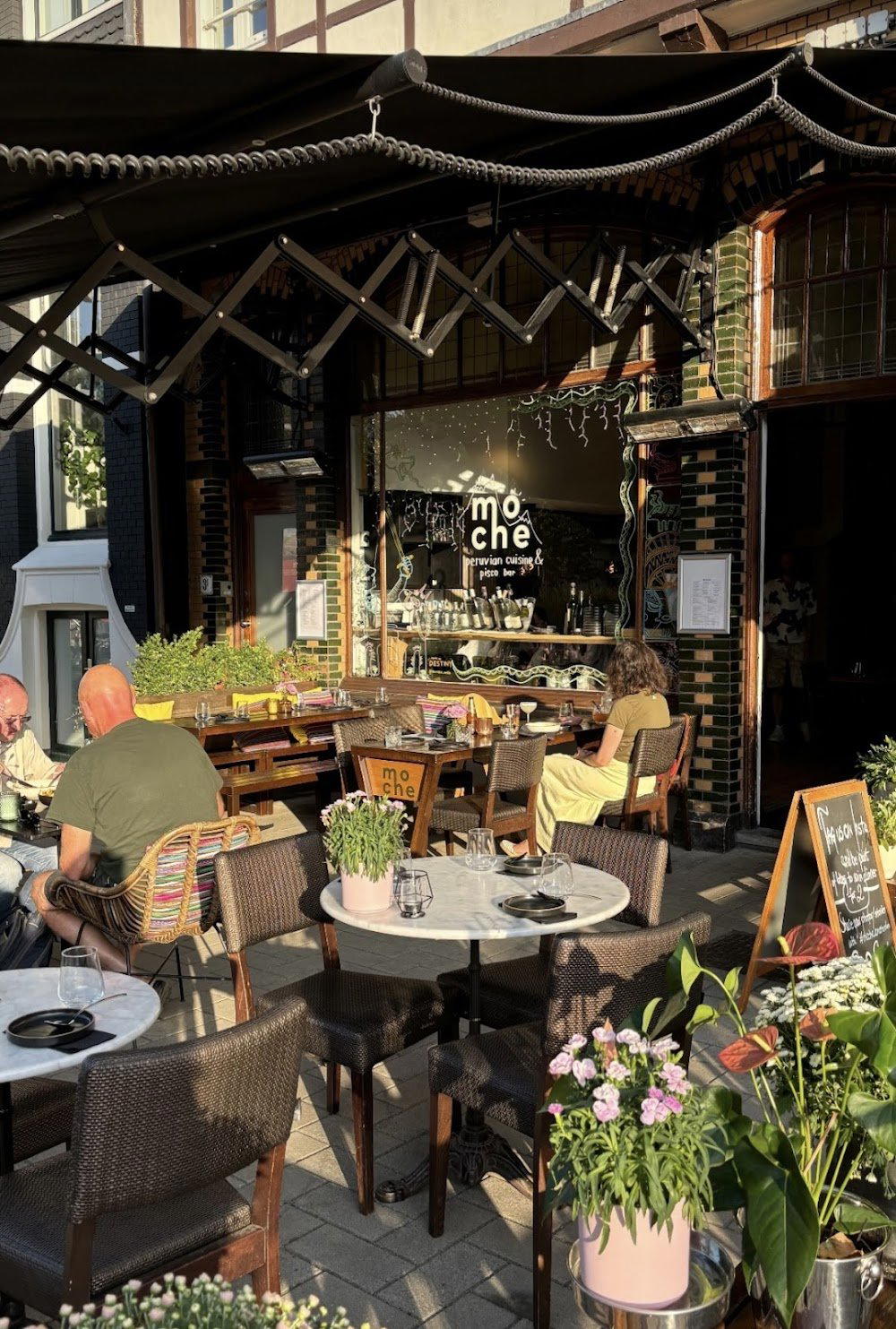
Warm and inviting with stylish modern décor featuring printed tiles, striking lamps, woven wicker and wood chairs, and colorful artwork that transports diners to Peru.