
Tabelog 100 #49
Our verdict
Miyabi Tei puts Hanyu on Japan’s serious bread map without the ceremony of a destination dining room. Its Tabelog Bread EAST “Tabelog 100” selections in 2020 and 2022 place a small Saitama bakery inside a broader movement of regional bakers competing on fermentation, flour choice, and daily production discipline rather than urban polish.

Pearl is the En Primeur Club membership app, where members save venues, book tables and use the concierge.
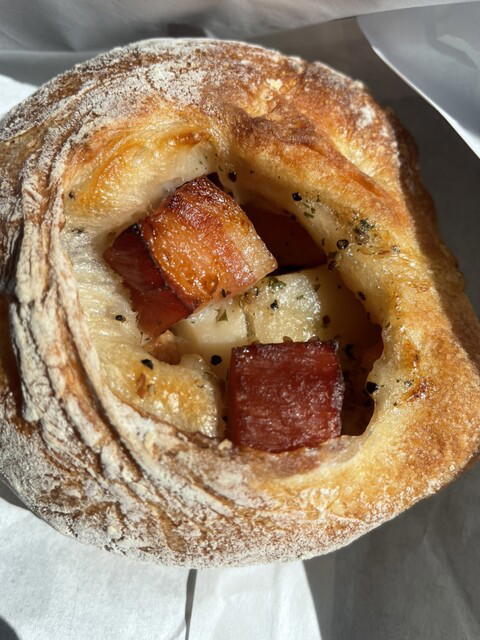
Approaching a small bakery in Hanyu feels different from entering a Tokyo counter or Kyoto dining room. The cues are quieter: a modest local setting, bread as the central language, and a rhythm shaped more by everyday buying than extended table service. That matters because Japan’s bakery culture is not only French technique transplanted intact; it is also local buying habits, commuter timing, family use, and regional shops turning flour, butter, milk, yeast, and seasonal produce into daily retail craft.
Miyabi Tei belongs to the kind of Japanese bakery where reputation is earned incrementally. Its selection for Tabelog Bread EAST recognition in 2022 gives it a credential beyond Hanyu, but the point is not just the award. It shows that a bakery outside the major dining capitals can enter a competitive eastern Japan bread conversation by doing the fundamentals consistently enough to stand beside better-known urban addresses.
Hanyu's bread culture rewards daily craft over dining-room theatre
Japanese bread sits at a crossroads: the European inheritance of baguettes, viennoiserie, and enriched doughs, and the domestic appetite for shokupan, filled breads, curry pan, sweet buns, and compact take-home formats. Regional bakeries work in the overlap: familiar enough for local families, technical enough for bread-focused travellers, and priced for repeat buying rather than occasion dining.
That is the lens for Miyabi Tei. It is not competing with sushi counters such as Sushi Megumi or Sushi Obana, where price and scarcity shape the experience before a diner sits down. It sits nearer the everyday-specialist end of the spectrum, closer in spend logic to casual regional addresses such as Fuku Yoshi or Yoshisumi, while operating in a category where production timing and turnover matter more than service choreography. Bread is judged less by ceremony than by repetition: dough development, proofing, bake schedule, shelf life, and the balance between staple loaves and impulse purchases.
Ingredients are central because bread exposes shortcuts quickly. Flour selection, butter quality, dairy handling, salt balance, and fillings decide whether a bakery is neighborhood convenience or a destination for people who track bread lists. In Japan, where soft texture and precision finishing often matter as much as crust and fermentation, a strong bakery must satisfy local expectations and diners comparing it with larger-city addresses across the region. A Tabelog Bread EAST selection signals a move from local utility to regional relevance.
The format is modest, the recognition is not
The setting is part of the argument. Miyabi Tei is best understood as a focused bread address rather than a restaurant built around lingering. That restraint is refreshing in a dining culture where awards often come wrapped in tasting-menu formality. Here the accolade attaches to bread, not theatre. The transaction may be simple; the product standard is not.
For travellers, the question is whether a Hanyu bakery belongs on a broader food itinerary. The answer depends on the route. As a stand-alone detour from central Tokyo, it requires interest in Japanese bread as a category, not a casual craving. As part of a Saitama day around local food, rail towns, or regional shopping, it becomes evidence for how much serious food culture in Japan sits outside the obvious capitals. Hanyu is not framed internationally as a dining city like Tokyo or Kyoto, making bread a legible way to read the place: local, practical, technically demanding, and bought by returning customers.
The comparison set clarifies value. A bakery in this bracket does not ask diners to commit to omakase or dégustation costs. It asks for attention to a smaller purchase, where the difference between ordinary and serious is carried by crumb, crust, filling restraint, and the shop’s ability to hold standards through the day. That is another kind of luxury: not rarity through price, but precision applied to food people can buy regularly.
Readers building a wider Hanyu plan should start with Our full Hanyu restaurants guide, then decide whether the trip needs overnight context through Our full Hanyu hotels guide, drinking options via Our full Hanyu bars guide, regional bottles in Our full Hanyu wineries guide, or local programming in Our full Hanyu experiences guide. For a broader Japan comparison, contrast this bakery logic with destination meals, casual specialists, and other dining rooms across Hanyu and beyond.
How to read the stop: small purchase, serious benchmark
Approach Miyabi Tei not as a long lunch but as a benchmark stop. Bread awards can be harder for casual travellers to interpret than Michelin stars because the experience is brief and the spend low, yet that brevity is the point. A strong bakery compresses technique into food that must work immediately: bought at the counter, carried away, shared at home, eaten in transit, or folded into a family day.
The shop’s Tabelog score of 3.64 and 2022 Bread recognition give the address enough outside validation to read as more than a purely local convenience. For visitors, timing and flexibility matter more than formality. Go if Japanese bread is part of the reason for travelling through Saitama, not if the itinerary demands a seated restaurant experience. In that narrower frame, Miyabi Tei is a credible, award-recognized stop that explains much about how regional Japan eats every day.
Frequently asked questions
Does Miyabi Tei work for a family meal?
Yes, it can fit a family stop if the goal is bread rather than a full sit-down meal. The address is in Hanyu.
What should I expect atmosphere-wise at Miyabi Tei?
Expect a focused bakery stop rather than a formal dining-room experience. Miyabi Tei in Hanyu is best approached as a place to judge bread quality, selection, and everyday craft.
What's the price range at Miyabi Tei?
Pricing at Miyabi Tei is listed as - JPY 999 JPY 1,000 - JPY 1,999 View spending breakdown.
What time does Miyabi Tei open and close?
Check current opening hours directly before visiting Miyabi Tei, as small bakery schedules can change.
Comparison Snapshot
Comparable venues by cuisine and price in the same metro.
| Venue | Cuisine | Price | Awards | Notes |
|---|---|---|---|---|
| Miyabi TeiThis venue (the venue you are viewing) | Japanese neighborhood bakery & deli | $1–10 | Tabelog 100 #49 | Not listed |
| レストハウス寺子屋 | Japanese Mountain Comfort Food | Not listed | Not listed | 山ノ内町 |
| Chuka Soba Dokoro Konpiraso | Traditional Japanese ramen (chuka soba) | $1–10 | Tabelog 100 #12 | Sanze |
| Chuka Soba Hayami | Traditional Wakayama Ramen | Not listed | Not listed | Shingu |
| Montagne (モンタニュ) | Japanese Casual Ski Lodge | Not listed | Not listed | 妙高高原 |
| Teuchi Udon Matsuya | Traditional handmade udon & curry udon | $1–10 | Tabelog 100 #37 | Okegawa |
Recognition history
Dated appearances from independent guides and award organizations, with the underlying list record or original source where available.
Tabelog 100 #49 · No. 49
Tabelog · Tabelog 100 - Bread - EAST - 2022
Continue exploring
More in Hanyu
Restaurants in Hanyu
All restaurants in Hanyu →

Bars in Hanyu
Browse all →
Hotels in Hanyu
Browse all →

Wineries in Hanyu
Browse all →
Details
- Solo
- Family
- Casual Hangout
- After Work
- Standalone
- A La Carte
Current opening hours
- Monday
- Closed
- Tuesday
- Closed
- Wednesday
- Closed
- Thursday
- 7 AM–7 PM
- Friday
- 7 AM–7 PM
- Saturday
- 7 AM–6 PM
- Sunday
- 7 AM–6 PM
Hours can change for holidays and private events. Hours as of .
Based on local review platforms, Miyabi Tei has the feel of a quiet, residential "house restaurant" bakery with a relaxed, everyday atmosphere rather than a formal dine-in setting.