
Minna no Pan'ya brings Tokyo’s everyday bakery culture into the Marunouchi commuter circuit: take-out focused, compact, and built around bread, sandwiches, side dishes, and delicatessen staples rather than a seated meal. Its selection for Tabelog Bread TOKYO “Tabelog 100” 2022 places it inside a serious citywide bread conversation, despite the format remaining casual and quick.
Pearl is the En Primeur Club membership app — saves, bookings, and concierge access live there. Same editors, same standards.
- Address
- Japan, 〒100-0005 Tokyo, Chiyoda City, Marunouchi, 2 Chome−7−3 東京 ビル TOKIA B1F
- Phone
- +81 3-5293-7528
- Website
- marunouchi.com
 Saves & bookings on Pearl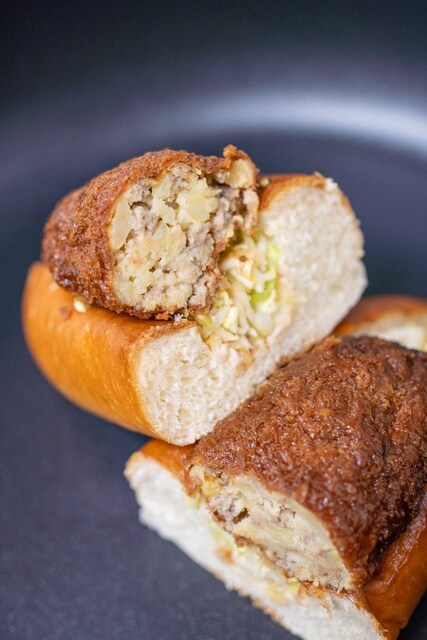
The Marunouchi basement food world has its own rhythm: office shoes on polished floors, paper bags between station exits, and a lunch hour that rewards speed without forgiving weak craft. Tokyo bakery culture fits because bread here is not just breakfast or dessert; it can be a commuter meal, desk lunch, family errand, or low-cost tasting sequence assembled one tray at a time.
That is the useful way to read Minna no Pan'ya. It is not a long-form restaurant experience, and need not be. Its format follows the Japanese bakery shop tradition, where the meal is built by selection rather than course: bread first, then a sandwich or savory item, then something from the side-dish or delicatessen register if timing calls for it. In a city where luxury dining often means counter seats, long booking windows, and chef-led progression, this is the opposite grammar. The customer edits the meal.
A bakery progression built by the tray, not the tasting menu
The assigned tasting arc here is practical rather than ceremonial. Tokyo bakeries often encourage quiet sequencing: start with plain bread to assess texture, move into filled or prepared bread for seasoning, then use sandwich and deli categories to turn a snack into lunch. Minna no Pan'ya’s listed categories, bread, sandwich, side dishes, and delicatessen, place it in that hybrid lane: daily bread culture, not the patisserie-as-gift economy or hotel bakery counter.
That distinction matters in Marunouchi. The district supports several price and occasion tiers within a few blocks: VIRON Marunouchi ten works in a higher bakery-cafe bracket, Okonomiyaki Kiji Marunouchi ten answers a seated hot-meal craving, Cafe 1894 brings the Mitsubishi Ichigokan orbit into a leisurely cafe frame, while Sézanne and MAISON MARUNOUCHI represent hotel-linked dining at another register entirely. Against that spread, Minna no Pan'ya occupies the quick, everyday end of the area’s food hierarchy, but its inclusion in Tabelog Bread TOKYO “Tabelog 100” 2022 gives it a credential beyond convenience.
The lesson is not that a bakery replaces a restaurant. It is that Tokyo food culture often treats small formats with the same seriousness as grand ones. A take-out shop can sit in the same mental itinerary as a counter restaurant because precision is not limited to expensive rooms. For visitors building a day around Marunouchi, Tokyo Station, and the Imperial Palace side of the city, this stop can carry more local texture than another formal reservation.
Why Marunouchi bread culture rewards decisiveness
Marunouchi is built for movement. Office towers, station concourses, department-store floors, and underground passages create a dining pattern where speed is not a compromise; it is part of the design. Bakeries succeed when they make choice efficient: categories must read clearly, take-out flow must move, and the food must survive a walk back to an office, train seat, hotel room, or bench without losing purpose.
The restaurant fits that urban role. Reservations are unavailable, private rooms are unavailable, and the service model is take-out, so the experience is shaped by timing and selection rather than table management. That makes it useful for travelers who already have a formal dinner planned but want a daytime read on how Tokyo eats between appointments. The Tabelog score of 3.73 and 2022 Bread TOKYO selection separate it from a random station bakery, while the format keeps the stakes low.
The comparison with higher-spend Marunouchi venues is instructive. A French room asks the diner to surrender time and attention; a bakery asks the diner to make a sequence quickly and move on. Both reveal the neighborhood differently: one speaks to Marunouchi as international business capital, the other to the daily choreography of workers, families, and travelers passing through Tokyo Station’s orbit.
For a broader Tokyo eating plan, this address pairs well with sharper category contrasts. A day might include grilled fish or charcoal cooking at . 鮪と炭火焼き うお炭 秋葉原店, a Shinjuku stop such as 12/10 Shinjuku ten, yakitori at 124. KAGURAZAKA (Yakitori), or a visual cafe detour at 2D Cafe. Curry-focused travelers can compare the capital’s casual range through 3 Chome no Curry Ya San. For wider planning, use Our full Tokyo restaurants guide, Our full Tokyo hotels guide, Our full Tokyo bars guide, Our full Tokyo wineries guide, and Our full Tokyo experiences guide.
How to place it in a Japan food itinerary
The restaurant is especially useful for travelers who want Tokyo food without making every meal a production. Treat it as a compact daytime sequence: bread for craft, sandwich for utility, deli or side-dish items for the Japanese bakery habit of folding Western forms into local convenience. That avoids overreading it as a destination restaurant while crediting its place in Tokyo’s serious casual-food culture.
Across Japan, that casual register changes by city and category. A traveler can read beef and sukiyaki traditions through -Grilled beef Sukiyaki- KAMAKURA TANUKIAN 鎌倉 たぬき庵 in Kamakura, cafe culture through.cafe in Osaka, Kumamoto’s small-format dining through.know in Kumamoto, regional Vietnamese cooking in the Tokyo orbit through (Shoku) Vietnam in Kawasaki, Sapporo curry through [Curry Senmon Ten] Maruyama Kyoju. in Sapporo, and Kyoto’s contemporary dining register through [ki:] in Kyoto. Even outside Japan, the same editorial thread appears in focused Japanese formats such as Jōdo Saké Bar in Los Angeles and Onigiri Time in Pasadena: small formats can carry a cuisine’s habits with unusual clarity.
The critical case for the restaurant is modest but firm. It is a credentialed Tokyo bakery in a high-traffic business district, useful for reading how the city compresses craft, convenience, and lunch planning into take-out. Do not approach it looking for ceremony. Approach it as a short, self-directed progression through bread and savory bakery culture, then let the rest of Marunouchi supply the contrast.
Cuisine and Awards Snapshot
Comparable venues for cuisine and category context.
| Venue | Cuisine | Price | Notes |
|---|---|---|---|
| Minna no Pan'yaThis venue — the venue you are viewing | Traditional Japanese bakery | $ | Not listed |
| Paris Ogawa Ken Shimbashi ten | Japanese Bakery Café | $ | Minato |
| Asada Ya | Traditional Japanese wagashi & daifuku shop | $ | Minato |
| Caligari Akihabara | Japanese curry house specializing in coconut curry | $ | Chiyoda |
| Sabameshi no Sabashou | Japanese saba-focused cafeteria | $ | Chiyoda |
| Koukai Bou | Classic Tokyo ramen & tsukemen | $ | Kōtō |
Recognition history
Dated appearances from independent guides and award organizations, with the underlying list record or original source where available.
Tabelog 100 #33 · No. 33
Tabelog · Tabelog 100 - Bread - TOKYO - 2022











At a Glance
- Cozy
- Classic
- Quiet
- Solo
- After Work
- Casual Hangout
- Family
- Standalone
- Local Sourcing
Current opening hours
- Monday
- 11 AM–6:30 PM
- Tuesday
- 11 AM–6:30 PM
- Wednesday
- 11 AM–6:30 PM
- Thursday
- 11 AM–6:30 PM
- Friday
- 11 AM–6:30 PM
- Saturday
- 11 AM–5 PM
- Sunday
- 11 AM–5 PM
Hours can change for holidays and private events. Last verified .
Casual and functional basement-floor bakery with simple displays of freshly baked breads, creating a nostalgic and relaxed stop-in atmosphere rather than a sit-down restaurant vibe.