
Koukai Bou belongs to Tokyo’s serious everyday ramen tier: small-room, low-price, reputation-driven, and measured by repeat selection rather than spectacle. Its place on the Tabelog 100 Ramen Tokyo list, with recognition running from 2017 through 2025, puts it in a competitive bracket where consistency matters more than novelty.
Pearl is the En Primeur Club membership app — saves, bookings, and concierge access live there. Same editors, same standards.
- Address
- 2 Chome-13-10 Fukagawa, Koto City, Tokyo 135-0033, Japan
- Phone
- +81 3-5620-4777
- Website
- tabelog.com
 Saves & bookings on Pearl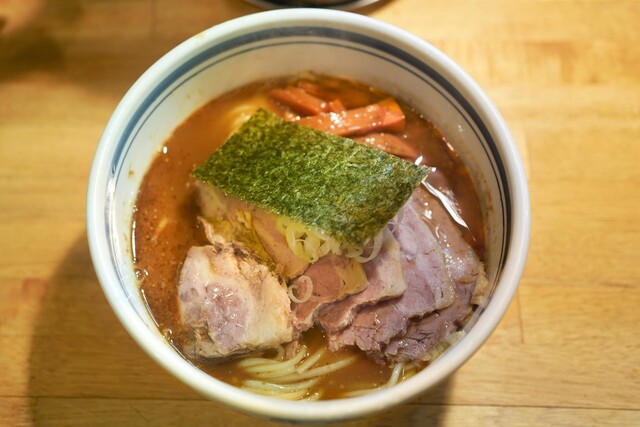
Fukagawa’s ramen scene is quieter than the station-front clusters of Shinjuku or Ikebukuro, and that matters. Koukai Bou is built for turnover, not ceremony: counter seats, a pair of tables, and Tokyo’s compressed rhythm of line, soup pot, and lunch hour. Without theatrics, its reputation has held, earning repeated selection in Tabelog’s Ramen Tokyo 100 from 2017 through 2025, including the 2025 list.
Tokyo ramen is now a citywide taxonomy: clear chintan specialists, dense tonkotsu shops, seafood-forward bowls, dipping-noodle houses, and hybrids that resist sorting. The sharper distinction is repeatability. A new shop can draw a queue; discipline keeps one in critical circulation for close to a decade of Tabelog 100 recognition. This is not a luxury counter recasting ramen as kaiseki, but a small Fukagawa address in Tokyo’s demanding ramen middle, where a bowl must justify attention against hundreds of competitors.
A Fukagawa ramen address measured by repeat recognition
Tabelog’s Hyakumeiten lists are blunt but influential signals in Japan’s restaurant culture. They are not Michelin stars, and displayed order is not an official ranking, but inclusion in the Ramen Tokyo 100 carries weight in a crowded, unforgiving field. Koukai Bou’s 2025 selection, after appearances from 2017 onward, marks sustained public and critic-facing traction rather than a single-cycle surge.
The listing score, 3.79, also matters locally. Tabelog ratings compress into narrow bands, so a high-three figure can signal meaningful traction, especially in casual genres with heavy comparison shopping. Ramen faces that pressure: customers judge broth depth, noodle texture, portion value, queue management, and aftertaste with severe precision. A long selection history is more persuasive than one accolade.
The category covers ramen and tsukemen, placing the shop in Tokyo’s familiar split between soup noodles and dipping noodles. That duality changes expectations: ramen rewards integration in the bowl; tsukemen emphasizes noodle structure and dipping intensity. A shop competing in both is judged across adjacent but different habits.
There is also a neighborhood argument. Fukagawa and Monzen-Nakacho carry an older east-side Tokyo texture, less glossy than west-side shopping and nightlife districts. Serious eating here often rewards patience: tempura rooms, old sweets shops, independent counters, and lunch-focused addresses built through local regularity. For a broader Tokyo itinerary, compare that texture with other city entries in Our full Tokyo restaurants guide, then balance the food map with Our full Tokyo hotels guide, Our full Tokyo bars guide, Our full Tokyo wineries guide, and Our full Tokyo experiences guide.
The value signal is part of the critical appeal
Ramen in Tokyo can be technically obsessive and financially modest. Koukai Bou fits that tradition, with a listed average below JPY 1,000 and 2024 revisions noting ramen at JPY 850, char siu ramen at JPY 1,250, and menma ramen at JPY 1,050. Those figures explain why its reputation differs from reservation-led dining: recognition rests on the public’s ability to return, compare, and hold the kitchen to a daily standard.
The room reinforces the point. Fifteen seats, including seven at the counter and two tables for four, keep it intimate without making it precious. Soup volume dictates service: it runs until sold out, and signs may appear before posted closing on busier days. In ramen terms, that is production logic, not gimmick. Broth is finite, and the shop’s reputation depends on stopping before quality thins.
This is where awards and logistics meet. A repeatedly listed ramen shop with a compact footprint creates a familiar Tokyo equation: low ticket, high demand, limited supply. Do not treat it as a conquest meal. Treat it as a neighborhood ramen session with serious reputation, then plan around the possibility that soup availability, not appetite, decides the outcome.
Within Tokyo comparisons, the appeal differs from a broader casual stop such as 3 Chome no Curry Ya San or a themed café such as 2D Cafe. It also occupies another lane from grill, yakitori, and izakaya-oriented choices such as. 鮪と炭火焼き うお炭 秋葉原店, 124. KAGURAZAKA (Yakitori), and 12/10 Shinjuku ten. The decision is less about occasion than appetite: a focused bowl, a short meal, and a reputation tested by repeat customers.
How to place it within a Japan food itinerary
For visitors building a Japan trip around food rather than landmarks, this ramen address is useful because it requires no formal-dining grammar: no dress code, multi-course pacing, or wine-pairing logic. The tradeoff is timing. Weekday lunch away from peak rush and early evening service are safer; Saturdays and public holidays bring higher sellout risk before service ends. Reservations are unavailable, and payment is cash-only, keeping the experience close to everyday ramen rather than an internationalized dining format.
The nearest rail anchor is Monzen-Nakacho, a useful stop for an east-side meal without a full evening plan. The area pairs well with walks through old merchant streets, temple precincts, and low-rise residential blocks, so the meal feels integrated into the neighborhood rather than isolated as a destination. That rhythm differs from a special-occasion restaurant in Ginza or a late-night drinking route in Shibuya.
For a broader route, the restaurant can sit alongside regional and overseas Japanese-food comparisons without pretending they answer the same need. A sukiyaki-focused stop such as -Grilled beef Sukiyaki- KAMAKURA TANUKIAN 鎌倉 たぬき庵 in Kamakura, a Kyoto restaurant such as [ki:] in Kyoto, or Sapporo’s curry specialist [Curry Senmon Ten] Maruyama Kyoju. in Sapporo show how regional categories pull travelers in different directions. Casual Japanese formats abroad, including Jōdo Saké Bar in Los Angeles and Onigiri Time in Pasadena, underline the contrast: Tokyo ramen culture is judged at the source, in fast, comparative, unforgiving conditions.
That is the reason to care. The appeal is not rarity for its own sake, but the way Tokyo rewards a daily form executed consistently enough to remain in critical circulation. Other Japan entries, from.cafe in Osaka and.know in Kumamoto to (Shoku) Vietnam in Kawasaki, serve different moods and formats. The restaurant’s case is narrower and more exacting: a compact Fukagawa ramen shop tested across years, lists, queues, and lunch hours.
Cost and Credentials
Comparable venues for context, by category and price tier.
| Venue | Cuisine | Price | Notes |
|---|---|---|---|
| Koukai BouThis venue — the venue you are viewing | Kōtō, Classic Tokyo ramen & tsukemen | $ | Not listed |
| Arry 8Bites | Tokyo, Japanese Small Bites | $ | Not listed |
| Taniya | Chūō, Sanuki udon noodle shop | $ | Not listed |
| Ramen Kai | Taitō, Clam-focused Japanese ramen | $ | Not listed |
| Kyokasuduke Uokyu Ginza ten | Not listed | $ | Chūō, Traditional Japanese kasuzuke fish teishoku |
| Caligari Akihabara | Not listed | $ | Chiyoda, Japanese curry house specializing in coconut curry |
Recognition history
Dated appearances from independent guides and award organizations, with the underlying list record or original source where available.
Tabelog 100 #18 · No. 18
Tabelog · Tabelog 100 - Ramen - TOKYO - 2025








At a Glance
- Cozy
- Lively
- Classic
- Solo
- After Work
- Casual Hangout
- Family
- Standalone
Current opening hours
- Monday
- 11 AM–3 PM, 5:30–7 PM
- Tuesday
- 11 AM–3 PM, 5:30–7 PM
- Wednesday
- Closed
- Thursday
- 11 AM–3 PM, 5:30–7 PM
- Friday
- 11 AM–3 PM, 5:30–7 PM
- Saturday
- 11 AM–3 PM
- Sunday
- Closed
Hours can change for holidays and private events. Last verified .
Small, non‑smoking neighborhood ramen shop with counter and a couple of tables, relaxed and friendly with frequent lines, bright and simple interior focused on the bowl rather than design.