Macot occupies a quiet stretch of Sants-Montjuïc, one of Barcelona's most residential and least tourist-trafficked districts. Readers seeking Michelin-tier tasting menus should cross-reference Barcelona's top creative houses first.
 Discover on Pearl
Pearl is the En Primeur Club membership app — saves, bookings, and concierge access live there. Same editors, same standards.
- Address
- Carrer de Violant d'Hongria Reina d'Aragó, 150, Sants-Montjuïc, 08014 Barcelona, Spain
- Phone
- +34676643785
- Website
- macotbaravins.com
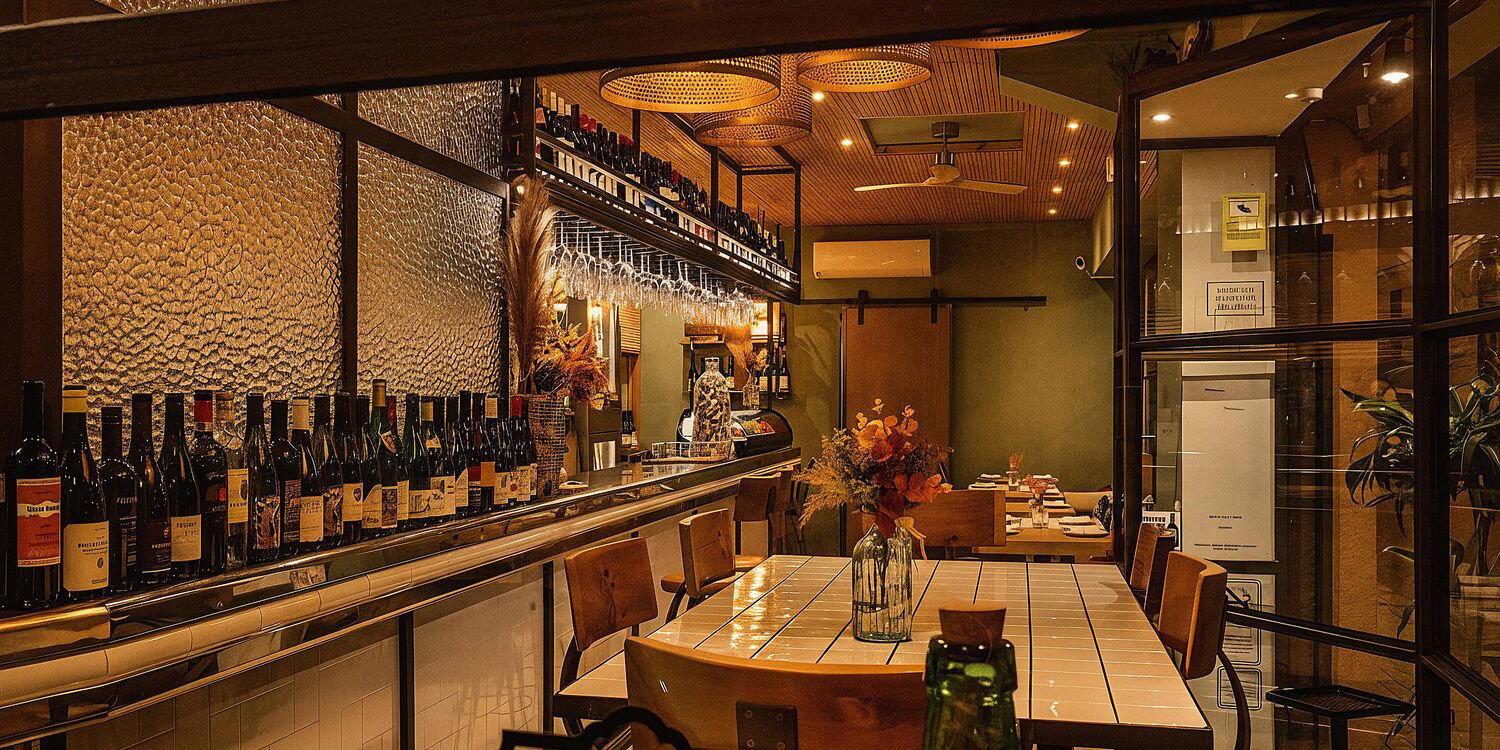
Sants-Montjuïc and the Case for Neighbourhood Dining in Barcelona
Barcelona's dining reputation is anchored to a small cluster of internationally visible addresses: the tasting-menu rooms in Eixample, the creative houses like Disfrutar and Cocina Hermanos Torres, and the hotel-adjacent fine dining that draws visitors on curated itineraries. But the city's neighbourhoods beyond that circuit operate on different logic entirely. In Sants-Montjuïc, Barcelona's largest district by area and one of its most consistently residential, the dining pattern is shaped by local demand rather than guidebook attention. Restaurants here answer to regulars, not to visiting critics.
That distinction matters when approaching Macot, which sits on Carrer de Violant d'Hongria Reina d'Aragó in the Sants-Montjuïc district, postal code 08014. The address alone signals something about the venue's orientation: this is not a location chosen for proximity to tourist corridors or design-press photography opportunities. It is a working neighbourhood address in a working neighbourhood, and that positioning is itself an editorial point about what kind of dining Barcelona sustains beneath its internationally recognised tier.
The Cultural Weight of the Neighbourhood Table in Catalan Barcelona
Catalan dining culture has always maintained a strong distinction between the restaurant as social institution and the restaurant as spectacle. The former is older, more durable, and arguably more representative of how Barcelona actually eats. The tasting-menu format that brought global recognition to addresses like ABaC, Lasarte, and Enigma represents a particular, internationally legible mode of dining that coexists with, but does not replace, the neighbourhood table.
That neighbourhood table tradition draws from several deep roots: the Catalan emphasis on seasonal, market-driven cooking; the Mediterranean habit of treating lunch as the day's primary meal; and a broader Spanish cultural understanding of the restaurant as a place for extended social time rather than efficient consumption. Across Spain, this tradition surfaces in very different registers, from the Basque pintxos circuit around Arzak in San Sebastián to the terrace culture of Ricard Camarena in València, but in Barcelona's residential districts, it takes the form of the neighbourhood restaurant that holds its community together across generations.
Sants-Montjuïc has its own particular character within Barcelona. The district encompasses the working-class history of Sants, the cultural weight of Montjuïc hill with its museums and Olympic legacy, and a resident population that has resisted the tourist-driven displacement that has transformed parts of the Gothic Quarter and Born. Restaurants in this district operate within a social compact with their neighbourhoods that is different from the one that governs venues in more commercially visible zones.
What Limited Data Tells You About a Venue's Tier
Macot's publicly available profile is sparse: an address, a district, a city. No Michelin recognition, no published menu format, no documented chef credentials. In Barcelona's upper creative tier, where ABaC and Disfrutar carry multiple Michelin stars and Enigma maintains a singular format that generates consistent press, venues develop extensive public documentation as a function of their profile. The absence of that documentation at Macot is itself informative: this is a venue that operates without the apparatus of international recognition, which in Barcelona's neighbourhood dining context is entirely normal.
Across Spain's broader restaurant scene, the venues that have built international reputations have done so through consistent award accumulation and documented culinary lineage. El Celler de Can Roca in Girona, Martin Berasategui in Lasarte-Oria, Mugaritz in Errenteria, Azurmendi in Larrabetzu, and Quique Dacosta in Dénia all carry verifiable credentials that situate them within a specific competitive set. Aponiente in El Puerto de Santa María and DiverXO in Madrid occupy the same tier. Atrio in Cáceres combines culinary recognition with a wine collection of documented depth. Macot is not operating in that register, and readers planning high-commitment dining trips to Barcelona should benchmark against the venues in that verifiable tier before filling their itinerary.
This is a calibration. Barcelona sustains hundreds of neighbourhood restaurants that deliver the city's actual daily dining culture, and those venues collectively represent something that a single Michelin-starred room cannot: the texture of how a city eats across income levels, schedules, and social occasions. The neighbourhood table is not a consolation prize for missing a reservation at a more decorated address. It is a different category with different criteria for success.
Planning a Visit to Macot
Macot is located at Carrer de Violant d'Hongria Reina d'Aragó, 150, in Sants-Montjuïc, Barcelona, 08014. The Sants district is well-connected by Barcelona's metro system, with Sants Estació serving as a major interchange on Lines 3 and 5, and the area sits within reasonable distance of Barcelona Sants railway station for visitors arriving by high-speed rail from Madrid or other Spanish cities. No booking method, hours, or pricing information is publicly documented for Macot at the time of publication, and readers should verify current operating details directly before visiting.
Visitors whose priorities run to technically ambitious tasting menus are better served by Barcelona's more credentialed addresses. Those interested in the neighbourhood dining tier that Sants-Montjuïc represents should treat a visit to Macot as part of a broader exploration of the district rather than as a destination booking in the mode of, say, a reservation at Lasarte or a ticket to Enigma. The two experiences answer different questions about what Barcelona is and how it functions as a food city.
Le Bernardin and Atomix represent the internationally visible tier while neighbourhood restaurants across the outer boroughs carry the city's daily dining culture. The dynamic is consistent across food cities: the recognised names are the index, but the neighbourhood table is the actual text.
City Peers
Comparable venues nearby, for context on price, style, and recognition.
| Venue | Cuisine | Price | Notes |
|---|---|---|---|
| MacotThis venue — the venue you are viewing | Mediterranean Wine Bar with Natural Wines | $$ | |
| Soma restaurant | Modern Mediterranean with Italian Influences | $$ | l'Antiga Esquerra de l'Eixample |
| Lincoln 32 | Modern Mediterranean Bistro | $$ | el Putxet i el Farro |
| Cuines Santa Caterina | Modern Market Cuisine with Catalan, Mediterranean, Asian & Vegetarian | $$ | Sant Pere, Santa Caterina i la Ribera |
| La Terraza de Anna | Mediterranean Tapas with Asian Fusion | $$ | la Dreta de l'Eixample |
| CACHO | Modern Mediterranean with International Influences | $$ | el Parc i la Llacuna del Poblenou |
Continue exploring
More in Barcelona
Restaurants in Barcelona
Browse all →
Bars in Barcelona
Browse all →
Hotels in Barcelona
Browse all →
At a Glance
- Cozy
- Intimate
- Rustic
- Modern
- Date Night
- Casual Hangout
- Wine Cellar
- Natural Wine
- Sommelier Led
- Local Sourcing
- Organic
Warm, inviting, and cozy atmosphere with rustic decor and a focus on quality natural wines.