London City
"Cappuccino at Cortázar's favorite café Buenos Aires is filled with historic bars and cafés, but London City, recently reopened after significant restorations, is worth seeking out for two reasons: its literary pedigree and its fantastic location. The café was the particular favorite of one of Argentina's great writers, Julio Cortázar, who wrote his novel Los premios (1960) while seated here. Today, the outward-facing sidewalk tables on Avenida de Mayo are a well-suited place to stop for coffee (or a glass of wine) and watch the world go by."
Pearl is the En Primeur Club membership app — saves, bookings, and concierge access live there. Same editors, same standards.
- Address
- Av. de Mayo 599, C1084 Cdad. Autónoma de Buenos Aires, Argentina
- Phone
- +54 11 4342 9057
- Website
- londoncity.com.ar
- Directions
- Get directions
 Saves & bookings on Pearl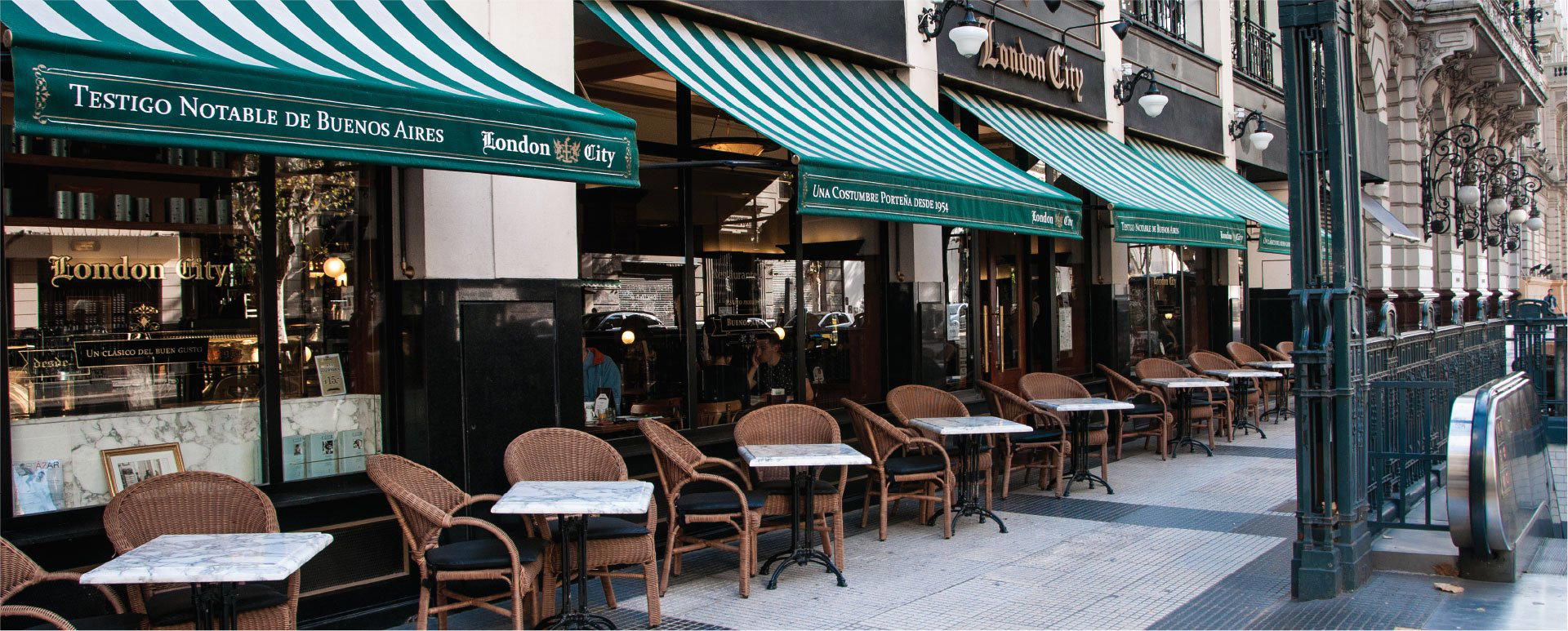
Avenida de Mayo and the Weight of Buenos Aires History
Avenida de Mayo is one of those streets that makes the scale of Buenos Aires legible. Modelled loosely on the grand European boulevards of the late nineteenth century, it connects the Casa Rosada at one end to the Congreso Nacional at the other, lined with Belle Époque facades, old confiterías, and buildings that carry the architectural ambition of a city that once positioned itself as the capital of the southern hemisphere. To arrive at Av. de Mayo 599 is to arrive at a corner address that has watched more than a century of Argentine political and cultural life pass by its windows.
Buenos Aires has a long tradition of European-inflected cafés and bars along this boulevard, spaces where conversation about politics, football, and literature was conducted with equal seriousness. The confitería format, in particular, became a social institution in this city in a way that has few parallels elsewhere in Latin America. These were not simply places to eat; they were the infrastructure of public intellectual life, and the architecture was designed to communicate permanence and civic importance.
The Address and What It Signals
The name London City places the venue inside a category of Buenos Aires establishments that once used European references to signal cosmopolitan credentials to their clientele. In the late nineteenth and early twentieth centuries, when Argentina was receiving significant British investment and immigration, references to London carried a specific cultural weight on Avenida de Mayo in particular, a street that also housed the historic Café Tortoni and a cluster of establishments that served the city's professional and political classes.
The corner location at number 599, where Av. de Mayo meets Perú, sits in the heart of what locals call the Microcentro-Monserrat boundary, a zone where the density of heritage architecture is among the highest in the city. This is not the Buenos Aires of Palermo's gastronomy scene, where Don Julio and Anafe draw diners from across the city and beyond. This stretch of Av. de Mayo belongs to an older, more formal Buenos Aires, one that is less visible in contemporary food coverage but retains genuine historical texture.
The Cultural Roots of the Café Tradition on Av. de Mayo
To understand what a venue like London City represents, it helps to understand the Argentine café as a cultural form. Buenos Aires in the early twentieth century absorbed large waves of Spanish, Italian, and British immigration, and the café became the meeting point of those communities. Unlike the European model where cafés were primarily for coffee and light refreshment, the Buenos Aires version expanded into full-service dining, long lunches, and the kind of extended afternoon table that is now under pressure from faster food formats across the city.
The contemporary Buenos Aires dining scene has bifurcated considerably. At one end, a wave of technically ambitious restaurants, including Aramburu and Trescha, has placed the city on the map for modern Argentine cuisine at the level of international peer comparison. At the other end, neighbourhood spots like Crizia serve the day-to-day dining needs of a specific local catchment. The historic café format sits outside both of those trajectories, operating on the logic of continuity rather than reinvention.
That continuity has value. In a city where the peso's volatility has repeatedly forced hospitality businesses to adapt or close, establishments that have operated along Avenida de Mayo for decades carry a kind of institutional resilience that is worth noting. The buildings themselves are patrimonio, protected heritage assets, which means the physical environment has a stability that the broader Buenos Aires hospitality sector does not always share.
Planning a Visit: Practical Context
Visitors approaching Buenos Aires from the airport will generally enter the city via the Autopista 25 de Mayo or the Autopista Riccheri, with the Microcentro typically 45 to 60 minutes from Ezeiza (EZE) depending on traffic. The address at Av. de Mayo 599 is walkable from the Lima or Perú stations of Línea A, the city's oldest subte line, which runs directly beneath Avenida de Mayo. That subte line itself is a piece of Buenos Aires history, opened in 1913 and still operating some of the original wooden cars on heritage services.
For visitors building a broader Buenos Aires dining itinerary, the Av. de Mayo area pairs naturally with a visit to the Congreso neighbourhood and is a short taxi or remis ride from San Telmo. Palermo's more celebrated restaurant cluster, where contemporary spots draw the bulk of international attention, is roughly 30 to 40 minutes on foot or 10 minutes by taxi. Those planning to extend their Argentina trip beyond Buenos Aires should consider the dining contexts in Mendoza, where venues like Azafrán and lodges such as Cavas Wine Lodge and Entre Cielos offer a complementary wine-country perspective. Further afield, Awasi Iguazu in Puerto Iguazu and Las Balsas in Villa La Angostura represent the country's more remote luxury hospitality options. For estancia dining with a strong sense of Argentine rural tradition, La Bamba de Areco is the reference point in the Pampas circuit.
Where London City Sits in the City's Dining Conversation
Buenos Aires rewards travellers who are willing to look beyond the short list of internationally recognised names. The contemporary dining conversation in the city has moved significantly toward the creative and the premium, with tasting-menu formats and ingredient-driven menus drawing most of the critical attention. What Avenida de Mayo represents is a different strand of the city's food culture: the café as civic institution, the long table as social ritual, the building itself as part of the experience.
That positioning is neither nostalgic pastiche nor competitive with the creative restaurant tier. It is its own category. Visitors seeking the kind of atmosphere you find at Le Bernardin in New York or the format discipline of Lazy Bear in San Francisco will find it elsewhere in Buenos Aires. What Av. de Mayo 599 offers is architectural context and a sense of the city's longer historical self, which is a different kind of value and one that is genuinely scarce in a dining scene increasingly defined by the new. For additional steakhouse and grill context across Buenos Aires, Los Talas del Entrerriano in Greater Buenos Aires and Agrelo and Chacras de Coria provide regional comparisons worth understanding before committing to a single dining style.
Comparable Venues
Comparable venues nearby, for context on price, style, and recognition.
| Venue | Cuisine | Price | Notes |
|---|---|---|---|
| London CityThis venue — the venue you are viewing | Classic Argentine Café | $$ | Not listed |
| Cantina Patio La Boca | Argentine Asado & Craft Beer | $$ | La Boca |
| Atte. Pizzeria Napoletana | Neapolitan Pizzeria | $$ | Palermo Hollywood |
| NOLA | Cajun & Creole Gastropub | $$ | Once |
| Chuchú | International | $$ | Retiro |
| Café San Juan | Modern Argentine with Spanish influences | $$ | Montserrat |
Continue exploring
More in Buenos Aires
Restaurants in Buenos Aires
Browse all →
Bars in Buenos Aires
Browse all →
Hotels in Buenos Aires
Browse all →
Wineries in Buenos Aires
Browse all →
At a Glance
- Classic
- Historic
- Well Known
- Casual Hangout
- Brunch
- Late Night
- Historic Building
- Street Scene
Current opening hours
- Monday
- 6 AM–10 PM
- Tuesday
- 6 AM–10 PM
- Wednesday
- 6 AM–10 PM
- Thursday
- 6 AM–10 PM
- Friday
- 6 AM–10 PM
- Saturday
- 6 AM–10 PM
- Sunday
- 6 AM–10 PM
Hours can change for holidays and private events. Last verified .
Classic bar atmosphere with soft lighting suitable for coffee meetings, business, politics, or literature discussions.