Leo's Latticini
A Corona institution since the mid-twentieth century, Leo's Latticini is one of Queens' most enduring Italian delis, known for its house-made mozzarella and old-neighborhood counter service. The address at 46-02 104th Street places it squarely in a working-class Italian-American community that has sustained it across generations. For anyone tracing New York's immigrant food traditions, it belongs on the itinerary alongside the borough's more celebrated dining rooms.
Pearl is the En Primeur Club membership app — saves, bookings, and concierge access live there. Same editors, same standards.
- Address
- 46-02 104th St, Corona, NY 11368
- Phone
- +17188986069
- Directions
- Get directions
 Saves & bookings on Pearl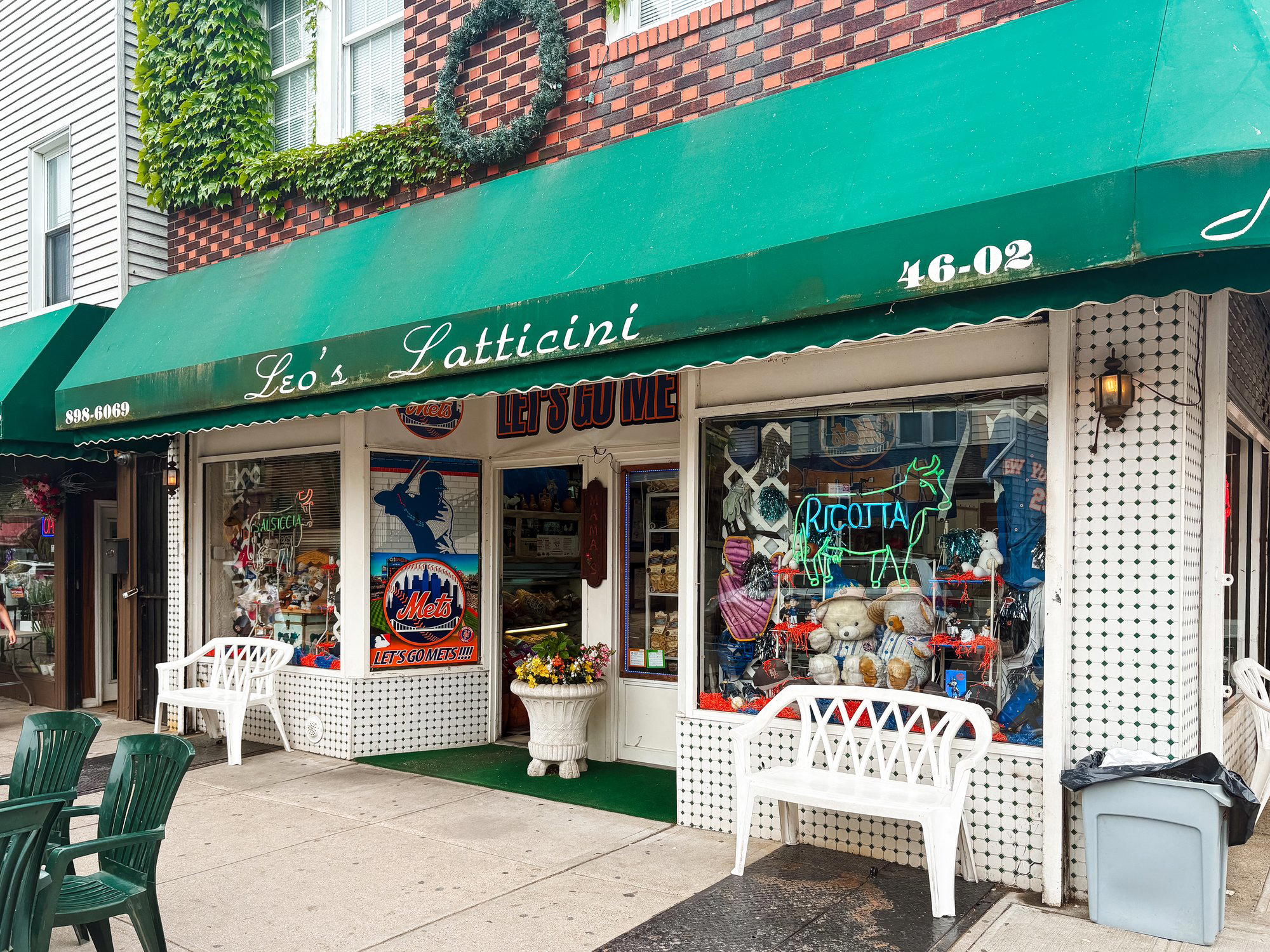
Queens and the Long Tradition of the Italian-American Deli Counter
New York's Italian-American food culture did not take root in Manhattan. It grew in the outer boroughs, in the neighborhoods where southern Italian immigrants settled in the early twentieth century and built supply chains, community ties, and food businesses that Manhattan restaurants would later mine for inspiration. Corona, Queens, is one of those neighborhoods, and the Italian deli counter there operates by a different logic than the polished salumerie that have appeared in Brooklyn or the West Village in recent years. The counter is functional, the product is the point, and longevity is the credential that matters.
Leo's Latticini, at 46-02 104th Street, sits inside that tradition. The shop has been making fresh mozzarella in Corona for decades, operating in a part of Queens where Italian-American food institutions predate the current wave of artisan dairy interest by a generation or more. In New York's broader deli and cheese counter conversation, the relevant comparison is not with the Michelin-starred tasting rooms of Midtown, places like Le Bernardin or Per Se, but with the borough-specific institutions that have maintained craft production through periods when mass-market alternatives dominated the category.
What the Counter Represents in the Context of New York Food Culture
The city's food media has long concentrated its attention on Manhattan and, more recently, on certain Brooklyn zip codes. Outer-borough institutions that do not court press coverage or social media audiences tend to remain known primarily to the communities that use them daily and to a narrower circle of food-focused travelers who research beyond the obvious lists. Corona's Italian corridor is a documented example of this pattern: the neighborhood's food shops have operated at a remove from mainstream food coverage even as the products they make have attracted loyal repeat visitors from across the five boroughs.
Fresh mozzarella production is a craft with a specific set of demands. The curd must be worked at the right temperature, stretched to the correct consistency, and consumed within a short window after production to capture the texture and mild acidity that distinguish hand-pulled cheese from the factory alternative. Shops that maintain daily production cycles rather than purchasing pre-formed product occupy a distinct position in the supply chain, and that position is what gives places like Leo's Latticini their standing among buyers who know the difference.
The Team Behind the Counter: Continuity as Editorial Subject
The editorial angle that makes Italian-American deli counters worth examining as a category is the operational model that sustains them. Venues of this type depend on a particular kind of internal coherence: counter staff who know the product well enough to advise buyers on how to use it, production workers who maintain consistent technique across high-volume days, and a front-of-house rhythm that handles a loyal neighborhood clientele alongside out-of-neighborhood visitors without friction. That balance is harder to maintain than it looks, and the shops that have held it for decades have done so because the knowledge transfer between generations of workers has remained intact.
In the context of New York's dining culture, this kind of institutional continuity is increasingly rare. The tasting menu restaurants that draw international attention, from the Korean-inflected precision of Atomix and Jungsik New York to the Japanese counter formalism of Masa, operate with documented team structures and named chef lineages. The Italian-American deli counter runs on a different kind of institutional knowledge, one that is embedded in the counter itself rather than in a single named practitioner, and that makes it more fragile in some respects and more durable in others. Comparable institutions at different price points and formats, from Blue Hill at Stone Barns to The French Laundry, have made team structure and knowledge transfer a documented part of their public identity. The deli counter model remains underrepresented in travel editorial despite its significance to the actual food culture of the city.
Corona as a Destination and What It Requires of the Visitor
Getting to 46-02 104th Street from Midtown Manhattan takes roughly forty minutes by subway on the 7 train, which runs directly through Queens. The 7 corridor has been documented as among the more linguistically and culturally diverse transit routes in the world, and the food businesses that line the streets it serves reflect that diversity at street level. Corona sits along this corridor, and the visit to Leo's Latticini works well when treated as part of a wider afternoon in the neighborhood rather than an isolated stop.
This is a pattern shared by comparable operations across the country, from specialty producers in New Orleans to farm-driven operations like Single Thread Farm in Healdsburg and Addison in San Diego, where the product's freshness sets the operational clock. At a mozzarella counter, that clock is shorter than almost anywhere else in the category.
How Leo's Latticini Sits in the comparable set
The relevant comparable set for the restaurant is not the fine dining tier. It is the small group of New York outer-borough shops that have maintained hand-production of fresh Italian dairy and deli goods across multiple decades, absorbing changes in the neighborhood's demographics and the city's food economy without abandoning the production methods that established their reputations. That group is small. The barriers to maintaining it are real: real estate pressure, generational succession, the cost of sourcing quality milk, and competition from both mass-market alternatives and from the newer wave of artisan producers who have entered the category with higher price points and Manhattan addresses.
Shops that survive in this category across the long term do so because the community around them treats them as infrastructure rather than as a destination, and because that community has enough density and loyalty to sustain daily foot traffic without reliance on tourism or press coverage. When visitors from outside the neighborhood find their way to these counters, they are arriving at a functioning local institution rather than at a venue designed for their visit, and that distinction shapes the entire experience. For context on how American fine dining institutions handle the equivalent tension between local identity and destination status, the contrast with Alinea in Chicago, Lazy Bear in San Francisco, Providence in Los Angeles, Bacchanalia in Atlanta, The Inn at Little Washington, 8 1/2 Otto e Mezzo Bombana in Hong Kong, and Alain Ducasse at Louis XV in Monte Carlo is instructive. The deli counter and the destination tasting room solve the same problem from opposite directions.
Cuisine and Credentials
Comparable venues nearby, for context on price, style, and recognition.
| Venue | Cuisine | Price | Notes |
|---|---|---|---|
| Leo's LatticiniThis venue — the venue you are viewing | Classic Italian Deli | $ | Not listed |
| Sal's Pizza Store | Classic New York Pizza | $ | Carroll Gardens-Cobble Hill-Gowanus-Red Hook |
| Joe | Classic New York-Style Pizza | $ | West Village |
| Solo Pizza NYC | New York Pizza | $ | East Village |
| Pizza Studio Tamaki | Tokyo-Neapolitan Pizza | $$ | East Village |
| Balera | Modern Roman-Style Pizza & Pasta | $$ | East Williamsburg |
Continue exploring
More in New York City
Restaurants in New York City
Browse all →
Bars in New York City
Browse all →
Hotels in New York City
Browse all →




At a Glance
- Cozy
- Rustic
- Classic
- Casual Hangout
- Family
- Historic Building
Current opening hours
- Monday
- Closed
- Tuesday
- 10 AM–4 PM
- Wednesday
- 10 AM–4 PM
- Thursday
- 10 AM–4 PM
- Friday
- 10 AM–4 PM
- Saturday
- 10 AM–4 PM
- Sunday
- Closed
Hours can change for holidays and private events. Last verified .
Charming old-school family atmosphere with walls covered in celebrity photos, NYPD/FDNY memorabilia, and warm personal service from owners treating guests like family.