
Michelin Bib Gourmand
Our verdict
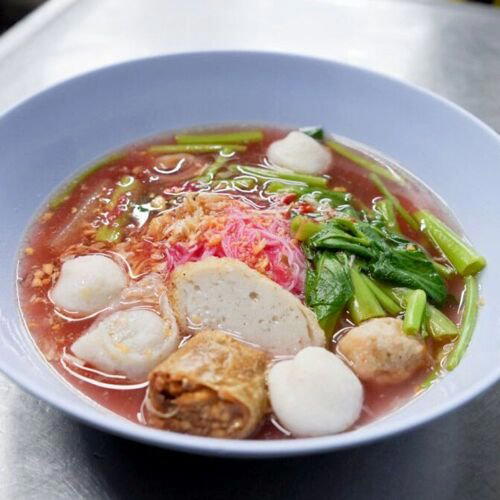
A Khon Kaen institution since 1984, Leng Yentafo has held the Michelin Bib Gourmand in both 2024 and 2025 for a single, sharply focused menu built around yentafo, the pink noodle soup the founder brought north from Bangkok's Chinatown. Fishballs, shrimp balls, and fish wontons arrive in a broth that has barely changed in four decades, at prices that remain firmly in the single-baht tier.

Pearl is the En Primeur Club membership app, where members save venues, book tables and use the concierge.
Pink Broth, Four Decades Deep
Glang Muang Road in central Khon Kaen does not announce itself as a dining destination. It is a working provincial thoroughfare, lined with shophouses and day-to-day commerce, the kind of street that rewards the person who has done their research. At number 52/8-9, a modest frontage signals nothing beyond the name painted above the door. What draws the queue, and there is a queue, is a bowl of yentafo that has been produced to a single recipe since 1984, when the founder left Bangkok's Chinatown and relocated the dish to the Isan heartland.
Yentafo, the pink noodle soup coloured and flavoured by fermented red tofu, is primarily a Chinese-Thai tradition with deep roots in the capital's wet markets and canal-side stalls. Bringing it north was not a neutral act. The northeastern palate runs to bold, often fermented flavours, the pungency of pla ra, the heat of fresh chillies, the smoke of grilled meat. A Shanghai-inflected pink broth occupies a different register entirely, and the fact that it found a lasting audience in Khon Kaen says something about the city's appetite for culinary diversity within the street food tier. Today, Khon Kaen's food scene spans Isan grilled meat alongside Chinese-Thai noodle traditions, and operations like Baan Heng (Thai-Chinese) and Guang Tang Noodles hold their own alongside the region's dominant Isan registers.
The Structure of the Bowl
Yentafo is not a soup that reveals itself instantly. The sequence matters. The broth arrives first as a visual statement: pale pink, faintly sweet from the fermented tofu, with an undertow of depth that develops as the heat rises from the bowl. The noodles, firm, with enough texture to hold the soup without dissolving into it, sit beneath a cargo of proteins that represents the classical Chinese-Thai assemblage: fresh fishballs with a clean snap, shrimp balls with a marginally coarser texture, and fish wontons that open along a thin wrapper to release a more concentrated fish filling into the surrounding liquid.
This kind of protein layering is the standard by which yentafo stalls are judged across Thailand. The proportions, the quality of the individual components, the balance between the sweetness of the tofu ferment and the savoury weight of the broth, these are the variables. At this address, the recipe has been held fixed long enough that the balance is not a matter of daily adjustment but of institutional memory. That continuity is part of what the Michelin inspectors appear to have recognised in granting Bib Gourmand status in both 2024 and 2025: a commitment to a specific execution, maintained at street food prices.
The Bib Gourmand designation, for context, identifies cooking that offers quality above what the price point would lead you to expect. At the single-baht price range (฿), Leng Yentafo sits in the same economic tier as Here Joi Beef Noodle and Jok Guay Jab Tom Sen Bat Queue, two other Khon Kaen street food operations working within noodle and soup traditions. The Michelin recognition places it in a smaller regional cohort, comparable in spirit to what Hill Street Tai Hwa Pork Noodle and 545 Whampoa Prawn Noodles represent in Singapore's hawker tradition: single-dish mastery, acknowledged by a credentialing body, sustained across decades.
Yentafo's Place in Thailand's Street Food Recognition Story
Thailand's Michelin programme has consistently found material in the street food tier, particularly for Chinese-Thai dishes that have embedded themselves in local food culture. The pattern from Bangkok outward is instructive: operations recognised at the Bib Gourmand level typically share a profile of deep specialisation, family continuity, and resistance to menu expansion. This address in Khon Kaen follows that pattern precisely. The contrast with the starred end of the Thai spectrum, where restaurants like Sorn in Bangkok and PRU in Phuket operate at a different price point and production philosophy, sharpens what the Bib tier actually represents: accessibility and repetition rather than occasion dining.
Outside Bangkok, Michelin recognition for street food remains relatively concentrated in a handful of provincial cities, which makes this Khon Kaen listing notable within the regional context. Aeeen in Chiang Mai and Agave in Ubon Ratchathani represent other nodes of recognition outside the capital, and together they sketch a picture of how Michelin's Thai coverage has gradually expanded its geographical scope. Leng Yentafo's inclusion in consecutive years signals that this is not a provisional nod but a settled position in the guide's provincial roster.
It is a strong score at volume, but not a perfect one, and the spread of opinion likely reflects the variables that affect any high-volume street stall: queue management, table turnover, the occasional day when the broth runs low and is refreshed in ways that affect consistency. The regulars precede the guide entry by decades.
Planning Your Visit
Leng Yentafo sits at 52/8-9 Glang Muang Road in the Nai Mueang sub-district, close to central Khon Kaen. No booking method or operating hours are listed in available data, which is standard for this format of operation, walk-in is the implied mode, and the queue is the natural regulator of entry. Arriving early in the service period, whether that corresponds to a breakfast or lunch window (the typical hours for yentafo in Thailand), reduces wait time. The price range is firmly at the lowest tier, making it accessible for any visit. For broader orientation, our full Khon Kaen restaurants guide covers the range from street food to mid-range dining, and our full Khon Kaen hotels guide covers accommodation options for those planning a stay around the city's food circuit. Visitors extending into other areas of the city's offer can find further reading in our Khon Kaen bars guide, our experiences guide, and our wineries guide. Those interested in Chinese-Thai cooking at other price tiers can also look at AKKEE in Pak Kret and The Spa in Lamai Beach for regional comparison points.
Frequently asked questions
Is Leng Yentafo expensive?
Pricing at Leng Yentafo is listed as ฿.
What distinctions does Leng Yentafo have?
Leng Yentafo has received recognition including: When Mr. Leng left Bangkok’s Chinatown for Khon Kaen in 1984, he brought a secret recipe for Yentafo, or pink noodle soup, and set up shop. His signature dish, which features toothsome noodles, fresh fishballs, shrimp balls and fish wontons….
What's the best thing to order at Leng Yentafo?
The signature bowl is the yentafo itself: a pale-pink fermented tofu broth built around fresh fishballs, shrimp balls, and fish wontons over toothsome noodles. The recipe dates to Mr. Leng's departure from Bangkok's Chinatown in 1984 and has earned back-to-back Michelin Bib Gourmand recognition in 2024 and 2025, so ordering anything other than the house bowl misses the point of the visit.
How do I find Leng Yentafo?
Leng Yentafo is located at 52/8-9, Glang Muang Rd, Nai Mueang, Mueang Khon Kaen District, Khon Kaen 40000, Thailand, Khon Kaen.
Do they take walk-ins at Leng Yentafo?
No advance booking method is listed for Leng Yentafo, which suggests walk-in is the standard approach. Operating hours are not published in available listings, so confirming locally before your visit is advisable.
Side-by-Side Snapshot
| Venue | Cuisine | Price | Awards | Notes |
|---|---|---|---|---|
| Leng YentafoThis venue (the venue you are viewing) | Thai Yentafo Noodles | $1–10 | Michelin Bib Gourmand | Not listed |
| Here Joi Beef Noodle | Thai Beef Noodles | $1–10 | Michelin Bib Gourmand | Noodles, ฿ |
| Jok Guay Jab Tom Sen Bat Queue | Thai Street Food Noodles & Porridge | $1–10 | Michelin Bib Gourmand | Street Food, ฿ |
| Kai Yang Rabeab (Khao Suan Kwang) | Isan | Not listed | Not listed | ฿ |
| Khun Jaeng Guay Tiew Pak Mor Kao Wang | Thai Noodle Shop | $1–10 | Michelin Bib Gourmand | Thai, ฿ |
| Praprai | Authentic Isaan Thai | $10–20 | Michelin Bib Gourmand | Isan, ฿฿ |
Recognition history
Dated appearances from independent guides and award organizations, with the underlying list record or original source where available.
Michelin Bib Gourmand
Michelin
Full recognition history (3 entries)
Michelin Bib Gourmand
Michelin
Michelin Bib Gourmand
Michelin
Continue exploring
More in Khon Kaen
Details
- Lively
- Casual Hangout
- Late Night
- A La Carte
Current opening hours
- Monday
- 7 AM–3 AM
- Tuesday
- 7 AM–3 AM
- Wednesday
- 7 AM–3 AM
- Thursday
- 7 AM–3 AM
- Friday
- 7 AM–3 AM
- Saturday
- 7 AM–3 AM
- Sunday
- 7 AM–3 AM
Hours can change for holidays and private events. Hours as of .
Lively street food setting with welcoming, bustling atmosphere typical of a popular local noodle shop.