
A compact bread-and-café counter inside Atre Ebisu, Le Grenier a Pain Atore ebisu ten belongs to Tokyo’s serious boulangerie circuit rather than the dessert-café lane. Tabelog selected it for Bread TOKYO “Tabelog 100” in 2020 and 2022, a useful signal in a city where station-linked bakeries range from commuter convenience to specialist craft.
Pearl is the En Primeur Club membership app — saves, bookings, and concierge access live there. Same editors, same standards.
- Address
- Japan, 〒150-0022 Tokyo, Shibuya, Ebisuminami, 1 Chome−6−1 アトレ恵比寿 西館 4F
- Phone
- +81 3-5475-8719
- Website
- legrenierapain.jp
 Saves & bookings on Pearl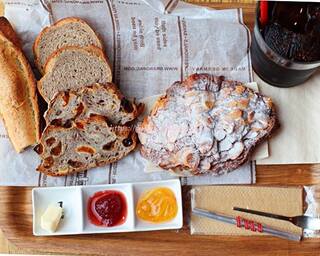
Ebisu’s station buildings compress Tokyo dining into a fast vertical sequence: coffee, sweets, lunch counters, takeaway boxes, then the occasional bakery that treats the commute as a serious eating occasion. In that setting, Le Grenier a Pain Atore ebisu ten reads less like a destination restaurant than a precision stop in the city’s bread culture, where the first decision is not courses in the formal sense, but tempo: something to carry away, something to eat at the counter, something to fold into the next part of the day.
Tokyo’s bakery scene has long absorbed French technique without turning every shop into a Paris replica. The local standard is different: tight service, clean display logic, small-format buying, and an expectation that bread can be planned as breakfast, lunch, or a late-afternoon reset. This Atre Ebisu branch sits in that urban pattern. Its categories are Bread and Cafe, its service includes take-out, and the room is built around counter seating rather than a lingering dining-room ritual.
Ebisu bread culture, read as a short tasting sequence
The useful way to approach a Tokyo boulangerie is to think in progression rather than volume. A meal can move from leaner breads into richer viennoiserie, then toward café pacing if the counter is available. That sequence matters in a station setting because it turns a quick purchase into a controlled edit: choose across texture, weight, and time of day rather than loading a tray at random.
Le Grenier a Pain Atore ebisu ten has earned recognition in Tabelog’s Bread TOKYO “Tabelog 100” selections for 2020 and 2022. In Tokyo, that places it within a narrower field than the city’s general café abundance. Bread awards here are useful because they separate daily-use bakeries with repeat local demand from photogenic cafés whose reputation depends more on room design than baking discipline.
The counter format also changes expectations. With 10 seats listed and take-out as part of the service model, this is not the Ebisu of long yakiniku dinners at Ushigoro Kan Ebisu honten, the higher-budget Chinese and dining-room bracket represented by Kirin, or the expense-account range signalled by Tsukushi Rou Ebisu ten. It belongs to the lighter, more frequent-use side of the neighbourhood, the one that makes sense before a train, between meetings, or as a controlled alternative to a full café stop.
Why the station location works for serious bread
Station-linked food in Tokyo is often misunderstood from outside Japan. The setting does not automatically mean compromise. Major rail nodes create daily scrutiny: office workers, residents, shoppers, and transfer traffic pass through with little patience for weak execution. Ebisu adds another layer, because the area’s dining identity stretches from casual drinking rooms to polished restaurants, and the station complex becomes the practical hinge between them.
That is why a bread counter inside Atre can sit credibly in the same neighbourhood conversation as more formal venues without pretending to compete with them. The comparison is not about luxury; it is about use-case clarity. A compact bakery has to deliver quickly, price accessibly, and hold quality across the day. A tasting-menu restaurant controls the room; a station bakery has to survive the rhythm of the building.
The absence of reservations is part of that logic. Tokyo has enough hard-to-secure counters and calendar-driven meals; this format is closer to controlled spontaneity. The editorial value lies in knowing when it fits. Pair it with a longer Ebisu lunch or use it as the first stop before moving across the city. For broader planning, Our full Tokyo restaurants guide gives the larger dining map, while Our full Tokyo bars guide, Our full Tokyo hotels guide, Our full Tokyo wineries guide, and Our full Tokyo experiences guide help build the rest of the itinerary.
Where it sits in a wider Tokyo itinerary
Tokyo rewards diners who do not force every meal into the same register. A day can hold a bakery counter, a curry shop, a yakitori table, and a late bar without any one of them needing to carry the whole trip. That is the point of this kind of Ebisu stop: it supplies a precise, low-ceremony segment in a city that can otherwise push visitors toward reservation-heavy dining.
For contrast within the same city, compare the bakery rhythm here with the casual visual café format at 2D Cafe, the curry-specialist lane at 3 Chome no Curry Ya San, the yakitori focus at 124. KAGURAZAKA (Yakitori), the Shinjuku format at 12/10 Shinjuku ten, or the seafood-and-charcoal register at. 鮪と炭火焼き うお炭 秋葉原店. Each asks for a different appetite and a different amount of time.
It also fits a national food itinerary without demanding a special detour. Travellers comparing Japan’s casual formats can look outward to -Grilled beef Sukiyaki- KAMAKURA TANUKIAN 鎌倉 たぬき庵 in Kamakura.cafe in Osaka.know in Kumamoto, (Shoku) Vietnam in Kawasaki, [Curry Senmon Ten] Maruyama Kyoju. in Sapporo, and [ki:] in Kyoto. For a transpacific comparison of compact specialist eating, Jōdo Saké Bar in Los Angeles and Onigiri Time in Pasadena show how Japanese formats travel when the focus is narrow rather than theatrical.
The critical takeaway is simple: this is a bakery-café entry for readers who take bread seriously but do not need every serious food stop to become a formal meal. The Tabelog Bread TOKYO selections supply the trust signal; the Ebisu station setting supplies the reason to use it. Fold it into a day when the itinerary needs craft, speed, and a clean break from reservation dining.
A Pricing-First Comparison
Nearby venues at a similar price tier for orientation.
| Venue | Cuisine | Price | Notes |
|---|---|---|---|
| Le Grenier a Pain Atore ebisu tenThis venue — the venue you are viewing | Shibuya, French bakery & café | $ | Not listed |
| patissier Hiro Yamamoto | Edogawa, French-style Patisserie & Cakes | $ | Not listed |
| BOULANGERIE SEIJI ASAKURA | Minato, French-Japanese bakery | $ | Not listed |
| noix de beurre Shinjuku isetan ten | Not listed | $ | Shinjuku, French-style patisserie & baked goods |
| IL PLEUT SUR LA SEINE | Shibuya, French Patisserie | $$ | Not listed |
| ASTERISQUE | Shibuya, Modern French patisserie | $$ | Not listed |
Recognition history
Dated appearances from independent guides and award organizations, with the underlying list record or original source where available.
Tabelog 100 #70 · No. 70
Tabelog · Tabelog 100 - Bread - TOKYO - 2022












At a Glance
- Cozy
- Modern
- Solo
- Casual Hangout
- After Work
- Standalone
- Design Destination
- Street Scene
Current opening hours
- Monday
- 10 AM–9 PM
- Tuesday
- 10 AM–9 PM
- Wednesday
- 10 AM–9 PM
- Thursday
- 10 AM–9 PM
- Friday
- 10 AM–9 PM
- Saturday
- 10 AM–9 PM
- Sunday
- 10 AM–9 PM
Hours can change for holidays and private events. Last verified .
A small non-smoking bakery café with about ten counter seats on the 4th floor of a shopping mall, offering a cozy, casual atmosphere suited to quick coffee-and-pastry stops rather than long meals.