Laser Wolf


Michelin Plate
Our verdict
On the rooftop of Williamsburg's Hoxton Hotel, Laser Wolf brings the Israeli skewer-house tradition to Brooklyn with a menu built around salatim spreads, charred kofta, and the smoky logic of the mangal grill. Awarded a Michelin Plate in 2024 and ranked in Opinionated About Dining's North America Casual list across multiple years, it pairs serious cooking credentials with one of New York's more dramatic open-air settings, with the Manhattan skyline framing every meal.

Pearl is the En Primeur Club membership app — saves, bookings, and concierge access live there. Same editors, same standards.
- Address
- 97 Wythe Ave, Brooklyn, NY 11249
- Phone
- (718) 215-7150
- Hours
- Mon–Wed 5–10:30 PMThu 5 PM–12 AMFri 12–11:30 AM, 5–11:30 PMSat 11:30 AM–3 PM, 5–11:30 PMSun 11:30 AM–3 PM, 5–10:30 PM
- Website
- laserwolfbrooklyn.com
- Directions
- Get directions
- Booking
- Book on Resy
The menu
What to order
- Chicken Shishlik
- Salatim
- Shawarma-Spiced Cauliflower
- Brown Sugar Soft Serve
Rooftop, Smoke, and the Spice Logic of the Israeli Grill
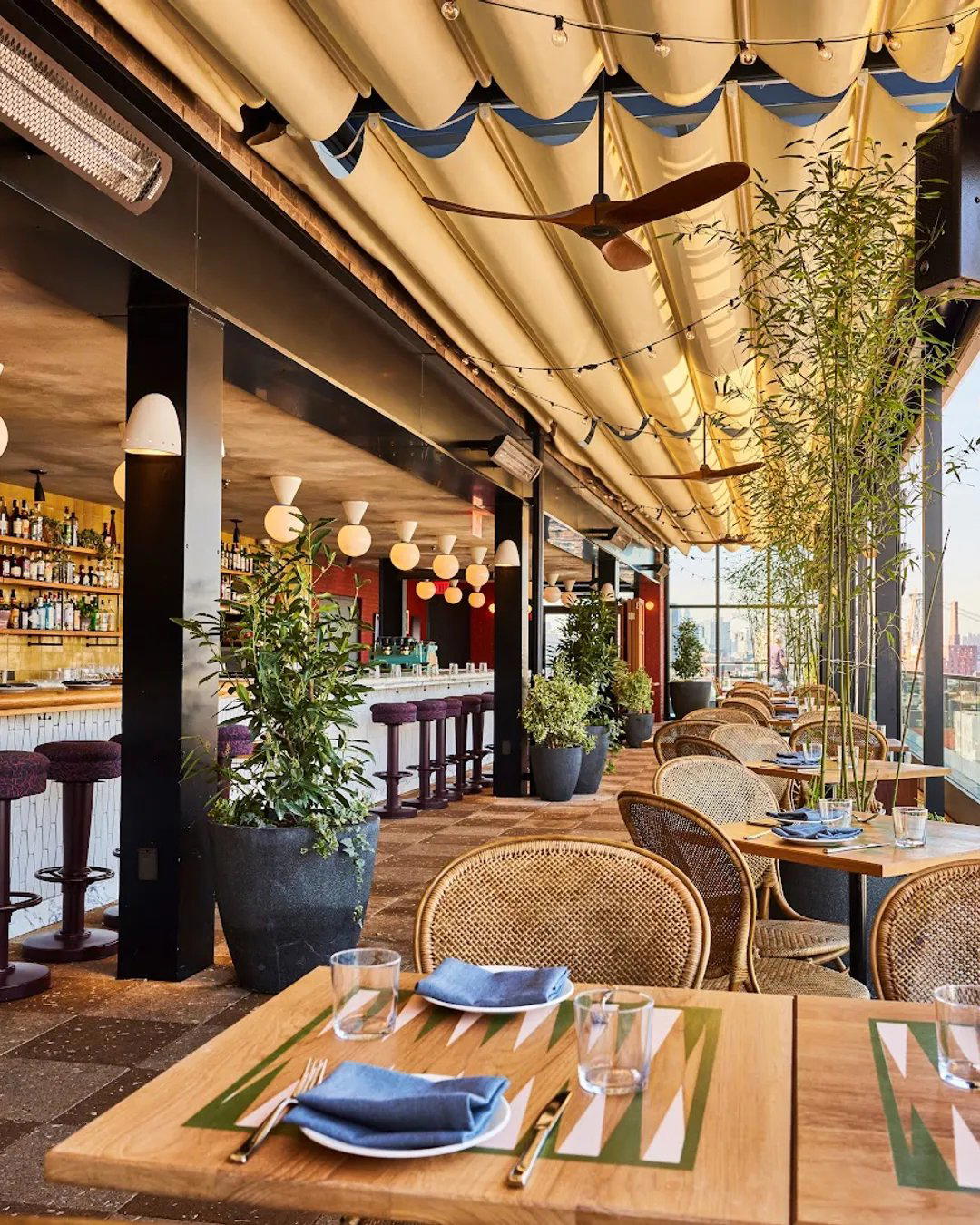
There is a particular sensory sequence to arriving at Laser Wolf that sets the meal's terms before you've touched the menu. The elevator opens onto the Hoxton Hotel's rooftop at 97 Wythe Avenue in Williamsburg, the Manhattan skyline spread across the western horizon at whatever shade the evening has reached, string lights overhead, and somewhere behind the open kitchen, the smell of char and spiced meat rising from the grill. This is not incidental atmosphere. It is the correct context for understanding what Israeli skewer-house cooking is actually doing.
The mangal tradition — wood or charcoal grilling as the structural center of a meal — carries a spice logic that differs from what most American diners associate with barbecue. Baharat, a blend of black pepper, coriander, cumin, cinnamon, and clove, provides depth without heat. Sumac brings a dry, tart acidity that brightens rather than sweetens. Za'atar functions as both herb and seasoning, its dried thyme and sesame notes working particularly well against the bitterness that high-heat grilling introduces. These are the aromatics that a well-executed skewer house deploys not as garnish but as architecture, and understanding that is the difference between reading a menu as a list of proteins and reading it as a coherent argument.
Salatim First: Why the Spreads Are the Point
Israeli dining culture moves in a direction that runs counter to Western tasting logic. Where European fine dining tends to build from restrained to rich, the Israeli table front-loads abundance. Salatim, the collective term for the spread of small vegetable preparations, dips, and pickled things that open a meal, arrive in quantity, and the quality of a kitchen's salatim tells you most of what you need to know about its sourcing discipline and palate.
At Laser Wolf, the salatim section includes preparations like baba ghanoush, mushrooms with Swiss chard and sour cherry, pickles, and gigante beans with harissa. That last combination is worth pausing on: gigante beans have a starchy, almost buttery interior that absorbs harissa's charred-pepper heat without losing texture, and the result reads as both satisfying and calibrated. The sour cherry addition to the mushroom dish speaks to the Levantine instinct for fruit-acid contrast, a technique with roots in Persian and Ottoman cooking that has become central to modern Israeli restaurant vocabulary.
This front-loaded structure also has a practical effect on pacing. By the time skewers arrive, the table has already established a flavor reference point, and the grilled proteins read against the backdrop of those earlier preparations rather than in isolation. Lamb kofta, for instance, arrives with its baharat-heavy seasoning already contextualized by whatever sumac or preserved lemon appeared in the salatim spread. It is a structurally intelligent way to eat, and it is one reason the Israeli casual-dining format has translated more successfully to American cities than many other regional traditions.
Where Laser Wolf Sits in New York's Israeli Dining Tier
New York's Israeli and broader Middle Eastern dining has expanded considerably over the past decade, moving from falafel-and-hummus casual into a more differentiated tier that includes serious wine programs, refined technique, and the kind of booking friction that signals genuine demand. Laser Wolf occupies a specific position in that tier: it is casual by format and price, priced at the $$$ range, but it draws enough reservation pressure that access requires planning. Its Opinionated About Dining Casual North America ranking has shifted across years, appearing at #233 in 2024 and #208 in 2025, which tracks a property still finding its footing in a competitive list but consistently present, and it holds a Michelin Plate as of 2024.
The comparison that clarifies Laser Wolf's positioning is not with New York's formal dining tier, the $$$$-bracket counters like Masa, the tasting-menu rooms like Atomix, Eleven Madison Park, Per Se, or Le Bernardin, but rather with the cohort of chef-driven casual restaurants that treat a specific regional tradition as a serious subject. The closer peer nationally might be Bavel in Los Angeles, which operates in the same Israeli and broader Levantine register with similarly structured booking demand. In London, Honey and Co demonstrates how the same tradition reads in a different city context, with less spectacle and more intimacy. Laser Wolf's rooftop format and Williamsburg address push it toward the more theatrical end of that spectrum.
Chef Michael Solomonov, who co-owns Laser Wolf with Steve Cook, carries Philadelphia's Zahav on his credential record, a restaurant that played a central role in establishing Israeli cooking as a serious category in American fine dining. That lineage matters here not as biography but as a signal of where the flavor vocabulary originates and how it has been refined across multiple properties before arriving in Brooklyn.
The Rooftop as Context, Not Decoration
American rooftop dining has a credibility problem. Too many hotel rooftops function as cocktail venues with food as an afterthought, where the view is the only argument for the price and the kitchen is an ancillary operation. Laser Wolf operates against that pattern. The open kitchen is structural to the experience, the grill is the center of the menu rather than its edge, and the cooking is what sustains the visit once the sunset has done its work.
That said, timing matters. The views track the light, and evening reservations, particularly in the earlier part of the dinner window, deliver the full sequence of pre-dusk Manhattan framing that the rooftop's position on Wythe Avenue makes possible. Dinner runs Monday through Sunday, 5 to 10 pm, which provides options across the week. The meal closes with brown sugar soft-serve, a clean, low-key ending that avoids the dessert-as-finale theatrics common to more formal rooms, and functions more like the fruit or tea that closes a Middle Eastern meal than a Western dessert course.
Planning Your Visit
Laser Wolf is located on the rooftop of the Hoxton Hotel at 97 Wythe Avenue, Williamsburg, Brooklyn. Dinner runs nightly from 5 to 10 pm. The price range sits at the $$$ level, positioning it as an accessible evening out relative to the city's formal dining tier. Booking is competitive; reservations should be secured in advance. For further context on dining in the borough and across the city, see our full New York City restaurants guide, our full New York City hotels guide, our full New York City bars guide, our full New York City wineries guide, and our full New York City experiences guide.
For reference across other chef-driven American casual formats in different cities, Lazy Bear in San Francisco, Alinea in Chicago, Emeril's in New Orleans, The French Laundry in Napa, Single Thread Farm in Healdsburg, and Providence in Los Angeles represent the broader context in which serious American restaurant ambition currently operates, each with a different format logic and regional reference point.
Frequently asked questions
What is the signature dish at Laser Wolf?
Lamb kofta is consistently cited as a strong choice among the skewer options, built on baharat seasoning and the high-heat char of the grill. The salatim spread that opens the meal, including preparations like baba ghanoush, gigante beans with harissa, and mushrooms with sour cherry, functions as a collective signature: it establishes the kitchen's flavor priorities and reflects the Israeli dining tradition of front-loading the table with vegetable preparations before proteins arrive. Brown sugar soft-serve closes the meal. The combination of salatim, skewer, and soft-serve represents the deliberate, focused structure that distinguishes a skewer house from a generic grill restaurant.
Style and Standing
A compact comparison to help you place this venue among nearby peers.
| Venue | Cuisine | Price | Awards | Notes |
|---|---|---|---|---|
| Laser WolfThis venue — the venue you are viewing | Modern Israeli Shipudiya | $50–100 | Michelin Plate | Not listed |
| Le Bernardin | French Seafood Fine Dining | $300–500 | 3 Michelin Stars · World's 50 Best #13 | French, Seafood |
| Atomix | Modern Korean Tasting Menu | $300–500 | 2 Michelin Stars · World's 50 Best #7 | Modern Korean, Korean |
| Masa | Seasonal Hokkaido Tempura Omakase | $150–200 | Tabelog 100 #34 | Sushi, Japanese |
| Per Se | French Fine Dining Tasting Menu | $300–500 | 3 Michelin Stars · World's 50 Best #40 | French, Contemporary |
| Eleven Madison Park | Contemporary Plant-Based Fine Dining | $300–500 | 3 Michelin Stars · World's 50 Best #4 | French, Vegan |
Recognition history
Dated appearances from independent guides and award organizations, with the underlying list record or original source where available.
Michelin Plate
Michelin
Opinionated About Dining Casual in North America Recommended
Opinionated About Dining
Full recognition history (8 entries)
Opinionated About Dining Casual in North America Ranked #567
Opinionated About Dining
Opinionated About Dining Casual in North America Ranked #208
Opinionated About Dining
Michelin Plate
Michelin
Opinionated About Dining Casual in North America Ranked #233
Opinionated About Dining
Opinionated About Dining Casual in North America Ranked #602
Opinionated About Dining
Opinionated About Dining Casual in North America Highly Recommended
Opinionated About Dining
Continue exploring
More in New York City
Restaurants in New York City
Browse all →


Bars in New York City
Browse all →
Hotels in New York City
Browse all →







Details
- Lively
- Trendy
- Energetic
- Modern
- Group Dining
- Celebration
- Date Night
- Special Occasion
- Rooftop
- Open Kitchen
- Craft Cocktails
- Skyline
- Prix Fixe
- Small Plates
- Cocktails
- Arak
- Vegetarian Friendly
Current opening hours
- Monday
- 5–10:30 PM
- Tuesday
- 5–10:30 PM
- Wednesday
- 5–10:30 PM
- Thursday
- 5 PM–12 AM
- Friday
- 12–11:30 AM, 5–11:30 PM
- Saturday
- 11:30 AM–3 PM, 5–11:30 PM
- Sunday
- 11:30 AM–3 PM, 5–10:30 PM
Hours can change for holidays and private events. Last verified .
Buzzy rooftop atmosphere with string lights, greenery, open kitchen, and lively energy under the NYC skyline.