Lasai





Lasai holds two Michelin stars, a place on The World's 50 Best Restaurants list, and the title of Best Restaurant in Brazil 2024. Chef Rafa Costa e Silva's 15-course tasting menu, fed by two private gardens, runs just 10 guests around a single L-shaped counter in Humaitá. This is Rio's most decorated modern restaurant, and one of the most precisely considered dining formats in South America.
 Discover on Pearl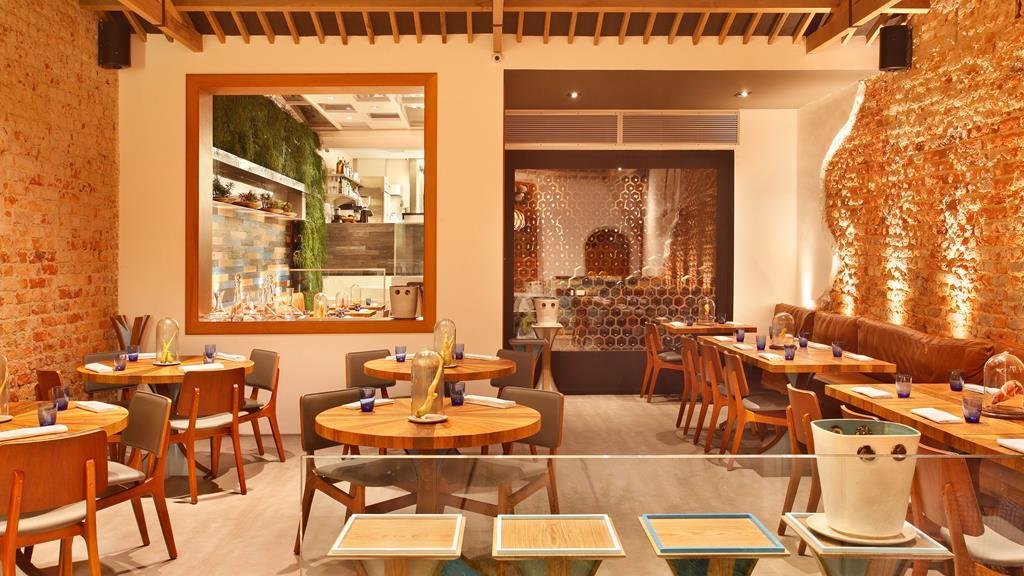
Ten Seats, Two Stars, One Counter
Largo dos Leões is a quiet residential square in Humaitá, the kind of corner of Rio de Janeiro that locals use as a shortcut between Botafogo and Lagoa rather than a dining destination. That incongruity is part of what defines the experience at Lasai: a restaurant holding two Michelin stars and a position at number 58 on The World's 50 Best Restaurants list, operating out of a room so deliberately small that it serves only ten people per sitting. The neighbourhood offers no visual fanfare. The restaurant offers none either. What you find instead, once inside, is one of the most considered tasting-menu formats currently running anywhere in Brazil.
The move to this smaller footprint happened in 2022, when Lasai relocated from a colonial townhouse nearby to its current L-shaped counter format. In the years since fine dining globally has lurched between maximalist spectacle and stripped-back precision, that shift to a counter serving ten has proved a clear editorial statement about where this kitchen sits. The comparison set for Lasai is not the large-format destination restaurants of São Paulo or the beach-adjacent brasseries that fill Rio's wealthier postcodes. It belongs to a smaller, globally connected tier of counter-first restaurants where proximity to the kitchen is the format's central proposition. Think of the logic underpinning Atomix in New York City or the intimate counter discipline at Le Bernardin, then apply it to a kitchen rooted entirely in Brazilian produce.
The Critical Record
Few restaurants anywhere in Latin America carry a dossier as consistent as Lasai's. The restaurant has appeared on the Latin America's 50 Best Restaurants list every year since opening, a run that spans more than a decade. In 2024 it was awarded Leading Restaurant in Brazil. In 2025 it made its debut on The World's 50 Best Restaurants at number 58, having already appeared at the same position in 2023 and 2024, suggesting sustained critical consensus rather than a single-year surge. The same year, Michelin confirmed two stars, a rating it had also held in 2024. On La Liste, which aggregates international critic scores, Lasai scored 83.5 points in 2025 and 82 points in 2026. Opinionated About Dining, the critic-weighted South American ranking, placed it at number nine in 2024 and number seven in 2025.
That accumulation of recognition across different methodologies — public critic votes, anonymous inspection, aggregated international scoring — is what separates a restaurant with a good year from one that has built something structurally durable. Lasai belongs to the latter category. For context within Rio itself, Oteque and Oro operate at the same price tier and share similar critical attention, but Lasai's international footprint extends noticeably further, a product of both longevity and the specificity of its vegetable-led format, which reads as distinctive to international critics in a way that broader modern-Brazilian menus often do not.
What the Format Actually Involves
The 15-course tasting menu is built around produce from two gardens. One sits in Itanhangá, within the city. The other is several hours' drive away in Rio de Janeiro state. Together they supply the menu's vegetable core, which is supplemented by local seafood and protein. The menu is seasonal by necessity: it follows what the gardens produce rather than the reverse. Dishes on record from the kitchen include chayote squash with romanesco broccoli, borage and scallops, and palm heart with cashew nuts, enoki and king oyster mushrooms alongside sweet potato leaf. The plating is restrained and precise in keeping with a room designed without visual noise.
The format includes a ritual that distinguishes it from most tasting menus: before each course, guests are shown the raw ingredients about to be cooked and encouraged to handle them directly. This is not theatre for theatre's sake. It connects the ten people at the counter to the sourcing logic behind the kitchen, making the garden-to-plate claim legible rather than rhetorical. It also gives each course a sensory reference point before the cooking intervenes.
Drinks pairing centres on biodynamic and natural wines selected by sommelier Maíra Freire. The list draws heavily on Brazilian producers, including reds from Rio Grande do Sul, vermouths from São Paulo, and a mead produced from wild, native honey. For guests unfamiliar with Brazilian fine wine, this is a meaningful introduction: Rio Grande do Sul produces most of Brazil's serious still wine, and the region's cooler-altitude producers have improved their output substantially over the past decade. Choosing a Brazilian-weighted pairing list at this price point is a statement of conviction, not just local pride.
Lasai in the Rio Fine Dining Context
Rio's highest-tier restaurant set is smaller and more geographically concentrated than São Paulo's. The main cluster of serious tasting-menu and premium à la carte restaurants runs through Botafogo, Humaitá, and Ipanema, with outliers in Leblon and Barra. Lasai anchors the Humaitá end of that range, a neighbourhood that otherwise offers neighbourhood trattorias and casual bars rather than destination dining. That separation from the main dining belt gives the counter a degree of intentionality: you go to Lasai specifically, not as part of a street-level sweep of options.
At the same price point within the city, Casa 201 and Cipriani offer more traditional European-leaning formats, while Mee works a different register entirely. Lasai's distinctiveness within this set lies in its commitment to a specifically Brazilian ingredient vocabulary at a level of technical execution that most regional tasting menus, across all of South America, have not yet reached consistently. For a broader picture of where Lasai sits within the city's dining offer, our full Rio de Janeiro restaurants guide maps the full range across price points and neighbourhoods.
Outside Rio, the vegetable-forward Brazilian tasting-menu format has analogues worth tracking. Evvai in São Paulo works comparable ingredient-sourcing logic. Manga in Salvador approaches regional produce from a different geography and cultural baseline. Elsewhere in Brazil, Primrose in Gramado, Castelo Saint Andrews in Gramado, Mina in Campos do Jordão, and Orixás North Restaurant in Itacaré each represent the regional variation in serious Brazilian tasting-menu cooking worth knowing about. The country's fine dining map has expanded considerably in the past five years, and Lasai remains the benchmark against which others are measured.
Planning the Visit
Lasai operates Tuesday through Friday from 8pm to midnight, and on Saturday from 7pm to 2am. Sunday and Monday are closed. The ten-seat counter means availability is sharply limited; booking well in advance is essential, particularly for weekend dates. The restaurant is at Largo dos Leões 35 in Humaitá, a short taxi or rideshare ride from both Botafogo and Lagoa. The price range sits at the leading of the Rio market, consistent with other two-Michelin-star tasting-menu formats operating at this counter size globally. Given the format and the price point, this is an evening reserved for adults with a genuine interest in how the menu is constructed; it is not a casual drop-in. For those building a broader trip around the visit, our Rio de Janeiro hotels guide, bars guide, wineries guide, and experiences guide cover the full range of options across the city.
How It Stacks Up
A small comparison set for context, based on the venues we track.
| Venue | Cuisine | Price | Awards | Notes |
|---|---|---|---|---|
| Lasai | Regional Brazilian, Modern Cuisine | $$$$ | Michelin 2 Stars | This venue |
| Oteque | Modern Brazilian, Modern Cuisine | $$$$ | Michelin 2 Star | Modern Brazilian, Modern Cuisine, $$$$ |
| Oro | Contemporary Italian, Brazilian, Modern Italian | $$$$ | Michelin 2 Star | Contemporary Italian, Brazilian, Modern Italian, $$$$ |
| Lilia | Italian, Brazilian | $$ | Italian, Brazilian, $$ | |
| Casa 201 | French | $$$$ | Michelin 1 Star | French, $$$$ |
| Cipriani | Italian | $$$$ | Michelin 1 Star | Italian, $$$$ |
Continue exploring