La REcyclerie occupies a converted former railway station on Boulevard Ornano in the 18th arrondissement, operating as an urban farm, café, and cultural space that reflects the northernmost edge of Paris's shift toward ecological dining and community-oriented hospitality. It sits outside the conventional restaurant tier entirely, offering a model closer to civic project than commercial venue. For visitors seeking context on the city's alternative food scene, it warrants attention.
Pearl is the En Primeur Club membership app — saves, bookings, and concierge access live there. Same editors, same standards.
- Address
- 83 Bd Ornano, 75018 Paris, France
- Phone
- +33 1 42 57 58 49
- Website
- larecyclerie.com
- Directions
- Get directions
 Saves & bookings on Pearl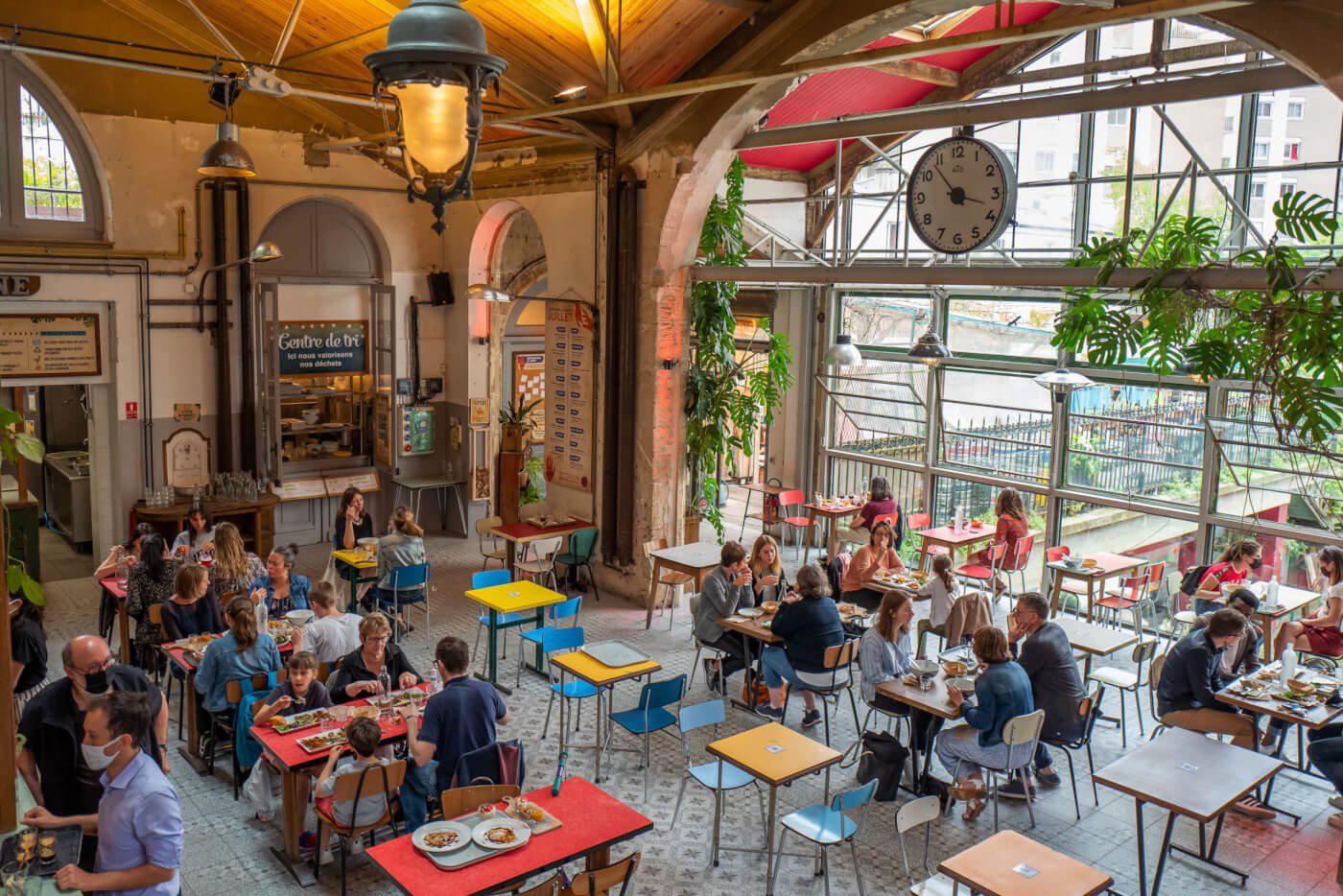
Where the 18th Arrondissement Meets Its Own Contradictions
La REcyclerie is an eco-friendly French bistro at 83 Bd Ornano, 75018 Paris, France. This is the 18th arrondissement at its most functional, a neighbourhood of covered markets, neighbourhood brasseries, and transit infrastructure, where the Seine is an abstraction and the Eiffel Tower might as well be in another city. La REcyclerie works precisely because it doesn't resist that context. The former Ornano railway station, part of the old Petite Ceinture line that once encircled Paris before falling into disuse in the 1930s, provides the structure, and the project fills it with a proposition that would feel thin in a glossier postcode but lands with conviction here.
Arriving on foot from the Porte de Clignancourt métro, the approach matters. The Petite Ceinture's disused rail bed runs alongside the building, now planted and managed as a strip of urban ecology. Before you've ordered anything, the space is already making an argument about what hospitality in a city with finite land and accelerating environmental pressure might look like.
A Format Shaped by the Ecological Movement in Urban Dining
Across European cities, a recognisable format has emerged over the past decade: part café, part cultural programming space, part working urban farm. These aren't restaurants in the conventional sense, and they aren't community centres in the old civic sense either. They occupy a productive middle ground, generating revenue through food and drink while anchoring their identity in an environmental or social mission. Berlin, Amsterdam, and Copenhagen each have variants of this model. In Paris, La REcyclerie is among the more sustained examples, drawing on the city's deep tradition of marché culture and repurposing it through a post-industrial, ecological frame.
The broader Paris dining scene runs a wide range, from the formal haute cuisine represented by places like Alléno Paris au Pavillon Ledoyen and L'Ambroisie to the technically ambitious contemporary formats at Kei and Le Cinq. The restaurant competes with none of these. It occupies a separate category entirely, one where the metrics of success are participation, programme diversity, and ecological credibility rather than culinary stars or tasting menu length.
The Team Dynamic: Service as a Collective Practice
In a setting like this, the conventional hierarchy of chef, sommelier, and front-of-house dissolves into something less delineated. The team at a space that functions simultaneously as urban farm, café, workshop venue, and bar cannot operate through the division of labour that structures service at, say, Arpège. Instead, the collaboration here is cross-functional by necessity: the people running weekend workshops on composting or repair culture are adjacent to those serving brunch or pulling natural wine from the bar. That overlap creates a different texture of hospitality, one where knowledge runs lateral rather than hierarchical. A question about provenance is as likely to be answered by someone who tends the on-site garden beds as by whoever is behind the pass.
This model contrasts sharply with how collaboration is structured at France's long-established destination restaurants. At Troisgros or Flocons de Sel in Megève, the team dynamic is built around culinary lineage and deep specialisation. At Bras in Laguiole or Auberge de l'Ill, generational continuity structures the service culture. The restaurant's team dynamic is built around a shared project rather than a culinary tradition, which produces a noticeably different energy in the room: more collective, less choreographed, and with a tangible sense that the people serving you have reasons beyond professional training for being there.
Seasonality and the Urban Farm Calendar
One of the more grounded ways to engage with the restaurant is to time a visit around its seasonal programming. The on-site urban farm follows a planting calendar, and the café's offerings shift accordingly. Spring and early summer bring the highest activity to the growing beds along the old rail corridor, and the weekend market and repair café events tend to cluster in warmer months when the outdoor terrace on the former platform is functional. For visitors arriving between October and February, the indoor spaces carry more of the weight, and the programme tilts toward workshops and evening events rather than outdoor activity. This seasonal rhythm gives the space a different character depending on when you arrive, something that static restaurant formats rarely offer.
Comparable seasonal sensitivity appears at properties with a strong relationship to their land: Mirazur in Menton organises its menu around a biodynamic garden calendar, and Les Prés d'Eugénie has long drawn on its estate gardens as a structural element of the cuisine. At the restaurant, that connection operates at a smaller scale and more urban register, but the underlying logic, that what grows locally should shape what arrives at the table, runs through all three.
Placing La REcyclerie in the Broader Picture
For context on how the ecological dining model translates internationally, the comparison set is instructive. Lazy Bear in San Francisco operates on a community-table, ticketed format that similarly collapses the distinction between hospitality and social event. Le Bernardin in New York City represents the opposite end of the formality axis. French regional houses like Paul Bocuse, Georges Blanc in Vonnas, Auberge du Vieux Puits, and La Table du Castellet each represent a tradition of destination dining anchored in terroir and regional identity. The restaurant draws on some of the same values, local sourcing, seasonal rhythm, connection to land, but delivers them through a participatory, urban format that operates outside any conventional restaurant tier.
Planning a Visit
The restaurant is located at 83 Boulevard Ornano in the 18th arrondissement, accessible from the Porte de Clignancourt métro on line 4. The space functions across multiple formats, café service, evening bar, weekend events, so the practical approach is to check the current programme before arriving, as what's available on a Tuesday afternoon will differ substantially from a Saturday. Walk-in access is generally feasible for café and bar visits, though specific workshops and events require advance registration. Dress is entirely casual; this is neighbourhood infrastructure, not a dining room.
Peers in This Market
Comparable venues nearby, for context on price, style, and recognition.
| Venue | Cuisine | Price | Notes |
|---|---|---|---|
| La REcyclerieThis venue — the venue you are viewing | Eco-friendly French Bistro | $$ | Not listed |
| Pristine | Modern French Neo-Bistro | $$ | 9th arrondissement |
| Les Gros Tontons de Paname | Classic French Bistro | $$ | 3ème arrondissement (Marais) |
| Le Relais Du Vin | Traditional French Bistro | $$ | Les Halles |
| Season Marais | Modern Healthy French Café | $$ | Le Marais |
| Lobineau | French Seafood | $$ | Saint-Germain-des-Prés |
Continue exploring
More in Paris
Restaurants in Paris
Browse all →

Hotels in Paris
Browse all →
Wineries in Paris
Browse all →
At a Glance
- Rustic
- Trendy
- Bohemian
- Industrial
- Brunch
- Casual Hangout
- Group Dining
- Garden
- Terrace
- Historic Building
- Natural Wine
- Craft Cocktails
- Farm To Table
- Local Sourcing
- Zero Waste
- Garden
- Street Scene
Current opening hours
- Monday
- 11 AM–10 PM
- Tuesday
- 11 AM–12 AM
- Wednesday
- 11 AM–12 AM
- Thursday
- 11 AM–12 AM
- Friday
- 11 AM–2 AM
- Saturday
- 11 AM–2 AM
- Sunday
- 11 AM–10 PM
Hours can change for holidays and private events. Last verified .
Bucolic and eco-chic atmosphere with vintage touches, picnic tables, and lush garden terrace evoking relaxed environmentalism.