Our verdict
La Brasserie des Chartrons sits on the Quai de Bacalan in Bordeaux's historic Chartrons wine-merchant quarter, placing it at the intersection of the city's riverside renewal and its deep-rooted tradition of table hospitality. The address puts it within reach of the Cité du Vin and a regenerating waterfront strip that has quietly become one of the city's more interesting dining corridors. For visitors calibrating a Bordeaux itinerary, it merits a place in that planning conversation.

Pearl is the En Primeur Club membership app — saves, bookings, and concierge access live there. Same editors, same standards.
- Address
- 8 Quai de Bacalan, 33300 Bordeaux, France
- Phone
- +33557025392
- Hours
- Mon–Sat 12–2 PM, 7:30–10 PMSun Closed
- Directions
- Get directions
- Booking
- Book on the venue's website
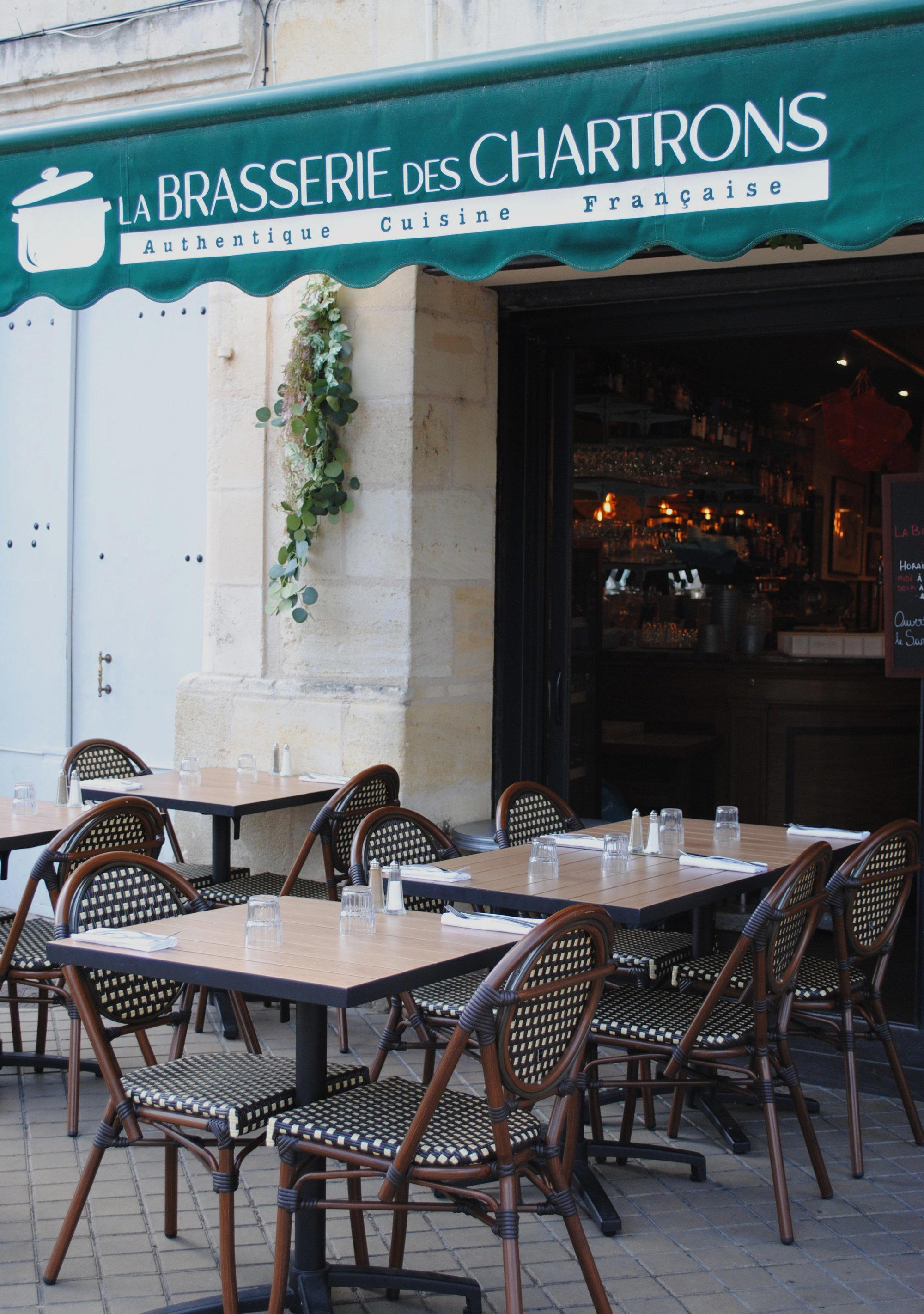
The menu
What to order
- Cote de Boeuf
- Entrecote
The Chartrons Quarter and What It Means for a Dining Address
The Quai de Bacalan has changed faster than almost any stretch of Bordeaux's riverfront. What was, for most of the twentieth century, a working port district defined by wine négociants and their stone warehouses now houses the Cité du Vin, a cluster of hotel openings, and a dining corridor that has attracted both neighbourhood regulars and wine-country visitors arriving from the Médoc to the north. La Brasserie des Chartrons sits at number 8 on that quai, which places it squarely inside this broader shift rather than at a remove from it.
Context matters in Bordeaux dining because the city's restaurant geography is genuinely stratified. The old town and the Golden Triangle concentrate the highest-end addresses — Le Pressoir d'Argent by Gordon Ramsay and L'Observatoire du Gabriel both operate in that zone, at price points and formality levels that suit a specific occasion. The Chartrons address carries a different register: historically the neighbourhood where Protestant wine merchants built their townhouses, it has always had a slightly more lived-in, less ceremonial relationship with food and wine than the monumental centre. A brasserie format here sits in the tradition of those working lunches and long weekend tables rather than in the Michelin-trajectory tier.
Approaching the Room
The Quai de Bacalan runs along the left bank of the Garonne, and arriving from the south means walking past a sequence of industrial-scale buildings that have been converted rather than demolished. The riverfront orientation is the physical fact that defines this part of the city: the Garonne is wide here, and the light off the water in the late afternoon is the kind of thing that makes even a modest terrasse feel like a reasonable place to spend two hours. The brasserie format, historically rooted in long service windows and a range of dishes suited to multiple occasions, fits the ambience of a regenerating waterfront better than a tightly formatted tasting menu operation would.
The Team Dynamic in a Brasserie Context
One of the more underappreciated dynamics in French brasserie dining is the degree to which the experience depends on coordinated service rather than on a single celebrity kitchen. The front-of-house in a brasserie carries a heavier share of the guest relationship than in a chef-driven tasting menu format, where the kitchen's sequence controls most of the pace and narrative. At the same time, the sommelier role in a Bordeaux brasserie is structurally different from that of its counterparts in the region's wine-country restaurants: the expectation is not a deep vertical of classified growths presented with ceremony, but a genuinely useful read of the table's appetite and budget, matched to a list that probably leans local. In a city where even mid-range wine lists carry the weight of the appellation's global reputation, that navigation requires real competence. The leading brasserie service in Bordeaux — and this applies as a general observation about the format, not only to this address, operates as a low-pressure, high-efficiency system where the floor team functions as the connective tissue between a kitchen running at volume and a guest who may have walked in off the riverfront without a reservation.
Bordeaux's brasserie tradition is distinct from the Alsatian model that exported the format to Paris. Here the repertoire reaches toward Gascony and the broader southwest: duck preparations, oysters from the Arcachon Basin, lamprey in season, and an entrecôte culture shaped by proximity to Bazas cattle country. A kitchen team working that register competently is doing something more specific than generic French bistro cooking. For comparison and contrast with what contemporary creativity looks like at the city's more ambitious end, Maison Nouvelle and Amicis both operate at the €€€€ creative tier in Bordeaux, while L'Oiseau Bleu sits in the modern cuisine middle ground. The brasserie sits below all of those in formality and, likely, price, which makes it a different kind of decision rather than a lesser one.
Bordeaux and the Broader French Table
The French regional dining conversation is anchored, at its apex, by addresses that carry multigenerational weight: Auberge de l'Ill in Illhaeusern, Troisgros in Ouches, Bras in Laguiole, and Paul Bocuse's Auberge du Pont de Collonges represent that long-arc institutional tradition. Bordeaux itself has never quite matched Lyon or Alsace for density of that top tier, Au Crocodile in Strasbourg and the Alsatian pipeline produced a different kind of consistency, but the city's position as the world's most commercially scrutinised wine region has always meant that mid-market and neighbourhood-level dining operates in a wine-literate environment that is genuinely unusual. You are unlikely to be handed a poor-value carafe at a working brasserie in the Chartrons quarter. The baseline is higher because the clientele, including the négociant trade and wine-country visitors, simply knows more.
For wider French context at the prestige end, Mirazur in Menton, Alléno Paris au Pavillon Ledoyen, Assiette Champenoise in Reims, AM par Alexandre Mazzia in Marseille, and Flocons de Sel in Megève all sit in the upper echelon of what France produces at the table. For international contrast at the technical extreme, Le Bernardin in New York and Atomix represent what precision-driven counter formats look like at the opposite end of the spectrum from a riverside brasserie. None of that context diminishes the Chartrons address; it places it correctly.
Planning a Visit
La Brasserie des Chartrons is at 8 Quai de Bacalan, in the Chartrons district of Bordeaux, a short distance from the Cité du Vin. The Quai de Bacalan is accessible on foot from central Bordeaux along the riverfront promenade, or by tram on the city's Line B network, which has stops serving the area. Visitors building a Bordeaux dining itinerary would do well to consult our full Bordeaux restaurants guide for the broader picture of how the city's dining tiers are currently arranged.
Frequently asked questions
Where is La Brasserie des Chartrons in Bordeaux?
La Brasserie des Chartrons is located at 8 Quai de Bacalan, 33300 Bordeaux, France, Bordeaux.
Is La Brasserie des Chartrons a good option for dining near the Cité du Vin in Bordeaux?
La Brasserie des Chartrons at 8 Quai de Bacalan is among the closest sit-down dining options to the Cité du Vin, Bordeaux's wine museum on the northern riverfront. The Chartrons quarter has developed into one of the city's more active dining corridors over the past decade, making this brasserie a natural stop for visitors spending time in that part of the left bank.
What's the must-try dish at La Brasserie des Chartrons?
Specific menu details are not published for La Brasserie des Chartrons, so no single dish can be cited with confidence. In the French brasserie tradition, the kitchen typically anchors its repertoire around straightforward preparations: cuts cooked to order, daily market fish, and regional produce. At a Bordeaux address on the Quai de Bacalan, expect the local wine culture to inform what lands on the table.
How hard is it to get a table at La Brasserie des Chartrons?
Booking details for La Brasserie des Chartrons are not publicly listed, and no central reservations platform is confirmed at this address. The Quai de Bacalan draws steady footfall from the Cité du Vin and the broader Chartrons neighbourhood, so contacting the venue directly ahead of peak dining hours is the practical approach. Walk-in availability will vary by day and season.
What makes La Brasserie des Chartrons worth seeking out?
The address itself carries weight: 8 Quai de Bacalan sits in the Chartrons district, a stretch of Bordeaux that has shifted from working port to one of the city's most active dining and cultural corridors. For visitors arriving from the Cité du Vin or exploring the left bank of the Garonne, it occupies a position that few riverfront brasseries in Bordeaux can claim by proximity alone. Whether formal awards or critical recognition apply here is not documented, but the neighbourhood context is a credential in its own right.
Budget Reality Check
Comparable venues nearby, for context on price, style, and recognition.
| Venue | Cuisine | Price | Awards | Notes |
|---|---|---|---|---|
| La Brasserie des ChartronsThis venue — the venue you are viewing | Traditional French Brasserie | $30–50 | Not listed | Not listed |
| Café Maritime | Modern French Brasserie | $30–50 | Not listed | Bordeaux Maritime, Modern French Brasserie |
| Baud et Millet | French Cheese and Wine Bistro | $30–50 | Not listed | Centre ville, French Cheese and Wine Bistro |
| Bistrot Cul Sec | Modern French Bistro | $50–100 | Michelin Plate · Star Wine List | Centre ville, Modern French Bistro |
| L'Originel | Contemporary French Bistro | $50–100 | Not listed | Centre ville, Contemporary French Bistro |
| Le Regallien | Modern French Bistro | $30–50 | Not listed | Centre ville, Modern French Bistro |
Continue exploring
More in Bordeaux
Restaurants in Bordeaux
Browse all →
Bars in Bordeaux
Browse all →
Hotels in Bordeaux
Browse all →
Details
- Classic
- Cozy
- Elegant
- Group Dining
- Family
- Casual Hangout
- Terrace
- Extensive Wine List
- Local Sourcing
- Street Scene
- A La Carte
Current opening hours
- Monday
- 12–2 PM, 7:30–10 PM
- Tuesday
- 12–2 PM, 7:30–10 PM
- Wednesday
- 12–2 PM, 7:30–10 PM
- Thursday
- 12–2 PM, 7:30–10 PM
- Friday
- 12–2 PM, 7:30–10 PM
- Saturday
- 12–2 PM, 7:30–10 PM
- Sunday
- Closed
Hours can change for holidays and private events. Last verified .
Authentic and warm atmosphere blending tradition and modernity with elegant decor.