
Tokyo’s Italian dining has moved well beyond imported grammar, and this six-seat Ningyocho counter sits in the city’s smaller wood-fire, wine-led tier. Selected for Tabelog Italian TOKYO “Tabelog 100” in 2025 and 2023, L'appartamento di NAOKI reads less as a trattoria transplant than as a Japanese ingredient kitchen using Italian structure, controlled flame, and cellar judgment.
Pearl is the En Primeur Club membership app — saves, bookings, and concierge access live there. Same editors, same standards.
- Address
- Japan, 〒103-0013 Tokyo, Chuo City, Nihonbashiningyocho, 2 Chome−10−11 KYOE PLAZA 4F
- Website
- naokiyokoe.com
 Saves & bookings on Pearl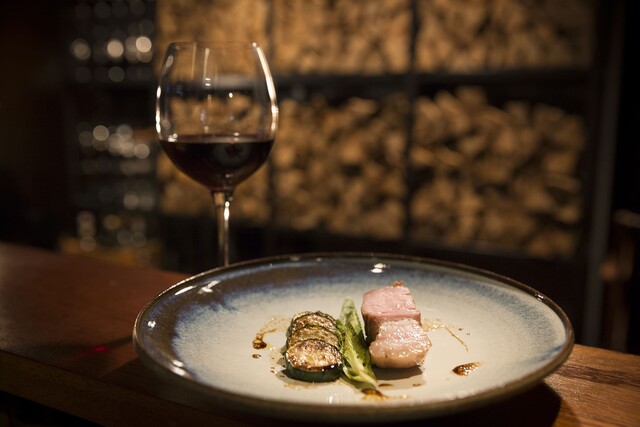
The approach to this kind of Tokyo dining is rarely theatrical: a lift, an upper-floor address, a small room, then the compression of the city’s serious counters, few seats, little distance between guest and kitchen, and a meal built on attention rather than scale. L'appartamento di NAOKI sits in the compact Tokyo category where Italian cooking is not décor or nostalgia. The frame is fire, wine, and Japanese sourcing, not red sauce, marble, or the broad comfort vocabulary that still shapes many international ideas of Italian restaurants.
Ningyocho gives it context. This part of Chuo is older, more workaday, and less performance-driven than Ginza, Aoyama, or Roppongi. Its dining culture includes long-established Japanese formats, sweets shops, sukiyaki houses, and small specialist counters. Ningyocho Imahan (人形町今半) anchors the neighbourhood’s association with beef and old Tokyo hospitality, while Morinoen gives it a tea-shop rhythm. Here, an Italian-innovative counter feels less like imported luxury than another precise craft format in a narrow lane.
Wood fire and wine place this counter in Tokyo's Italian-innovative tier
Tokyo’s Italian scene has split into generous regional kitchens, pasta-led neighbourhood rooms, luxury hotel dining rooms, and a smaller group of chef-counter restaurants using Italian technique as a framework for Japanese produce. The latter compete less on abundance than on sequence, temperature, smoke, acidity, and wine placement. L'appartamento di NAOKI is listed in the Italian and Innovative categories and was selected for Tabelog Italian TOKYO “Tabelog 100” in 2025 and 2023, a useful signal because Tabelog’s Hyakumeiten lists recognise categories rather than generic popularity.
The wine emphasis matters. Serious Italian rooms in Tokyo separate themselves not just by famous labels, but by matching leaner, more mineral, or more structured bottles to Japanese ingredients that do not behave like central Italian game, Piedmontese beef, or southern seafood. A six-seat counter has a different relationship to wine than a larger dining room: pairing decisions can be adjusted precisely, and pacing can absorb bottles that might feel austere or dominant in a louder room. The listing’s wine focus places the restaurant inside that conversation.
Wood fire has become a key language for Tokyo’s contemporary Italian cooking. It supplies char and aroma, but in Japan it also becomes a tool for restraint: controlled heat applied to ingredients from across Japan, with Italian structure shaping the progression. The room separates itself from a conventional Italian meal by reading through flame and product first, then Italy as grammar rather than costume.
Ningyocho makes the restaurant feel quieter than its recognition suggests
Recognition often pushes Tokyo restaurants toward predictable geography: Ginza for price and polish, Omotesando for design, Ebisu for contemporary ease. Ningyocho changes the expectation. Its dining identity is older and more layered, with small-format restaurants beside shops serving residents and office workers, not only destination diners. That friction helps explain why a six-seat Italian counter feels credible here. It is not trying to reproduce the social theatre of a grand dining room.
The nearby comparison set is instructive. Edomae Shinsaku occupies the tempura lane, Oryori Kokoroba points to Japanese course dining, and Ningyocho Imahan (人形町今半) represents an established beef tradition. L'appartamento di NAOKI sits adjacent to those formats rather than above them. It asks how far Italian technique can travel when the meal is built around Japanese ingredients, close-proximity service, and a wine program with real weight.
That question is one of Tokyo’s defining dining themes. The city absorbs foreign cuisines without leaving them intact. French, Italian, Chinese, and Spanish formats have all been reworked by counter culture, seasonal sourcing, and the Japanese expectation that a serious meal should have internal discipline. Italian cooking benefits because it moves between simplicity and technical interpretation without losing coherence. At this level, pasta is only part of the argument. Fire, stock, vegetable handling, seafood, and wine structure matter as much as familiar signposts.
How to place it within a wider Tokyo itinerary
This is not for a casual group dinner or a broad survey of Tokyo dining in one sitting. It is a focused evening for diners who know the difference between Italian comfort cooking and Tokyo’s smaller Italian-innovative counters. The six-seat scale rewards attention. Conversation, pacing, and wine decisions matter more than menu breadth.
For a wider read on the city, pair this meal with a contrasting Japanese specialist format rather than another luxury counter. Tokyo’s range is clearer when an Italian-innovative dinner is set against charcoal seafood at . 鮪と炭火焼き うお炭 秋葉原店, Shinjuku dining at 12/10 Shinjuku ten, or yakitori at 124. KAGURAZAKA (Yakitori). Casual stops such as 2D Cafe and 3 Chome no Curry Ya San show another side of Tokyo’s eating culture, where visual play or single-dish focus carries the experience rather than wine service.
Travellers building a broader Japan itinerary should use contrast rather than repetition. A beef-focused meal at -Grilled beef Sukiyaki- KAMAKURA TANUKIAN 鎌倉 たぬき庵 in Kamakura, a cafe stop at.cafe in Osaka, contemporary dining at.know in Kumamoto, Vietnamese cooking at (Shoku) Vietnam in Kawasaki, curry at [Curry Senmon Ten] Maruyama Kyoju. in Sapporo, or Kyoto dining at [ki:] in Kyoto will say more about Japan’s current restaurant culture than stacking similar counters. Outside Japan, Jōdo Saké Bar in Los Angeles and Onigiri Time in Pasadena offer useful diaspora counterpoints to how Japanese ingredients and formats travel abroad.
The editorial verdict is narrow and clear: this is a serious choice for diners who care about wine as part of the meal’s architecture, not as an afterthought. Its Tabelog Italian TOKYO “Tabelog 100” selections in 2025 and 2023 place it inside a recognised Tokyo Italian category, while the six-seat format keeps the experience closer to a specialist counter than a conventional restaurant. For broader planning, use Our full Tokyo restaurants guide, then layer in Our full Tokyo hotels guide, Our full Tokyo bars guide, Our full Tokyo wineries guide, and Our full Tokyo experiences guide to build the trip around neighbourhood rhythm rather than isolated reservations.
Cuisine and Recognition
Comparable venues for cuisine and category context.
| Venue | Cuisine | Price | Notes |
|---|---|---|---|
| L'appartamento di NAOKIThis venue — the venue you are viewing | Wood-fired Italian tasting counter | $$$$ | Not listed |
| アンティカ・オステリア・デル・ポンテ | Modern Milanese Fine Dining | $$$$ | Chiyoda |
| 神楽坂 ヴェーリ | Modern Italian Fine Dining | $$$$ | Shinjuku |
| Inbosuko Jingumae | High-end Seasonal Italian Counter | $$$$ | Shibuya |
| Bulgari Cafe II | Italian Fusion Cafe & Bar | $$$$ | Chūō |
| イル・プレージョ | Modern Creative Italian | $$$$ | Shibuya |
Recognition history
Dated appearances from independent guides and award organizations, with the underlying list record or original source where available.
Tabelog 100 #17 · No. 17
Tabelog · Tabelog 100 - Italian - TOKYO - 2025






At a Glance
- Intimate
- Elegant
- Cozy
- Rustic
- Sophisticated
- Date Night
- Special Occasion
- Business Dinner
- Solo
- Chefs Counter
- Open Kitchen
- Design Destination
- Standalone
- Extensive Wine List
- Zero Proof
Current opening hours
- Monday
- Closed
- Tuesday
- Closed
- Wednesday
- 7–9 PM
- Thursday
- 7–9 PM
- Friday
- 7–9 PM
- Saturday
- 7–9 PM
- Sunday
- 7–9 PM
Hours can change for holidays and private events. Last verified .
An intimate six-seat counter facing a custom brick wood-fired oven, with walls of stacked firewood and a bubinga wood counter creating a warm, flickering, and quietly elegant atmosphere that feels like a chef’s private apartment.