
Michelin Plate
Our verdict
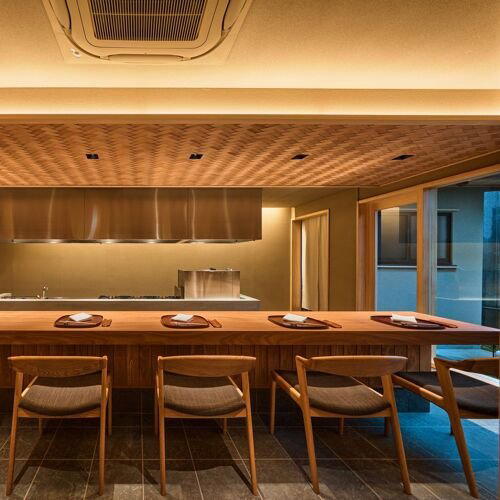
A Michelin Plate-recognised French address in Osaka's Yodogawa Ward, ku:de kiyo translates its neighbourhood roots into a format that few Western kitchens in the city attempt: generous portions, minimal arrangements, and a lunchtime set that pairs Western cooking with rice and miso soup. The name blends Osaka dialect with French phonetics, and the bright blue-and-green interior signals a kitchen comfortable operating outside convention.

Pearl is the En Primeur Club membership app, where members save venues, book tables and use the concierge.
Where Osaka's French Scene Meets Its Neighbourhood Reality
Osaka's French dining scene has long operated on two distinct registers. At the leading, addresses like La Cime and Différence compete against the national fine-dining tier, with price points and tasting formats that position them in a different conversation from the city's everyday restaurant culture. Below that, a smaller cohort of French kitchens operates closer to the neighbourhood level, less interested in ceremony and more focused on what lands on the plate. ku:de kiyo in Tsukamoto, Yodogawa Ward, sits firmly in that second register, and the gap between the two tiers tells you something meaningful about how French cooking has taken root in Japan's most appetite-forward city.
The name itself is a compressed editorial statement. «Ku:de» is Osaka dialect for «let's eat», and the chef goes by Kiyo; pressed together, the result sounds vaguely French to an unprimed ear. That phonetic play is deliberate rather than accidental. It signals a kitchen that has absorbed the vocabulary of French cooking without treating it as something requiring translation into reverence. The bright blue and green colour scheme reinforces the point on arrival, this is not a room trying to conjure a Parisian brasserie or perform European formality.
The Lunch Equation: Why Daytime Is the Entry Point
The lunch-versus-dinner divide is one of the more reliable indicators of a restaurant's relationship with its neighbourhood. Addresses that run identical formats across both services are usually optimising for visiting diners. Those that shift significantly between the two are usually talking to different audiences at different times of day, which at ku:de kiyo means the lunchtime set is the format that most clearly defines what the kitchen actually thinks about.
Lunch offering pairs Western preparations with rice and miso soup, a combination that sidesteps the idea that French cooking and Japanese staples belong in separate categories. It is a practical fusion in the most literal sense: not a creative conceit, but a way of making the food fit into a lunchtime rhythm that local regulars recognise. In Osaka's broader dining culture, where the instinct to adapt and domesticate incoming cuisines runs deep, this kind of format makes more sense than it might in a city with stricter ideas about culinary purity. The result is that the midday set has become a draw for the local neighbourhood rather than a compromise aimed at tourists.
This approach has a precedent in how French cuisine has embedded itself across Japanese cities more broadly. At La Bécasse and LE PONT DE CIEL, the relationship between French technique and local dining habits plays out at higher price points and with more structured menus. ku:de kiyo strips that dynamic down to its most accessible form.
A Kitchen Philosophy Built Around Restraint and Generosity
The stated framework is minimal arrangements, no more than three items per dish, and portions that err on the side of generosity. In French cooking terms, this places ku:de kiyo closer to the bistro end of the spectrum than to the dégustation table, but the discipline of the three-item rule prevents it from becoming casual in the way that word implies. Reduction through composition is a harder problem than addition through garnish, and a kitchen that commits to it is making a claim about confidence in the core ingredients.
Generous portions and minimal plating are not always natural partners. The tension between the two is where this format either succeeds or collapses. When it works, the result is food that reads as direct rather than bare, substantial without excess visual noise.
The Michelin Plate recognition in both 2024 and 2025 places the kitchen in the guide's acknowledged tier without the star count that would shift its clientele or its ambitions. Within Osaka's French dining spectrum, that distinction matters. Starred addresses like La Cime and venues at the nent end of the innovative spectrum are aiming at a different kind of diner. The Michelin Plate signals a kitchen the guide considers worth noting without placing it in a competitive bracket that would require tasting-menu pricing to sustain.
Tsukamoto and the Logic of the Location
Yodogawa Ward is not the part of Osaka that draws restaurant tourists. Tsukamoto sits on the Hankyu Kobe line, a residential district without the density of options that makes Namba or Shinsaibashi navigable by instinct. A French kitchen operating here is, by definition, serving a catchment area that lives nearby rather than visits. That local dependency shapes everything about the format: the accessible price range at ¥¥¥, the lunchtime set designed for weekday rhythms, the name that speaks Osaka dialect before it speaks French.
For comparison, the premium French and innovative addresses in central Osaka operate on the assumption that diners will travel. Addresses like Différence draw from across the city and from visiting diners willing to plan around a reservation. ku:de kiyo's Tsukamoto address suggests a different compact: the kitchen comes to the neighbourhood rather than asking the neighbourhood to come to it.
For visitors making the case for an off-centre dinner or lunch, the parallel is worth drawing. Across Japan, some of the most consistent French cooking happens at exactly this remove from the prestige circuits. L'Effervescence in Tokyo operates on a different scale and price tier, but the instinct toward directness and restraint in French cooking finds expressions at multiple points across the country. akordu in Nara is another reference point for Western cooking finding a durable place outside the obvious urban centres.
Know Before You Go
| Detail | Information |
|---|---|
| Cuisine | French |
| Price Range | ¥¥¥ |
| Location | 2 Chome-16-5 Tsukamoto, Yodogawa Ward, Osaka |
| Recognition | Michelin Plate 2024, Michelin Plate 2025 |
| Format | Lunchtime set meals (Western dishes with rice and miso soup); evening service available |
| Getting There | Tsukamoto Station on the Hankyu Kobe line |
For broader Osaka planning, see our full Osaka restaurants guide, our full Osaka hotels guide, our full Osaka bars guide, our full Osaka wineries guide, and our full Osaka experiences guide. For French dining beyond Osaka, Hotel de Ville Crissier in Crissier and L'Effervescence in Tokyo offer useful points of comparison across different national contexts. Within Japan's wider dining circuit, Harutaka in Tokyo, Gion Sasaki in Kyoto, Goh in Fukuoka, 1000 in Yokohama, and 6 in Okinawa round out the regional picture.
Frequently asked questions
Is ku:de kiyo expensive?
Pricing at ku:de kiyo is listed as ¥¥¥.
Do they take walk-ins at ku:de kiyo?
Given the Michelin Plate status, ¥¥¥ pricing, and the strong local following the restaurant has built in Tsukamoto, arriving without a reservation carries risk, contacting the venue directly before visiting is advisable.
What's the standout thing about ku:de kiyo?
The kitchen works within a self-imposed constraint: no more than three items per dish, minimal arrangement, and generous portions. In French cooking terms, that combination is deliberate, restraint in composition alongside scale in serving runs against the fine-dining tendency to reduce both. The Michelin Plate in 2024 and 2025 confirms the approach has registered beyond the neighbourhood.
| Venue | Cuisine | Price | Awards | Notes |
|---|---|---|---|---|
| ku:de kiyoThis venue (the venue you are viewing) | Modern French Counter Dining | Not listed | Michelin Plate | Not listed |
| HAJIME | Avant-Garde Japanese Fine Dining | $300–500 | 3 Michelin Stars · World's 50 Best #83 | French, Innovative |
| La Cime | Modern French with Japanese Ingredients | $150–200 | 2 Michelin Stars · World's 50 Best #13 | French |
| Kashiwaya Osaka Senriyama | Seasonal Kaiseki Omakase | $200–300 | 3 Michelin Stars · La Liste Top Restaurants | Japanese |
| Taian | Traditional Japanese Kaiseki Omakase | $150–200 | 3 Michelin Stars · La Liste Top Restaurants | Kaiseki, Japanese |
| Fujiya 1935 | Modern Japanese with European influences | $100–150 | 2 Michelin Stars · La Liste Top Restaurants | Innovative |
Recognition history
Dated appearances from independent guides and award organizations, with the underlying list record or original source where available.
Michelin Plate
Michelin
Full recognition history (3 entries)
Michelin Plate
Michelin
Michelin Plate
Michelin
Continue exploring
More in Osaka
Restaurants in Osaka
All restaurants in Osaka →



Bars in Osaka
All bars in Osaka →
Hotels in Osaka
All hotels in Osaka →


Wineries in Osaka
Browse all →
Details
- Modern
- Minimalist
- Intimate
- Sophisticated
- Date Night
- Special Occasion
- Chefs Counter
- Counter Dining
Current opening hours
- Monday
- 11 AM–1:30 PM, 5–8 PM
- Tuesday
- 11 AM–1:30 PM
- Wednesday
- Closed
- Thursday
- 11 AM–1:30 PM, 5–9 PM
- Friday
- 11 AM–1:30 PM, 5–9 PM
- Saturday
- 11 AM–1:30 PM, 5–9 PM
- Sunday
- 11 AM–1:30 PM, 5–8 PM
Hours can change for holidays and private events. Hours as of .
Intimate counter seating with a focus on simple, modern French dishes blending classic and modern styles.