


Kjun on Lexington Avenue in Murray Hill sits at a narrow culinary crossroads: Korean technique and pantry applied directly to Cajun and Southern Louisiana cooking. The result is a fusion format that has found real traction in a New York dining scene increasingly comfortable with hybrid cuisines operating outside traditional ethnic categories. For the neighbourhood, it represents something the surrounding blocks lack, a kitchen working two traditions simultaneously rather than borrowing superficial flavour signals from each.
Pearl is the En Primeur Club membership app — saves, bookings, and concierge access live there. Same editors, same standards.
- Address
- 154 E 39th St, New York, NY 10016
- Phone
- (347) 675-8026
- Website
- kjun-nyc.com
- Directions
- Get directions
 Saves & bookings on Pearl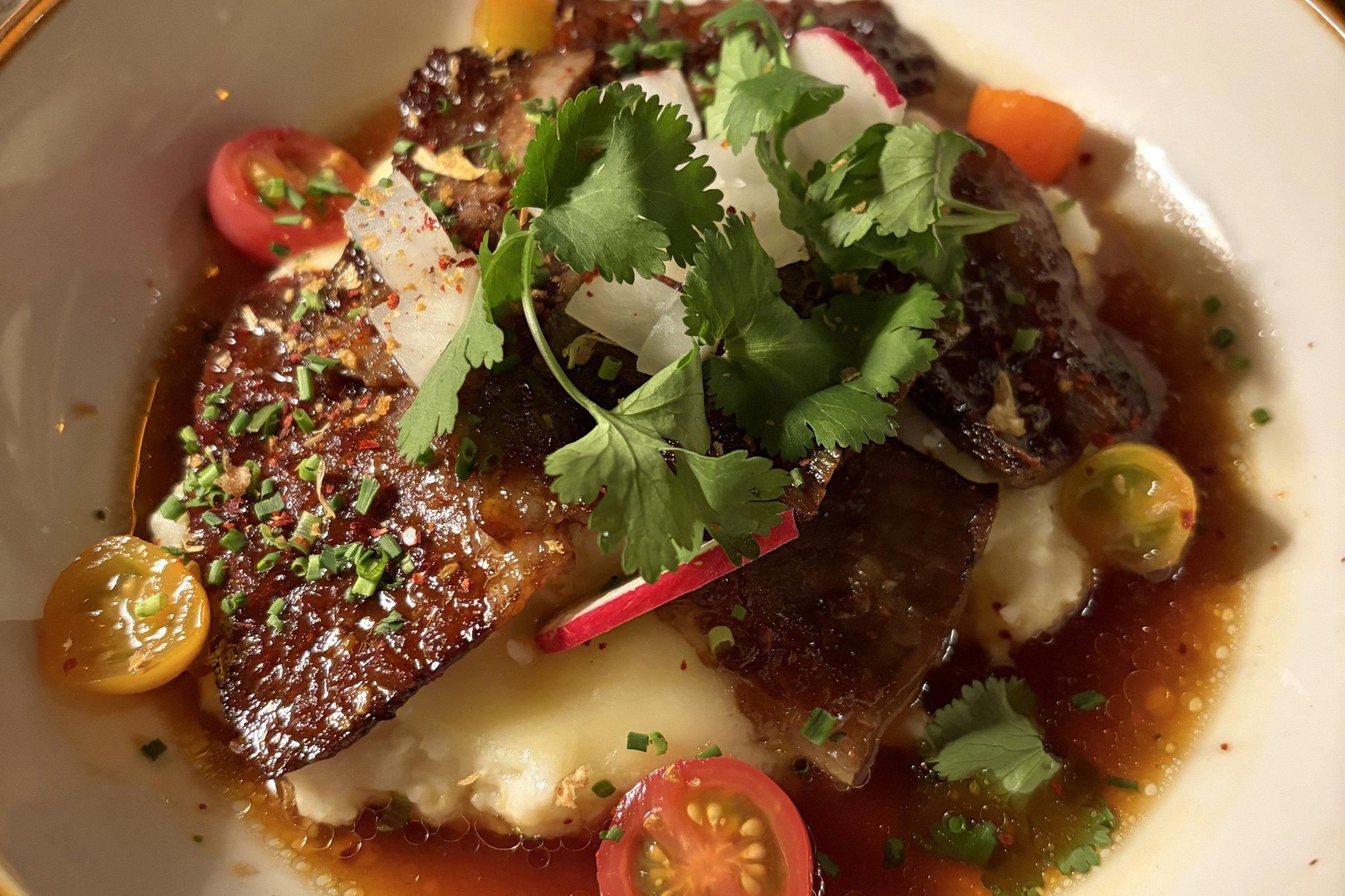
Where Two Pantries Meet on Lexington Avenue
Kjun is a Korean-Cajun restaurant in Murray Hill, New York City, priced at about $75 per person. That context matters when considering Kjun, which plants itself on Lexington Avenue with a cuisine concept, Korean Cajun, that demands more explanation than most fusion formats. Korean-Cajun is not a diplomatic borrowing of surface flavours. At its most considered, it engages two deeply specific food cultures: one built around fermentation, precise seasoning hierarchies, and the logic of banchan; the other rooted in French-Creole technique, the trinity of onion, celery, and bell pepper, and the long-cooked richness of Louisiana's bayou parishes. The tension between those traditions is the point.
The Banchan Principle Applied to Fusion
Korean dining is structured around accompaniment. The table arrives before the main dish does, populated with small plates, kimchi in several forms, pickled vegetables, seasoned greens, braised proteins, that frame and counterbalance whatever anchors the meal. That philosophy of variety, contrast, and the supporting role of fermented and cured elements translates with surprising coherence into a Cajun context. Cajun cooking has its own version of this logic: the roux as foundation, the trinity as supporting structure, the addition of pickled okra or hot pepper vinegar as brightness against richness. When a Korean kitchen approaches those Louisiana building blocks, the instinct to ferment, to layer heat through gochugaru rather than cayenne alone, and to season with doenjang depth rather than butter weight produces genuinely different results, not a diluted version of either tradition, but a third register.
In a city where Korean fine dining has consolidated into a small, serious tier, places like Atomix and Jungsik New York operate at the $$$$ level with tasting menus that treat Korean ingredients through a European fine-dining framework, Kjun represents something structurally different. It is not reaching upward toward French or contemporary technique. It is moving laterally, finding common ground between two working-class, ingredient-driven food traditions that share more structural DNA than their geographical distance suggests. Both Korean and Cajun cooking are preservation cultures, built around the question of how to make what is available last, and how to make it satisfying across a long meal.
The Hybrid Format in American Dining
Korean-Cajun as a category is not distinctive to New York. Houston developed an early version of this fusion partly through the overlap of Korean and Vietnamese communities with the Gulf Coast seafood tradition. The format typically clusters around boiled or steamed shellfish, crab, crawfish, shrimp, seasoned with a compound butter or sauce that draws from both pantries simultaneously. Garlic, Old Bay, gochugaru, sesame, and butter appear together in proportions that shift the Cajun boil's flavour axis noticeably east. The question for any Korean-Cajun operation in New York is whether it extends beyond that crawfish-boil premise into something with broader menu range.
New York's willingness to absorb and sustain hybrid cuisines has increased substantially over the past decade. The city that once filed fusion concepts under novelty now has several operating in long-term, stable formats. This is partly a function of the Korean diaspora's growing culinary confidence and partly a function of the dining public's familiarity with Korean ingredients. Gochujang appears on ingredient lists at restaurants from Blue Hill at Stone Barns to neighbourhood ramen counters. That familiarity lowers the barrier for a concept like Kjun, which can now assume its guests arrive with at least working knowledge of the Korean pantry without needing to explain fermentation from first principles.
Murray Hill as Context
The choice of Murray Hill, and Lexington Avenue specifically, is its own editorial signal. Lexington above 30th Street runs through a residential stretch that feeds into the Koreatown corridor and the broader Korean-American communities in the neighbourhood. The audience is already there. A Korean-Cajun concept in this location is not a calculated bet on gentrification footfall; it is a neighbourhood restaurant making a specific offer to a specific community that already holds both halves of the flavour equation in working memory. That is a different proposition than placing the same concept in, say, the West Village or Tribeca, where it would read as destination dining aimed at an adventurous but Korean-adjacent audience.
For comparison: New York's most formally recognised restaurants at the highest price tier, Le Bernardin, Masa, Per Se, operate in Midtown and on the Upper West Side, drawing destination diners from across the city and internationally. Kjun's neighbourhood positioning suggests a different operating logic, one closer to local restaurant than to destination, even if the cuisine concept has enough distinctiveness to draw from beyond the immediate blocks.
Across the country, the restaurants doing interesting work in hybrid regional cuisines tend to operate at mid-level price points with focused menus. Emeril's in New Orleans demonstrated that Cajun and Creole cooking could carry serious restaurant weight. More recently, format-driven places like Lazy Bear in San Francisco and Alinea in Chicago have shown how conceptually specific formats sustain long-term critical attention. Single Thread Farm in Healdsburg, The French Laundry in Napa, Providence in Los Angeles, Addison in San Diego, The Inn at Little Washington, and Bacchanalia in Atlanta each demonstrate that regional American cuisines, approached with genuine seriousness, hold their own against European-derived fine dining formats. Korean-Cajun sits in a different tier from all of those, but it belongs to the same broader argument: that American regional food cultures, when taken on their own terms, produce specific and compelling results. For international points of comparison on multi-culture fusion at formal levels, look to 8 1/2 Otto e Mezzo Bombana in Hong Kong or Alain Ducasse at Louis XV in Monte Carlo for examples of how two culinary cultures can be held in productive tension at the table.
Planning Your Visit
Location: 154 E 39th St, New York, NY 10016. Cuisine: Korean Cajun. Reservations: recommended. Dress: smart casual. Budget: about $75 per person.
The Minimal Set
Comparable venues nearby, for context on price, style, and recognition.
| Venue | Price | Notes |
|---|---|---|
| KjunThis venue — the venue you are viewing | $$$ | Not listed |
| DDOBAR by Joomak NYC | $$$ | Chelsea-Hudson Yards, Modern Korean Omakase with Yubutarts |
| Tosokchon NYC | $$ | Midtown South-Flatiron-Union Square, Authentic Korean Home-Style |
| Golden HOF | $$ | Midtown-Times Square, Modern Korean Bar & Grill |
| Dons Bogam | $$$ | Midtown South-Flatiron-Union Square, Korean BBQ with Tableside Grilling |
| The Kunjip | $$ | Midtown South-Flatiron-Union Square, Authentic Korean BBQ |
Recognition history
Dated appearances from independent guides and award organizations, with the underlying list record or original source where available.
Grub Street Best Food of 2026 (So Far)
Grub Street
Michelin Plate
Michelin
Opinionated About Dining Casual in North America Recommended
Opinionated About Dining
Continue exploring
More in New York City
Restaurants in New York City
Browse all →
Bars in New York City
Browse all →
Hotels in New York City
Browse all →





At a Glance
- Trendy
- Cozy
- Lively
- Date Night
- Casual Hangout
- Group Dining
- Open Kitchen
- Sake Program
Current opening hours
- Monday
- Closed
- Tuesday
- 11:30 AM–10 PM
- Wednesday
- 11:30 AM–3 PM, 4–10 PM
- Thursday
- 11:30 AM–3 PM, 4–10 PM
- Friday
- 11:30 AM–3 PM, 4–10 PM
- Saturday
- 11:30 AM–3:30 PM, 4–10:30 PM
- Sunday
- 11:30 AM–8 PM
Hours can change for holidays and private events. Last verified .
Casual hole-in-the-wall with big soul, featuring New Orleans-style bar vibe downstairs with loud music and a more formal Korean-leaning dining room upstairs.