KingChang-La
KingChang-La serves Authentic Korean BBQ at 3732 W 6th St in Los Angeles, with local sourcing, casual service, and conversational pacing for dinner.
Pearl is the En Primeur Club membership app — saves, bookings, and concierge access live there. Same editors, same standards.
- Address
- 3732 W 6th St, Los Angeles, CA 90020
- Phone
- +12133185250
- Website
- kingchangla.com
- Directions
- Get directions
 Saves & bookings on Pearl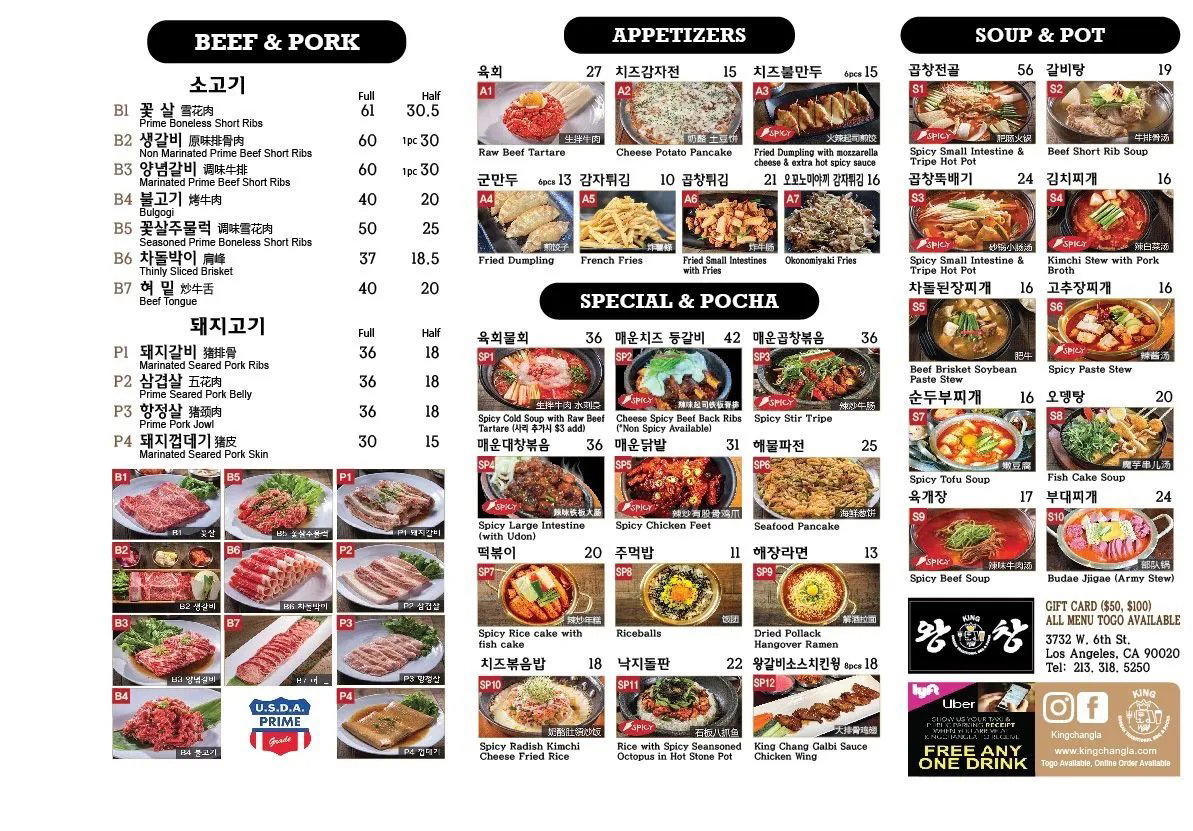
Koreatown's Ingredient-Led Table
West 6th Street through Koreatown moves at a particular frequency after dark: the neon signs of barbecue houses, the low thrum of music from karaoke rooms above storefronts, and, tucked into the mid-block rhythm of it all, the address at 3732 where KingChang-La occupies its space. Koreatown is one of the densest and most self-sufficient dining corridors in Los Angeles, a neighbourhood that has historically fed its own community first and absorbed outside attention second. That insularity is, in practice, a quality-control mechanism. Restaurants here answer to regulars with long institutional memory, not to rotating visitors hunting novelty.
That context matters because it shapes what serious dining in this zip code tends to look like: less performance, more substance. The broader Los Angeles dining conversation has moved sharply toward sourcing transparency in the past decade, a shift visible across the city's ambitious rooms from Providence (Contemporary Seafood) in Hollywood to Kato (New Taiwanese, Asian) in Culver City. KingChang-La sits within that same current, though its Koreatown address plants it in a neighbourhood where the supply chain for fermented, cured, and seasonal Korean produce has existed for generations without needing a press release.
Where the Food Comes From
The ingredient sourcing conversation in Los Angeles fine dining has largely been dominated by farm-to-table narratives attached to California's agricultural bounty: Central Valley produce, Central Coast seafood, Sonoma County dairy. Korean cuisine in Koreatown operates on a parallel axis that rarely gets folded into that story. The corridor along 6th Street and its surrounding blocks has long sustained a network of specialty importers, tofu houses, and fermentation producers that supply restaurants with ingredients unavailable at mainstream wholesale. Doenjang aged to specification, gochugaru sourced from particular Korean growing regions, myeolchi from specific coastal fisheries: these are the supply-chain details that define the flavour register of serious Korean cooking, and they exist in Koreatown at a density found almost nowhere else on the West Coast.
That infrastructure is the silent competitive advantage of a restaurant operating at this address. Comparable ambition in a less-established Korean corridor, say in a different American city without Koreatown's import depth, would require sourcing workarounds that compromise the ingredient baseline. In Los Angeles, those workarounds are largely unnecessary. The seasonal rhythm of Korean cooking, which tracks fermentation cycles, harvest windows, and preserved ingredient readiness, can be followed with more fidelity here than almost anywhere outside Korea itself. Restaurants in this mode, from Seoul's high-end hanshik houses to the small serious rooms that have emerged in New York (see Atomix in New York City for the clearest American peer), build their identity on that fidelity.
The Koreatown Dining Tier
Los Angeles's Korean dining scene has stratified considerably over the past several years. The entry tier of quick-service galbi and sundubu jjigae has always been present and densely populated. What has shifted is the middle and upper tier: restaurants that apply the same sourcing rigour and format discipline found at the city's more widely profiled ambitious tables. Hayato (Japanese) in the Arts District and Somni (Molecular) represent the intensive, fixed-format end of that spectrum for Japanese and progressive cuisine respectively. The serious Korean table in Los Angeles occupies analogous territory, though its reference points are different: the aged ferments, the precision of banchan sequencing, the sourcing of proteins to specification rather than to cost.
This is the tier where KingChang-La operates, in a neighbourhood that has the infrastructure to support it. For comparison, the farm-anchored approach seen at Single Thread Farm in Healdsburg or the hyper-regional sourcing at Blue Hill at Stone Barns in Tarrytown is the closest structural analogue in American fine dining: the kitchen's identity is inseparable from where its ingredients originate and how they were produced. The Korean version of that commitment maps differently, because the supply chain is urban and import-based rather than agrarian and local, but the underlying logic is the same.
Seasonal Logic in a Korean Context
Korean cuisine's seasonal calendar does not always align with California's growing seasons, which creates an interesting tension for serious Korean restaurants in Los Angeles. Spring kimchi traditions track Korean agricultural cycles. Kkakdugi timing, the curing of radish kimchi, follows radish harvest windows that may not correspond to local availability. The response from serious kitchens is typically a combination of local sourcing where equivalent quality exists and import reliance where it does not. This is not a compromise so much as a reflection of the cuisine's actual structure: Korean cooking has always been a preservation-forward tradition, which means that the leading ingredients are often those prepared months or seasons earlier, not the ones harvested this week.
That logic differentiates serious Korean kitchens from the farm-to-table model that dominates American fine dining coverage. At The French Laundry in Napa or Osteria Mozza (Italian), freshness and immediacy of seasonal produce are the guiding principles. Korean cuisine at its most technically refined works on a longer time horizon, where a kimchi served today may reflect decisions made six months prior. That is a different kind of precision, and it requires a different kind of sourcing intelligence.
Planning Your Visit
KingChang-La is located at 3732 W 6th Street in Koreatown, a neighbourhood with reliable public transit access and consistent street parking on surrounding blocks. Koreatown restaurants in the serious-dining tier tend to be busiest on weekend evenings, when the neighbourhood's residential density drives significant foot traffic to the entire corridor. Visiting mid-week generally means a calmer room and more attentive service pacing. As with many Koreatown establishments, the dining culture assumes familiarity with the cuisine, which can work in an informed guest's favour: less explanatory theatre, more direct engagement with the food. For the broader Los Angeles dining picture, our full Los Angeles restaurants guide maps the city's ambitious tables across neighbourhoods and cuisine categories, from Addison in San Diego for the extended Southern California context to Lazy Bear in San Francisco for the Northern California counterpart. For those tracking ingredient-sourcing narratives across the American fine dining conversation, Bacchanalia in Atlanta and The Inn at Little Washington in Washington represent the regional anchors of that movement on the East Coast. In the global conversation, Le Bernardin in New York City, Alinea in Chicago, Emeril's in New Orleans, and 8 1/2 Otto e Mezzo Bombana (Hong Kong) in Hong Kong each illustrate how sourcing credentials function differently by cuisine tradition and geography.
How KingChang-La Los Angeles compares with similar nearby venues.
| Venue | Cuisine | Price |
|---|---|---|
| Kyochon Chicken | Korean Fried | Not listed |
| BCD Tofu House | Korean | Not listed |
| Le Comptoir | French, Californian | $$$$ |
Continue exploring
More in Los Angeles
Restaurants in Los Angeles
Browse all →
Bars in Los Angeles
Browse all →
Hotels in Los Angeles
Browse all →
Wineries in Los Angeles
Browse all →
At a Glance
- Lively
- Trendy
- Group Dining
- Casual Hangout
- Late Night
- Standalone
- Local Sourcing
Current opening hours
- Monday
- 4 PM–12 AM
- Tuesday
- 4 PM–12 AM
- Wednesday
- 4 PM–12 AM
- Thursday
- 4 PM–2 AM
- Friday
- 4 PM–2 AM
- Saturday
- 4 PM–2 AM
- Sunday
- 4 PM–12 AM
Hours can change for holidays and private events. Last verified .
Casual, warm, and energetic, with a hot-spot neighborhood feel and conversational noise level.
Know Before You Go
- Getting there
- 3732 W 6th St, Los Angeles, CA 90020