
A Michelin Plate-recognised Thai kitchen on Phet Kasem Road in Takua Pa, Khrua Nong runs on a daily market routine that keeps the menu in step with whatever the local fishing boats and farm stalls are offering. The blackboard specials shift every day, and the crispy softshell crab with peppery chilli sauce has become a benchmark for the format. At the ฿฿ price tier, it holds an unusual position in southern Thailand's recognition landscape.
Pearl is the En Primeur Club membership app — saves, bookings, and concierge access live there. Same editors, same standards.
- Address
- 132/8 Phet Kasem Rd, Bang Nai Si, Takua Pa District, Phang Nga 82110, Thailand
- Phone
- +66 76 424 497
- Directions
- Get directions
 Saves & bookings on Pearl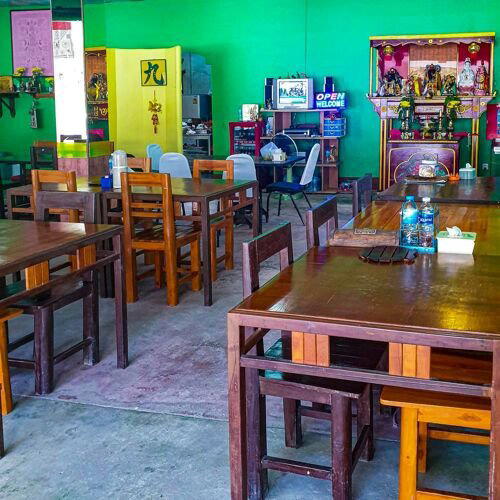
A Market Kitchen at the Edge of Southern Thailand
Phet Kasem Road in Takua Pa is not where most visitors to Phang Nga province end up. The crowd follows the limestone karsts south toward Ao Phang Nga Bay, or cuts west toward the Andaman coastline. Takua Pa sits above all of that, a quieter provincial town where the main road carries local traffic and the restaurant signage points toward Thai households rather than tourist itineraries. That gap between geography and recognition is exactly the condition that produces a certain kind of Thai cooking, daily, unselfconscious, and calibrated to whoever walked through the market that morning.
Khrua Nong operates on that model. The husband-and-wife team behind it go to market every day, selecting fresh local ingredients and seafood before service begins. The menu is not fixed in the way that most restaurants understand the term: the blackboard changes daily based on what came in, which means two visits a week apart can produce genuinely different meals. In a region where proximity to the Andaman coast and to productive hinterland farming gives kitchens real sourcing options, that daily market commitment translates directly into what arrives on the table.
What Daily Sourcing Actually Means at This Price Point
Across southern Thailand, the gap between ambition and reality in ingredient sourcing is often wider than menus suggest. At the premium end, kitchens like PRU in Phuket have built formal farm-to-table frameworks with named suppliers and documented provenance. At the other extreme, the leading street food counters, places like Anuwat in Phang Nga, operate on instinct and habit, buying what the market has without much ceremony around the fact.
Khrua Nong sits in a middle tier that is harder to sustain: a sit-down kitchen at the ฿฿ price level, running a daily-change model that requires both the discipline to source well and the flexibility to cook whatever arrived that morning. The Michelin Plate recognition in both 2024 and 2025 is a signal that the kitchen's execution meets a consistent standard despite that variability. The Plate designation marks exactly this kind of operation: technically sound, ingredient-driven, without the formality or price point of starred venues.
At the Bangkok end of the Thai fine-dining spectrum, the sourcing conversation has become its own subject, Sorn in Bangkok and Samrub Samrub Thai in Bangkok both frame southern and regional Thai ingredients as the editorial centre of their menus. What Khrua Nong does is structurally similar but entirely without that framing: the sourcing is the practice, not the story, and the proof is in the blackboard rather than the branding.
The Blackboard and What It Signals
The daily specials board is the clearest read of what the kitchen is working with on any given day. In coastal Phang Nga province, that means the Andaman catch drives a significant portion of the menu rotation, species and preparation methods shift with what the boats bring in. The wider Thai menu offers a selection of dishes that does not change, providing a baseline, but the blackboard is where the kitchen's sourcing discipline becomes legible to the diner.
Among the items that appear with enough regularity to have built a reputation, the crispy softshell crab with peppery chilli sauce is the kitchen's most discussed preparation. Softshell crab, taken during the brief window when the animal has moulted its hard shell, is a product that demands both sourcing timing and frying precision. The peppery chilli sauce places it in a distinctly southern Thai register, where heat and aromatics tend to be more assertive than in the central or northern traditions. For comparison, the seafood-focused Baan Rearn Mai in Phang Nga offers its own approach to the province's coastal catch, but Khrua Nong's Michelin recognition gives it a different kind of calibration marker.
Southern Thai cooking as a regional tradition is among the more technically distinct in the country, sharper, more turmeric-forward, heavier on fermented shrimp paste, and built around coconut milk profiles that differ from central Thai norms. The kitchens in Bangkok that have made a point of southern tradition, including Nahm in Bangkok, often treat it as a form of culinary archaeology. In Takua Pa, it is simply the local register.
Where Khrua Nong Sits in the Phang Nga Picture
Phang Nga's restaurant scene is spread across a significant geographic range, from the bay-view settings of places like Nern Khao View Talay to the creative format at Aulis and the northern Thai presence of Phi Sao. The restaurant occupies a distinct position in that spread: a Michelin-recognised, mid-price Thai kitchen in the province's northern district, drawing its identity entirely from what the local market offers each morning rather than from a fixed concept or signature format.
That positioning makes it an interesting data point for how the Michelin Guide has been reading Southeast Asian dining in recent years. The Guide's expansion into Thailand and the broader region has consistently picked up kitchens that operate outside metropolitan centres and without the infrastructure of fine dining, awarding the Plate to operations where the cooking itself is the credential. Aeeen in Chiang Mai and AKKEE in Pak Kret represent different versions of that same recognition pattern across Thailand's regions.
For travellers moving through Takua Pa or staying in the northern part of Phang Nga province, the restaurant at 132/8 Phet Kasem Road is a practical option that carries meaningful external validation. The ฿฿ price tier sits comfortably below the resort-adjacent dining options further south and significantly below the creative tasting menu formats that have emerged in Phuket.
Given the daily-change menu structure, arriving with flexibility about what you order is more useful than arriving with a fixed plan. The blackboard specials are where the kitchen's sourcing choices become most visible; the softshell crab, when available, is the preparation that has drawn consistent attention. For planning a wider stay in the province, the full Phang Nga restaurants guide covers the range from street food to creative formats, alongside the Phang Nga hotels guide, bars guide, wineries guide, and experiences guide.
Recognition, Side-by-Side
Comparable venues nearby, for context on price, style, and recognition.
| Venue | Cuisine | Price | Awards | Notes |
|---|---|---|---|---|
| Khrua NongThis venue — the venue you are viewing | Authentic Thai | $$ | Michelin Plate | Not listed |
| Phi Sao | Southern Thai Seafood | $$ | Michelin Plate | Thai Mueang |
| Nern Khao View Talay | Southern Thai Regional Cuisine | $$ | Michelin Plate | Takua Thung, Khok Kloi |
| Khanom Jeen Baan Bang Kan | Authentic Thai Khanom Jeen | $ | Michelin Plate | Thung Kha Ngok |
| Roe Dang | Authentic Southern Thai Seafood | $ | Bib Gourmand | Lam Kaen, Thai Mueang |
| Krachang Khao Lak | Fresh Andaman Seafood | $$ | Bib Gourmand | Thai Mueang |
Recognition history
Dated appearances from independent guides and award organizations, with the underlying list record or original source where available.
Michelin Plate
Michelin
Michelin Plate
Michelin
Michelin Plate
Michelin
Continue exploring
More in Phang Nga
Restaurants in Phang Nga
Browse all →

At a Glance
- Rustic
- Cozy
- Casual Hangout
- Standalone
- Local Sourcing
Current opening hours
- Monday
- 11 AM–3 PM, 5–9 PM
- Tuesday
- 11 AM–3 PM, 5–9 PM
- Wednesday
- Closed
- Thursday
- 11 AM–3 PM, 5–9 PM
- Friday
- 11 AM–3 PM, 5–9 PM
- Saturday
- 11 AM–3 PM, 5–9 PM
- Sunday
- 11 AM–3 PM, 5–9 PM
Hours can change for holidays and private events. Last verified .