
Tabelog 100 #67
Our verdict
Kasei Curry belongs to Tokyo’s serious curry conversation, not because it borrows luxury cues, but because it keeps the format compact, focused, and ingredient-led. Its Tabelog Curry TOKYO 100 selections in 2023 and 2024 place it among the city’s recognized curry specialists, while the small-room format gives the meal a sharper, more local rhythm than larger station-area restaurants.

Pearl is the En Primeur Club membership app, where members save venues, book tables and use the concierge.
The menu
What to order
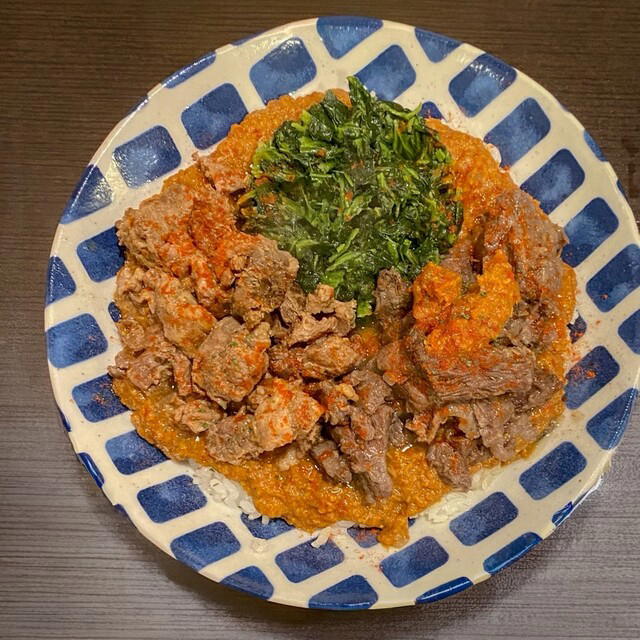
- Mars Curry
- Unusual meat curry (beef, horse, lamb etc.)
Tokyo changes character quickly from one dining pocket to the next: ramen queues, basement signs, narrow stairwells, and small restaurants that demand attention before diners sit. Kasei Curry belongs to the Tokyo category where the format is direct, turnover matters, and the cooking must justify the stop. In a city where curry runs from railway-counter comfort to specialist obsession, this venue sits in the focused lane: low-friction, category-led, and judged by the bowl rather than ceremony.
That matters because Japanese curry is not one tradition. Tokyo supports old-school roux shops, spice counters, soup curry influences, European-style yoshoku rooms, and hybrid kitchens using curry as a frame for the meal. The serious end has become increasingly format-aware, with diners reading curry shops for balance, identity, and repeat appeal rather than treating curry as generic lunch. Kasei Curry’s recognition in Tabelog Curry TOKYO 100 in 2024 places it among restaurants where curry is the central argument, not a side category.
Tokyo curry judged by focus, not ceremony
The useful way to read this restaurant is through the question Tokyo curry now asks of specialists: how clearly does the kitchen define the bowl? In cheaper everyday curry culture, sauce often dominates and toppings act as comfort cues. At the focused end, the whole plate carries more weight. Curry style, rice, portion logic, and overall balance become evidence of care. Without a named chef biography or luxury frame, the restaurant’s case rests on those choices.
Kasei Curry’s category recognition is therefore more revealing than a general popularity badge. Tabelog’s Curry TOKYO 100 list separates curry specialists from broader restaurant rankings, fitting a city where genre expertise often matters more than formal dining polish. A curry shop needs no linen, sommelier, or tasting-menu arc to command attention. It needs consistency, clear identity, and repeat appeal strong enough for local diners who compare bowls across Tokyo with the seriousness other cities reserve for sushi counters.
Tokyo is a useful setting for that cooking. The city has commuter-hub density and lived-in variety: quick meals, student budgets, evening specialists, department-store basements, and independent rooms. Compared with higher-spend casual peers such as PIZZA BORSA or Viva la Burger, Kasei Curry operates in a lower everyday bracket; compared with udon at Anpuku Ikebukuro ten or coffee at Sumibi Yaki Coffee Kura, it asks diners to treat curry as the main event rather than a convenient stop. That is the editorial point: Tokyo’s strength is not polish alone, but a dense supply of focused formats.
A focused format changes the way the meal works
The restaurant’s direct format gives the experience practical Tokyo clarity: a straightforward pace, a category-led menu, and little need for ceremony. Curry rooms reward diners who arrive with clear appetite and understand that the format is built around flow. The feeling also aligns the meal with the city’s counter-dining traditions, where proximity and pace can make a meal feel closely connected to the work of the kitchen.
This is not the part of Tokyo dining where luxury vocabulary helps. Curry at this level is about concentration: a kitchen built around one category, a price position listed in the JPY 1,000–1,999 range for both lunch and dinner, and a modest format that exposes inconsistency. The lack of grand-dining trappings is part of the point. In specialist curry, credibility comes from the bowl, service rhythm, and a local audience with alternatives across the city.
For travellers mapping a broader Tokyo food itinerary, Kasei Curry is a counterweight to reservation-heavy dining culture. It sits closer to the everyday specialist canon than destination dining theatre: category-specific, direct, and rooted in a city where serious meals can be brief. Readers can compare the curry category with other Tokyo dining generically, then widen the lens through Our full Tokyo restaurants guide.
How it fits into a sharper Tokyo itinerary
The smartest use of this stop is not as a grand meal, but as a study in Tokyo’s democratic food excellence: a focused restaurant, narrow category, and enough recognition to show local diners have been paying attention. It makes a good anchor for a Tokyo day that need not revolve around formal dining. Pairing curry with other casual-specialist addresses gives a clearer view of the city than chasing only tasting menus.
Within Tokyo, that might mean reading Kasei Curry alongside formats such as other counter restaurants, casual specialists, coffee rooms, and compact independent dining rooms. The comparison is not about similarity, but about how Tokyo rewards narrow commitments. A focused grill, a counter meal, a coffee stop, a burger specialist, and a curry specialist each show a different version of the city’s format discipline.
For a Japan-wide reading of casual precision, the same logic extends beyond Tokyo: tightly defined restaurants in other cities can carry a place’s food identity without leaning on ceremony. For readers extending the trip beyond restaurants, the broader Tokyo edit sits in Our full Tokyo hotels guide, Our full Tokyo bars guide, Our full Tokyo wineries guide, and Our full Tokyo experiences guide. For a trans-Pacific contrast in Japanese casual culture, unnamed overseas examples show how Japanese formats can change once they leave Japan.
The editorial value of Kasei Curry is precision at a human scale. It needs no long narrative. Tokyo’s curry scene is deep enough that selection for a curry-specific city list carries real meaning, and the modest format keeps focus on category clarity, repeatability, and the everyday meal that can explain the city better than a grand dining room.
Cuisine Lens
Comparable venues by cuisine and category.
| Venue | Cuisine | Price | Awards | Notes |
|---|---|---|---|---|
| Kasei CurryThis venue (the venue you are viewing) | Japanese Curry House | $10–20 | Tabelog 100 #67 | Not listed |
| Katei Saien Sasaki | Japanese home-style fish teishoku cafeteria | $10–20 | Tabelog 100 #59 | Shinjuku |
| Stand Totonoi | Japanese stand-up horumon-yaki bar | $20–30 | Tabelog 100 #77 | Kita |
| Sugamo Tokiwa Shokudo Honten | Japanese shokudo & teishoku diner | $10–20 | Tabelog 100 #11 | Toshima |
| Nakazato | Traditional Japanese Wagashi Shop | $1–10 | Tabelog 100 #49 | Kita |
| Imojin | Traditional Japanese sweets & ice cream café | $1–10 | Tabelog 100 #48 | Bunkyō |
Recognition history
Dated appearances from independent guides and award organizations, with the underlying list record or original source where available.
Tabelog 100 #67 · No. 67
Tabelog · Tabelog 100 - Curry - TOKYO - 2024
Continue exploring
More in Tokyo
Restaurants in Tokyo
All restaurants in Tokyo →

Bars in Tokyo
All bars in Tokyo →



Details
- Cozy
- Solo
- Casual Hangout
- After Work
- Late Night
- Standalone
- A La Carte
- Counter Dining
Current opening hours
- Monday
- Closed
- Tuesday
- Closed
- Wednesday
- 5:30–9:45 PM
- Thursday
- 11:30 AM–3 PM, 5:30–9:45 PM
- Friday
- Closed
- Saturday
- 11:30 AM–3 PM, 5:30–9:45 PM
- Sunday
- 11:30 AM–3 PM, 5:30–9 PM
Hours can change for holidays and private events. Hours as of .
Reviews and guides describe a compact basement curry shop with a casual, homey feel; it has the atmosphere of a local hidden spot rather than a polished chain, with a focus on hearty plates and friendly, direct service.