

Where Kansai food culture and Chinese tradition meet under one Michelin star, Kamigatachuka SHINTANI operates in a niche that few Osaka restaurants occupy: high-technique Chinese cooking grounded entirely in local Kinki-region ingredients. The result is a precise, place-specific interpretation of Chinese cuisine that positions it apart from both conventional Chinese restaurants and the kaiseki mainstream.
Pearl is the En Primeur Club membership app — saves, bookings, and concierge access live there. Same editors, same standards.
- Address
- Japan, 〒530-0016 Osaka, Kita Ward, Nakazaki, 1 Chome−4−21 1F
- Phone
- +81 6-7410-6334
- Website
- kamigata-shintani.com
- Directions
- Get directions
 Saves & bookings on Pearl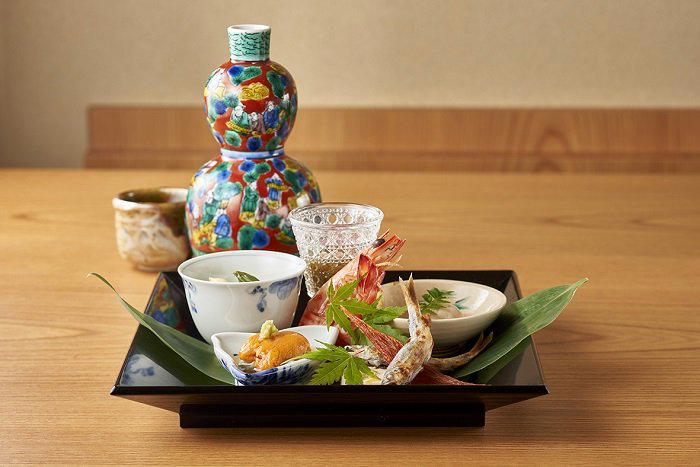
Where Two Culinary Traditions Meet at High Heat
Nakazaki-cho, the low-rise neighbourhood of Osaka's Kita Ward known for its independent cafes and vintage shops, sits at an unlikely remove from the city's fine-dining corridors. The area's domestic scale sets an immediate contrast with what happens inside Kamigatachuka SHINTANI, a first-floor address on a quiet residential stretch of 1 Chome where the cooking belongs to a serious and deliberately constructed conversation between Chinese and Japanese traditions.
That conversation is not decorative. It operates at the level of technique, sourcing, and the physical objects on the table. Ingredients drawn from the Kinki region are prepared using both Chinese and Japanese methods; the dishes arrive on a mix of Chinese and Japanese plates and bowls, a curatorial choice that makes the synthesis visible rather than abstract. In a city where kaiseki rooms and izakayas define the dominant registers of eating out, SHINTANI occupies a narrower, more considered position.
The Technical Logic of Kamigatachuka
Chinese cooking at this level lives and dies by heat management. Wok hei, the smoky, slightly charred quality produced by a seasoned wok over intense flame, requires split-second timing and a kitchen configured for speed. The concept of kamigatachuka, a Kansai-rooted interpretation of Chinese cuisine, does not soften that technical demand. It redirects it. Where a Cantonese kitchen might calibrate wok technique to amplify the sweetness of seafood, here the same high-heat precision is brought to ingredients that carry a Kinki provenance: produce from the Kawachi Plain, proteins tied to the region's agricultural and coastal identity.
The vegetarian section of the menu carries its own name, 'Naniwa', a reference to an older name for the Osaka area and an explicit invocation of the Kawachi Plain's history as a vegetable-growing region. This is not a symbolic gesture. It places the kitchen's plant-based cooking inside a documented agrarian tradition, and it signals that the sourcing logic extends across every section of the menu, not just the headline proteins. Chinese technique applied to hyper-local Japanese vegetables is a specific culinary problem, and the kitchen addresses it with evident seriousness.
In the broader map of Chinese fine dining that has emerged globally over the past decade, the Kamigatachuka approach has a discernible position. Restaurants like Restaurant Tim Raue in Berlin and Mister Jiu's in San Francisco have pursued analogous projects: using the structural logic of Chinese cooking as a frame for local ingredient stories. SHINTANI operates in the same intellectual territory but with a specifically Kansai inflection, drawing on a regional food culture that already has its own deep internal arguments about restraint, produce quality, and the ethics of flavour.
One Star in a City of Multiple Stars
Osaka's Michelin-starred tier is dense and competitive. At the three-star level, rooms like Kashiwaya Osaka Senriyama and Taian represent the kaiseki tradition at its most exacting. At two stars, La Cime and Fujiya 1935 operate in French and innovative registers respectively. SHINTANI's one-star status, awarded in the 2024 Michelin Guide, places it in a different category of recognition, though the distinction between star tiers in Osaka's guide reflects differentiation of type as much as quality. A Chinese restaurant earning Michelin recognition in a city whose fine-dining identity is so thoroughly associated with Japanese cuisine is, in itself, a form of editorial statement from the guide's inspectors.
Within Osaka's Chinese dining tier specifically, SHINTANI's position is easier to read. Chugokusai S. Sawada represents another strand of Chinese fine dining in the city, and Chi-Fu occupies a different point on the Chinese cuisine spectrum. SHINTANI's Kamigatachuka framework, with its explicit Kansai anchoring, distinguishes it from both.
The Nakazaki-cho Address in Context
Location matters here in a way that goes beyond logistics. Nakazaki-cho developed its character partly in resistance to the commercial saturation of central Osaka: it is a neighbourhood where small operators have maintained distinct identities. A restaurant built around the synthesis of Kansai food culture and Chinese tradition fits the neighbourhood's general temperament better than it might at a conventional fine-dining address in Shinsaibashi or the Dotonbori corridor. The domestic scale of the street-level setting echoes, in a minor key, the intimacy that the cooking itself seems to be after.
For comparison across Kansai and Japan's broader fine-dining circuit, the Kamigatachuka model sits in a different register from the kaiseki-led rooms that define the region's highest-profile dining. Gion Sasaki in Kyoto and akordu in Nara represent the kind of place-specific fine dining that defines Kansai at its most ambitious. SHINTANI operates in a parallel lane: serious, local, technically demanding, but oriented around a culinary tradition that the region has not historically centred. That relative novelty is part of what makes it worth attention.
Elsewhere in Japan, restaurants that blend international culinary traditions with hyper-local sourcing have found sustained Michelin recognition: Harutaka in Tokyo, Goh in Fukuoka, and 1000 in Yokohama each demonstrate, in different ways, that Japan's guide inspectors reward precision and conceptual coherence across formats. SHINTANI's 2024 star fits that broader pattern.
Planning Your Visit
Know Before You Go
- Address: 1 Chome-4-21 1F, Nakazaki, Kita Ward, Osaka 530-0016
- Price range: ¥¥¥ (mid-to-upper tier; comparable to other Michelin-starred rooms in the ¥¥¥ bracket)
- Recognition: Michelin 1 Star (2024 Guide) 0 (16 reviews)
- Booking: Reservations are expected at this level; contact details and availability are best confirmed through current dining reservation platforms serving Osaka
- Neighbourhood: Nakazaki-cho, Kita Ward, accessible from Nakazacho Station on the Tanimachi Line
- Menu note: The 'Naniwa' vegetarian section draws on Kawachi Plain produce; vegetarian guests should confirm current menu structure at time of booking
At a Glance
Comparable venues nearby, for context on price, style, and recognition.
| Venue | Cuisine | Price |
|---|---|---|
| Kamigatachuka SHINTANIThis venue — the venue you are viewing | Chinese | $$$$ |
| LE PONT DE CIEL | Chūō, Modern French Fine Dining | $$$$ |
| Différence | Nishi, French with a Sense of Japan | $$$$ |
| Hiraishi | Kita, Michelin-Starred Tempura Omakase | $$$$ |
| Iroha | Kita, Michelin-Starred Kappo Kaiseki | $$$$ |
| Point | Fukushima, Modern French Fine Dining | $$$$ |
Recognition history
Dated appearances from independent guides and award organizations, with the underlying list record or original source where available.
Michelin 1 Star
Michelin
Tabelog 100 #44 · No. 44
Tabelog · Tabelog 100 - Chinese cuisine - WEST - 2026
Michelin 1 Star
Michelin
Continue exploring
More in Osaka
Restaurants in Osaka
Browse all →




Bars in Osaka
Browse all →




Hotels in Osaka
Browse all →



Wineries in Osaka
Browse all →
At a Glance
- Elegant
- Intimate
- Sophisticated
- Date Night
- Special Occasion
- Celebration
- Chefs Counter
- Open Kitchen
- Private Dining
- Sommelier Led
- Local Sourcing
Current opening hours
- Monday
- 12–11 PM
- Tuesday
- 12–11 PM
- Wednesday
- 12–11 PM
- Thursday
- 12–11 PM
- Friday
- 12–11 PM
- Saturday
- 12–11 PM
- Sunday
- 12–11 PM
Hours can change for holidays and private events. Last verified .
Low lighting with gentle background music creates a welcoming, unpretentious setting ideal for intimate meals and special occasions.