Johnny's Reef
Johnny's Reef sits at the southern tip of City Island in the Bronx, occupying a different register entirely from Manhattan's tasting-menu circuit. This is waterside seafood eaten at outdoor picnic tables, with the kind of no-frills directness that defines the island's long-standing fishing culture. For visitors navigating New York's spectrum from white-tablecloth formality to neighbourhood institution, it represents a legitimate pole of the city's seafood tradition.
Pearl is the En Primeur Club membership app — saves, bookings, and concierge access live there. Same editors, same standards.
- Address
- 2 City Island Ave, Bronx, NY 10464
- Phone
- +17188852086
- Website
- johnnysreefrestaurant.com
- Directions
- Get directions
 Saves & bookings on Pearl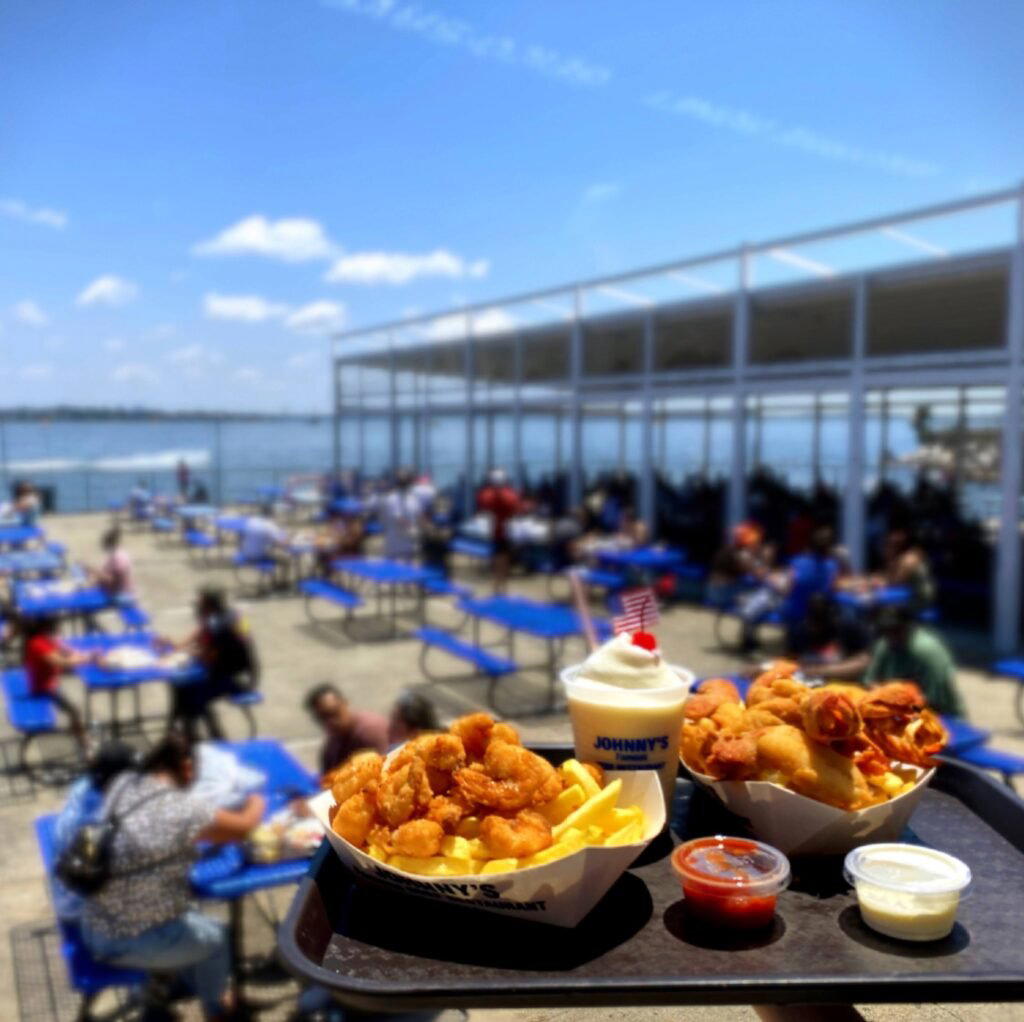
Where the Bronx Meets the Sound
City Island sits at the northeastern edge of the Bronx, connected to the mainland by a single causeway and surrounded by Long Island Sound on three sides. The island has operated as a working maritime community since the eighteenth century, with boatyards, sailing clubs, and a commercial fishing heritage that long predates the arrival of restaurant culture as New York understands it today. When you reach the southern tip of City Island Avenue, the water is visible on multiple sides, and the sense of being outside the city's conventional dining orbit is immediate and complete.
Johnny's Reef occupies that southern end, and the approach sets the terms clearly: outdoor seating, paper plates, a counter-service format, and an unobstructed view of the water. This is not the register of Le Bernardin, where seafood becomes the subject of formal French technique in a Midtown room built for sustained concentration. Nor does it share anything structurally with the precision omakase format at Masa or the tasting-menu architecture of Per Se. The point, rather, is proximity to source and directness of preparation — a culinary logic that New York's outer boroughs have maintained in parallel to Manhattan's upward price spiral.
City Island's Seafood Tradition and What It Preserves
City Island's identity as a seafood destination is less about restaurant innovation and more about a particular kind of continuity. The island's restaurants historically drew from local catches in Long Island Sound — clams, lobster, flounder, shrimp, and served them in formats that required minimal elaboration. Fried seafood, steamed shellfish, and raw bar presentations have defined the strip for decades. That tradition survives most visibly at the island's southern end, where the casual-outdoor format has resisted the modernization pressure that has transformed comparable waterfront spots in other American cities.
This approach has its own logic when placed in broader American seafood context. Operations like Providence in Los Angeles and Single Thread Farm in Healdsburg represent the end of the spectrum where local coastal product is filtered through refined technique and refined service structures. City Island's tradition represents the opposite pole: the product is the point, and the preparation exists to deliver it with as little interference as possible. Both approaches are coherent. They simply address different questions about what seafood dining is for.
Across other American cities, similar institutions occupy comparable roles. Emeril's in New Orleans operates in the tradition where Gulf seafood meets formal Southern cooking, while Bacchanalia in Atlanta integrates regional product into a contemporary fine-dining framework. The City Island model belongs to a different category entirely: the casual waterfront institution that survives on volume, repetition, and geographic specificity.
Local Ingredients, Minimal Intervention
The editorial angle that City Island seafood occupies, local product, direct preparation, has become more, not less, interesting as the opposite end of the spectrum has grown more elaborate. Places like Blue Hill at Stone Barns in Tarrytown have made the sourcing story central to a formal dining experience, constructing multi-course narratives around regional ingredients. Alinea in Chicago and Lazy Bear in San Francisco use technique as the primary lens. At City Island, neither narrative nor technique is the organizing principle. The organizing principle is the water itself, and the fact that it is close.
What this means practically is that the cooking at waterfront spots like Johnny's Reef functions as a delivery mechanism rather than a transformation. Fried clams, steamed lobster, and grilled fish are preparations that exist to put the ingredient on the table with a recognizable texture and temperature. The skill involved is real, fry oil management, temperature control, timing across high-volume orders, but it operates invisibly relative to the chef-forward presentations at Jungsik New York or Atomix, where technique is made legible and discussable. Different ambitions, different audiences, different measures of success.
For visitors to New York interested in how the city organizes its seafood culture across price points and geographies, the contrast between the Manhattan tasting-menu circuit and City Island's outdoor counter service is itself instructive. The same Long Island Sound that supplies raw material to restaurants across the metropolitan area appears here in its most direct form, without the mediation of formal service structures.
Getting to City Island
City Island requires deliberate effort from Manhattan. The island is accessible by car via the Pelham Parkway and City Island Bridge, or by public transit using the 6 train to Pelham Bay Park station followed by the Bx29 bus. The journey from Midtown Manhattan runs approximately an hour each way by transit, which functions as a self-selecting filter: the people who make it there have chosen to seek out this particular version of New York rather than stumbling across it.
The seasonal dimension matters here. Waterfront outdoor dining on City Island is a fair-weather experience, and the stretch from late spring through early autumn represents the window when the combination of open-air seating, water views, and the broader atmosphere of the island works as intended. Weekend afternoons in summer draw consistent crowds from across the Bronx and beyond. Arriving on a weekday or during off-peak hours reduces wait times at counter-service operations.
The broader New York dining picture, from neighbourhood institutions like this to formal tasting rooms, is covered in our full New York City restaurants guide. For comparison across American fine-dining formats, Addison in San Diego, The Inn at Little Washington, and The French Laundry in Napa represent the formal end of the American dining spectrum, with 8 1/2 Otto e Mezzo Bombana in Hong Kong and Alain Ducasse at Louis XV in Monte Carlo showing how seafood-forward cooking operates at the highest formal tier internationally.
Quick reference: Johnny's Reef, 2 City Island Ave, Bronx, NY 10464. Outdoor counter service; arrive by car or Bx29 bus from Pelham Bay Park station. Leading visited late spring through early autumn.
How Johnny's Reef New York City compares with similar nearby venues.
| Venue | Cuisine | Price |
|---|---|---|
| Archie's Tap & Table | American | $$ |
| Patricia’s | Italian-American | $$$ |
Continue exploring
More in New York City
Restaurants in New York City
Browse all →
Bars in New York City
Browse all →


Hotels in New York City
Browse all →







At a Glance
- Lively
- Rustic
- Scenic
- Casual Hangout
- Family
- Waterfront
- Terrace
- Craft Cocktails
- Beer Program
- Waterfront
Current opening hours
- Monday
- 11:30 AM–9:30 PM
- Tuesday
- 11:30 AM–9:30 PM
- Wednesday
- 11:30 AM–9:30 PM
- Thursday
- 11:30 AM–9:30 PM
- Friday
- 11:30 AM–10:30 PM
- Saturday
- 11:30 AM–10:30 PM
- Sunday
- 11:30 AM–9:30 PM
Hours can change for holidays and private events. Last verified .
Know Before You Go
- Getting there
- 2 City Island Ave, Bronx, NY 10464