
IOrI places Chitose ramen in the Hokkaido conversation rather than the airport-only snack circuit. Its Tabelog Ramen HOKKAIDO “Tabelog 100” selection in 2024 and 2025 gives it a clear credential, while the small-room format keeps the experience closer to local noodle culture than transit-terminal convenience dining.
Pearl is the En Primeur Club membership app — saves, bookings, and concierge access live there. Same editors, same standards.
- Address
- 1 Chome-12-2 Sumiyoshi, Chitose, Hokkaido 066-0026, Japan
- Phone
- +81 123-23-5098
- Website
- tabelog.com
- Directions
- Get directions
 Saves & bookings on Pearl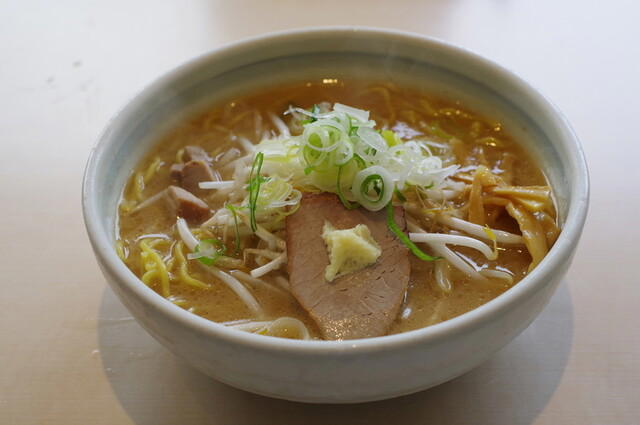
Chitose can feel like a city of arrivals: suitcase wheels, rental-car counters, and the quick choice to eat before or after the airport. A ramen room resists that tempo. The point is heat, turnover, steam on windows, and the local habit of treating a bowl as lunch and weather management. IOrI fits that Chitose grammar: a small-format ramen address in Sumiyoshi, not a polished airport concession, a distinction that matters in Hokkaido.
Hokkaido ramen carries different cultural weight from the lighter shoyu and shio traditions of parts of Honshu. The northern climate made richer broths, miso seasoning, and heavier bowls feel less like excess than common sense. Sapporo may dominate the national shorthand, but the prefecture has a deep bench of shops where local traffic, road access, and repeat eating matter more than destination theatrics. Recognition on the Tabelog Ramen HOKKAIDO “Tabelog 100” list in both 2024 and 2025 places IOrI inside that regional conversation: not a luxury outlier, but a serious everyday counter.
Chitose ramen away from the terminal economy
Airport ramen has its logic: speed, predictability, and brand recognition for travelers eating between security lines. Chitose has useful examples, including Ajisai Shin chitose kuukou ten, Hokkaido Meibutsu Ramen Ebisoba Ichigen Shin chitose kuukou ten, and the food-led airport cluster that also includes Biei Senka Shin chitose kuukou ten and Hokkaido Gyunyu Castella. Those stops make sense when the schedule controls the meal. The better question is what happens when the city, not the terminal, sets the rhythm.
IOrI answers through scale. An 18-seat room, with counter seating and a handful of tables, belongs to the ramen-shop model where the bowl is the event and the room is built for focused eating. That scale makes its recognition unlike a hotel dining award or tasting-menu accolade. In ramen, consistency across regular service is the metric: broth discipline, noodle handling, timing, and keeping a modest format compelling for repeat local use. A Tabelog score of 3.67 is not decorative; on Japanese review platforms, ramen shops compete in a crowded field where small execution differences are heavily litigated by regular diners.
The Chitose comparison is useful. Kita no Hana Hayashi sits in a much higher spending band and belongs to a different dining decision. Airport ramen counters such as Ajisai and Sapporo Miso Ramen Senmon Ten Keyaki Shin chitose kuukou ten compete on convenience and quick access. IOrI occupies the middle ground that often tells the truer story of a Japanese food city: not celebratory dining, not transit necessity, but a specialist shop with enough local gravity to justify leaving the default path.
Why Hokkaido ramen rewards small rooms
Ramen culture in Japan is not one national style wearing different labels. It is regional, technical, and intensely local. Hokkaido’s association with miso ramen, butter, corn, and winter-ready richness can obscure the prefecture’s variety. Chitose, between Sapporo’s ramen identity and the airport’s visitor traffic, reveals that tension. A shop with counter seats and family-friendly tables must serve solo diners, small groups, and local families without changing its core proposition.
Room format matters. Counter seating in ramen is not merely design; it keeps attention on pacing. Noodles do not improve with delay, and a compact counter shortens the distance between kitchen and diner. Tables broaden the audience without turning the place into a general-purpose restaurant. Both signal a shop built for everyday use rather than one customer type. In Japanese ramen terms, that is a meaningful seriousness.
Chitose also rewards practical eating. It is not Tokyo, where ramen hunters can build afternoons around queues across rail lines. Here, a bowl often fits a larger Hokkaido day: a late arrival, an early flight, a drive toward lakes and onsen towns, or a first meal after landing. That makes recognition from a regional ramen list more useful than a generic popularity claim. It shows this is not simply another convenient noodle stop; it has been sorted within Hokkaido’s ramen field and selected in consecutive years.
For travelers building a wider Chitose plan, IOrI pairs naturally with a broader read of the city rather than a single-meal detour. The restaurant scene ranges from airport counters to higher-spend Japanese dining, and the useful overview sits in Our full Chitose restaurants guide. The city’s travel infrastructure also matters: Our full Chitose hotels guide, Our full Chitose bars guide, Our full Chitose wineries guide, and Our full Chitose experiences guide help place a ramen stop inside a larger Hokkaido itinerary.
A modest bowl category with serious signals
One useful way to read IOrI is through category restraint rather than luxury markers. Ramen does not need a tasting menu, chef mythology, or sommelier pairing to carry editorial weight. Its seriousness comes from repetition and public scrutiny. A shop opened in 2010 and selected for Tabelog’s Hokkaido ramen list in 2024 and 2025 has survived cycles of local taste, traveler attention, and review-platform pressure without changing its basic grammar.
That makes it sharper for readers who care about food culture rather than checklist dining. The value is not rarity for its own sake. It is seeing how Hokkaido ramen functions outside Sapporo’s headline districts and New Chitose Airport’s controlled dining environment. Chitose is often treated as a gateway; meals like this argue for reading it as a city with its own small but legible food map.
For broader Japan context, contrast helps. Specialist formats appear across the country in different registers, from beef-focused dining such as -Grilled beef Sukiyaki- KAMAKURA TANUKIAN 鎌倉 たぬき庵 in Kamakura to casual urban addresses like. 鮪と炭火焼き うお炭 秋葉原店 in Tokyo.cafe in Osaka.know in Kumamoto, and (Shoku) Vietnam in Kawasaki. Hokkaido’s casual food culture adds variants, including curry specialists such as [Curry Senmon Ten] Maruyama Kyoju. in Sapporo. Abroad, Japanese everyday formats translate differently, as seen at Jōdo Saké Bar in Los Angeles and Onigiri Time in Pasadena. Against that wider field, IOrI’s strength is specific: it keeps ramen tied to place, weather, routine, and the local appetite for a well-made bowl.
Price and Positioning
Comparable venues by cuisine and price in the same metro.
| Venue | Cuisine | Price | Notes |
|---|---|---|---|
| IOrI | Sumiyoshi, Ramen | $$ | Not listed |
| Ramen Sora Shin chitose kuukou ten | Not listed | $$ | New Chitose Airport, Hokkaido Ramen & Dumplings |
| 北のうまいもん碧水 | 支笏湖温泉, 北海道ローカルフード | $$ | Not listed |
| Hokkaido Gyunyu Castella | Not listed | $ | New Chitose Airport, Hokkaido milk castella café |
| Sapporo Miso Ramen Senmon Ten Keyaki Shin chitose kuukou ten | Not listed | $$ | New Chitose Airport Domestic Terminal 3F (Hokkaido Ramen Dojo), Sapporo miso ramen shop |
| Ajisai Shin chitose kuukou ten | New Chitose Airport, Hakodate Shio Ramen | $ | Not listed |
Recognition history
Dated appearances from independent guides and award organizations, with the underlying list record or original source where available.
Tabelog 100 #74 · No. 74
Tabelog · Tabelog 100 - Ramen - HOKKAIDO - 2025
Continue exploring
More in Chitose
Restaurants in Chitose
Browse all →
At a Glance
- Cozy
- Classic
- Solo
- Family
- Casual Hangout
- Standalone
Current opening hours
- Monday
- 11 AM–2:30 PM, 5–7:30 PM
- Tuesday
- 11 AM–2:30 PM, 5–7:30 PM
- Wednesday
- 11 AM–2:30 PM, 5–7:30 PM
- Thursday
- 11 AM–2:30 PM, 5–7:30 PM
- Friday
- 11 AM–2:30 PM, 5–7:30 PM
- Saturday
- 11 AM–2:30 PM, 5–7:30 PM
- Sunday
- 11 AM–2:30 PM, 5–7:30 PM
Hours can change for holidays and private events. Last verified .
A modest, stylish house restaurant with counter seating and a cozy neighborhood ramen-shop feel.