
Hurricane Ramen Honten places Tsukuba’s everyday ramen culture in a serious national frame: low-price bowls, counter-and-table seating, and repeat selection for Tabelog Ramen EAST “Tabelog 100” from 2017 through 2025. The setting is practical rather than ceremonial, with no reservations, cash-only payment, and a 20-seat room that suits solo diners, friends, and families.
Pearl is the En Primeur Club membership app — saves, bookings, and concierge access live there. Same editors, same standards.
- Address
- 2857-8 Kurihara, Tsukuba, Ibaraki 305-0001, Japan
- Phone
- +81 29-886-3833
- Website
- twitter.com
 Saves & bookings on Pearl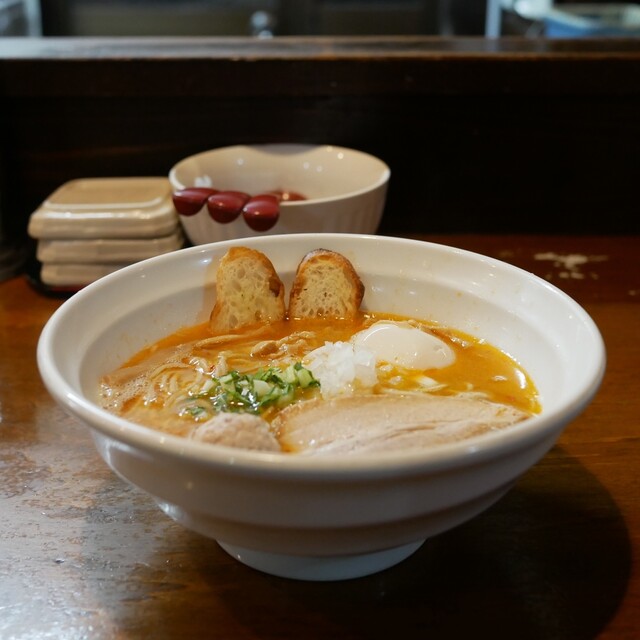
Kurihara is not the theatrical side of Tsukuba dining. The approach is suburban, low-rise and car-friendly, the kind of setting where a ramen shop is judged less by décor than by pace, turnover and the discipline of a short meal done well. Hurricane Ramen Honten belongs to that everyday Japanese category: a house restaurant with counter seating, table seats, children welcome, and the kind of price point that keeps ramen tied to routine rather than occasion.
That is the cultural point worth understanding. In Japan, ramen can carry obsessive craft without behaving like formal dining. The bowl is fast, the room is compact, the expectation is direct. Tsukuba’s version of that culture has a different rhythm from Tokyo’s station-district queues or late-night drinking corridors. This is a science-city suburb, spread around campuses, research parks and residential pockets, so the meal often functions as lunch, family dinner or solo reset rather than urban spectacle.
Tsukuba ramen without the Tokyo performance
Hurricane Ramen Honten is useful because it shows how serious ramen recognition can exist inside an accessible format. The restaurant has been selected for Tabelog Ramen EAST “Tabelog 100” every year from 2017 through 2025, a run that places it beyond passing online enthusiasm. Its Tabelog score is 3.75, and the category remains simply ramen, not a multi-course tasting format or chef-led counter ceremony.
That combination matters. Much of Japan’s high-interest ramen culture now splits between destination shops with limited servings and neighbourhood counters that earn trust through repetition. Here, the signal is not luxury language or elaborate service; it is consistency across years. The listed budget sits at JPY 999, with review-based spending commonly shown at JPY 1,000 to JPY 1,999, which keeps the experience in the democratic lane even while the recognition puts it in a selective bracket for eastern Japan.
Within Tsukuba, the comparison is less about fine-dining hierarchy than about how different casual formats define the city’s food map. Backerei Brotzeit points toward the city’s bakery-and-café habits, while heladiwa shows how international cooking folds into the same suburban dining pattern. Ramen occupies a sharper lane: shorter visits, tighter seating, and a stronger expectation that the shop’s core product does the talking.
A compact room built for turnover, not ceremony
The physical format says a great deal about the meal. There are 20 seats, divided between 8 counter seats and 12 table seats. That split is important: counter seating supports the solo ramen habit, while tables make the shop workable for friends and families. Private rooms and private use are unavailable, so the experience remains public, quick and casual rather than secluded.
Reservations are unavailable, which aligns with the ramen tradition more than it inconveniences it. The structure rewards timing and flexibility: lunch and dinner services run Tuesday through Sunday, Monday is closed, and service may end when bowls sell out. Payment is another practical marker of the category. Credit cards, electronic money and QR payments are not accepted, so cash is part of the planning rather than an afterthought.
Access also shapes the audience. The address sits at 2857-8 Kurihara, and parking is available, though the lot is described as unpaved, gravel and bumpy. Bus access from Tsukuba Station is possible, but this is a venue that fits the car-based geography of outer Tsukuba more naturally than a rail-hopping city itinerary. For visitors mapping a broader day, Our full Tsukuba restaurants guide is the better planning frame than treating one ramen stop as the entire itinerary.
How to place it in a wider Tsukuba day
The smarter reading is not that Tsukuba lacks range; it is that the city’s range is distributed. A ramen counter in Kurihara, a bakery stop, a casual international table and a campus-adjacent meal may sit several kilometers apart. That geography rewards deliberate routing. Pairing a ramen lunch with a quieter afternoon plan makes more sense than trying to stack several cross-city meals without transport.
For visitors staying locally, the dining decision connects naturally to lodging and after-hours planning. Our full Tsukuba hotels guide helps with base selection, while Our full Tsukuba bars guide, Our full Tsukuba wineries guide and Our full Tsukuba experiences guide place the meal in a wider local circuit. Nearby restaurant alternatives such as Bon Gout, david pain and DROOL DINER show the breadth of casual eating around the city rather than a single dominant dining strip.
For travellers comparing Japanese casual formats across regions, Hurricane Ramen Honten also sits in a wider national conversation about price, specialization and repeat local use. The contrast with -Grilled beef Sukiyaki- KAMAKURA TANUKIAN 鎌倉 たぬき庵 in Kamakura. 鮪と炭火焼き うお炭 秋葉原店 in Tokyo.cafe in Osaka.know in Kumamoto, (Shoku) Vietnam in Kawasaki and [Curry Senmon Ten] Maruyama Kyoju. in Sapporo is instructive: Japanese casual dining is not one style, but a set of local solutions to speed, value and specialization. Even outside Japan, compact single-focus formats such as Jōdo Saké Bar in Los Angeles and Onigiri Time in Pasadena show how specific Japanese dining rituals travel, though ramen in Tsukuba remains tied to its local commuting and family rhythms.
The editorial case for the restaurant is therefore precise: it is a recognized ramen shop operating in a low-friction, low-price, suburban format. Go for the culture of the category as much as the bowl itself: no reservations, cash in hand, a compact room, and a city where serious food often hides in ordinary geography rather than formal restaurant districts.
Price and Recognition
Side-by-side context: comparable cuisine and price.
| Venue | Cuisine | Price | Notes |
|---|---|---|---|
| Hurricane Ramen HontenThis venue — the venue you are viewing | Tsukuba, Ramen & Tsukemen | $ | Not listed |
| Numata Ya Honten | Not listed | $ | Numata, Traditional Japanese confectionery (wagashi) shop |
| Ramen Kinoko | Inaoka, Japanese Ramen | $ | Not listed |
| Sumibi Hamburger steak Nikuyaki Tei | Not listed | $$ | Tsukuba, Charcoal-grilled Japanese Hamburg & Beef Tendon Curry |
| Trattoria Pizzeria Amici | Not listed | $$ | Teshirogi, Authentic Neapolitan Pizzeria & Southern Italian Trattoria |
| Niboshi Chuka Soba Ichikawa | Amakubo, Niboshi-focused ramen | $ | Not listed |
Recognition history
Dated appearances from independent guides and award organizations, with the underlying list record or original source where available.
Tabelog 100 #19 · No. 19
Tabelog · Tabelog 100 - Ramen - EAST - 2025








At a Glance
- Lively
- Casual
- Solo
- Casual Hangout
- After Work
- Family
- Group Dining
- Standalone
Current opening hours
- Monday
- Closed
- Tuesday
- 11:30 AM–2:30 PM, 5:30–9 PM
- Wednesday
- 11:30 AM–2:30 PM, 5:30–9 PM
- Thursday
- 11:30 AM–2:30 PM, 5:30–9 PM
- Friday
- 11:30 AM–2:30 PM, 5:30–9 PM
- Saturday
- 11:30 AM–2:30 PM, 5:30–9 PM
- Sunday
- 11:30 AM–2:30 PM, 5:30–9 PM
Hours can change for holidays and private events. Last verified .
Typical busy local ramen-ya atmosphere with a compact, functional interior focused on quick, casual dining rather than decor, often crowded with ramen enthusiasts.