
Tabelog 100 #93
Our verdict
Hikiniku to Kome Kichijouji belongs to Tokyo’s precise, format-driven yoshoku culture, where hamburger steak is treated less as comfort-food nostalgia and more as a tightly controlled counter meal. Its recognition in Tabelog’s Yoshoku EAST 100 for 2025 puts it in a serious peer group, while the Kichijoji setting keeps the experience rooted in a neighbourhood rather than a hotel-dining circuit.

Pearl is the En Primeur Club membership app, where members save venues, book tables and use the concierge.
The menu
What to order
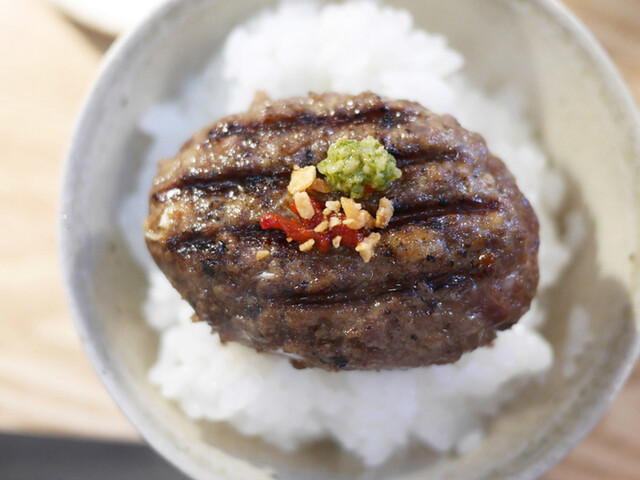
- Three 90g charcoal-grilled hamburg set with rice and miso soup
Approaching Hikiniku to Kome Kichijouji in Tokyo, the signal is not ceremony but focus: a compact restaurant proposition built around hamburger steak rather than choice for its own sake. Tokyo has long been good at turning everyday categories into disciplined dining systems, from quick meals to specialist restaurants. Here, the idiom is narrowed around a familiar dish and the expectations that come with it.
That matters because hamburger steak occupies a particular place in Japan’s everyday restaurant culture. It is familiar enough to be widely understood, but still exposed when stripped of distraction. The contemporary Tokyo version often rewards attention to timing, accompaniments, and pacing rather than excess. Hikiniku to Kome Kichijouji sits inside that shift, with Tabelog Hyakumeiten recognition in 2025 and a listed score of 3.67 confirming that this is not merely a local queue phenomenon.
A hamburger-steak restaurant built around focus, not breadth
The menu’s strength is its refusal to sprawl. In a city where even casual restaurants can bury the diner under set variations, this format turns limitation into pace. Hamburger steak is the axis; the meal is arranged around a clear central proposition rather than a large catalogue of options. The appeal is in how a familiar category is tightened into a repeatable dining experience.
That architecture places the restaurant close to Tokyo’s specialist dining traditions rather than to a broad, all-purpose reading of casual dining. A focused format compresses the meal into something direct and legible: arrive, order, eat, and move on with the sense that the restaurant knows exactly what it is trying to do. There is little room for the long, wandering meal. The pleasure is in the tight loop.
Tokyo is a useful setting for this kind of cooking. The city has deep demand for specialist formats that are casual in price language but strict in execution, from narrow lunch spots to small restaurants built around a single proposition. In that frame, Hikiniku to Kome Kichijouji reads as part of a broader Tokyo appetite for places that make discipline feel accessible rather than austere.
Why hamburger-steak recognition matters in Tokyo
Tabelog’s Hyakumeiten recognition is a useful lens because hamburger steak can be misunderstood by visitors as a soft category. In practice, Tokyo’s stronger examples can be as format-conscious as more formal genres, just with different signals. Recognition in 2025 places this address among restaurants judged within a specific dining context rather than in a generic casual-dining pool.
The comparison set shows how wide the local field can be. Chinese Sai Yunron, LITTLE SPICE, Sabo Musashino Bunko, Liberte Patisserie Boulangerie Tokyo honten・kichijoji, and Dans Dix ans point to a dining culture comfortable with narrow specialisms across hot meals, café formats, and baked goods. The point is not that these places are interchangeable; it is that Tokyo diners are used to focused propositions. Hamburger steak can therefore be treated with the same seriousness as curry, bread, or tea-room cooking.
For travellers, that distinction is useful. Tokyo’s luxury dining conversation is often dominated by formal reservations and high-end restaurant categories. Hamburger-steak specialists tell a different story: domestic comfort, efficient service, and high repetition. The meal does not need a chef biography to make sense. Its argument is structural: a compact format, a clear central dish, table practices, and a category with deep everyday recognition.
Where it fits in a Tokyo itinerary
This is a meal to place in a day built around Tokyo rather than as a detour between formal reservations. The restaurant’s format suits a diner who wants Tokyo specificity without the long-form tasting-menu commitment. It is also a useful corrective to the idea that serious Tokyo eating always means high spend. Some of the city’s sharpest food experiences are built on repetition and constraint.
There are trade-offs. Focused casual dining will not satisfy diners looking for broad choice or lingering service. The restaurant’s appeal is strongest for diners who understand that the discipline is the point: arrive ready for a concise meal and let the structure carry it.
For broader planning, compare this stop with other Tokyo dining rooms and other casual formats across Japan and beyond. Citywide context sits in broader Tokyo restaurant planning, with adjacent planning in Tokyo hotels, bars, wineries, and experiences guides. For a wider comparison of casual formats, look at unnamed quick meals, cafés, curry shops, bakeries, and specialist restaurants rather than treating Hikiniku to Kome Kichijouji as a one-off curiosity.
Frequently asked questions
When is Hikiniku to Kome Kichijouji open?
Check current opening hours directly with Hikiniku to Kome Kichijouji before visiting.
How much does it cost to eat at Hikiniku to Kome Kichijouji?
Pricing at Hikiniku to Kome Kichijouji is listed as JPY 1,000 - JPY 1,999 for dinner and JPY 1,000 - JPY 1,999 for lunch.
Where exactly is Hikiniku to Kome Kichijouji?
Tokyo.
What is Hikiniku to Kome Kichijouji known for?
Hikiniku to Kome Kichijouji is known for hamburger steak in Tokyo, with Tabelog Hyakumeiten recognition in 2025 and a listed score of 3.67.
Cuisine and Recognition
Comparable venues by cuisine and category.
| Venue | Cuisine | Price | Awards | Notes |
|---|---|---|---|---|
| Hikiniku to Kome KichijoujiThis venue (the venue you are viewing) | Charcoal-Grilled Japanese Hamburger Steak Set | $10–20 | Tabelog 100 #93 | Not listed |
| Tonkatsu Maruichi (とんかつ丸一) | Tonkatsu Specialist | $20–30 | Tabelog 100 #44 | Fukagawa |
| COFFEE HALL Kugutsusou | Traditional Japanese kissaten with coffee and curry | $10–20 | Tabelog 100 | Kichijoji |
| En Dashi Ochazuke Lumine Shinjuku | Dashi Ochazuke | $10–20 | Not listed | Shinjuku |
| Tsunahashi Shinjuku | Traditional Japanese Tempura | $20–30 | Not listed | Shinjuku |
| Kirimugi Ya Jinroku | Udon and Tempura | $10–20 | Tabelog 100 #68 | Shinjuku |
Recognition history
Dated appearances from independent guides and award organizations, with the underlying list record or original source where available.
Tabelog 100 #93 · No. 93
Tabelog · Tabelog 100 - Yoshoku - EAST - 2025
Continue exploring
More in Tokyo
Restaurants in Tokyo
All restaurants in Tokyo →


Bars in Tokyo
All bars in Tokyo →


Hotels in Tokyo
All hotels in Tokyo →



Wineries in Tokyo
Browse all →
Details
- Lively
- Cozy
- Trendy
- Solo
- Casual Hangout
- After Work
- Date Night
- Family
- Chefs Counter
- Open Kitchen
- Standalone
- Local Sourcing
- Set Menu
- Counter Dining
Current opening hours
- Monday
- 11 AM–3 PM, 5–9 PM
- Tuesday
- 11 AM–3 PM, 5–9 PM
- Wednesday
- Closed
- Thursday
- 11 AM–3 PM, 5–9 PM
- Friday
- 11 AM–3 PM, 5–9 PM
- Saturday
- 11 AM–3 PM, 5–9 PM
- Sunday
- 11 AM–3 PM, 5–9 PM
Hours can change for holidays and private events. Hours as of .
Compact counter-only shop with an open charcoal grill, creating a warm, slightly smoky and energetic atmosphere centered on watching patties being cooked to order.