Hadongkwan


Hadongkwan has served gomtang from its Myeongdong address since the mid-twentieth century, earning consecutive Michelin Plate recognition in 2024 and 2025. The menu is singular: slow-simmered beef bone broth, white and quiet, arriving at the table with rice and kimchi. For Seoul's working-lunch crowd and curious visitors alike, it represents the city's most direct argument that restraint is its own form of ambition.
Pearl is the En Primeur Club membership app — saves, bookings, and concierge access live there. Same editors, same standards.
- Address
- 12 Myeongdong 9-gil, Jung District, Seoul, South Korea
- Phone
- +82 2-776-5656
- Website
- hadongkwan.com
- Directions
- Get directions
 Saves & bookings on Pearl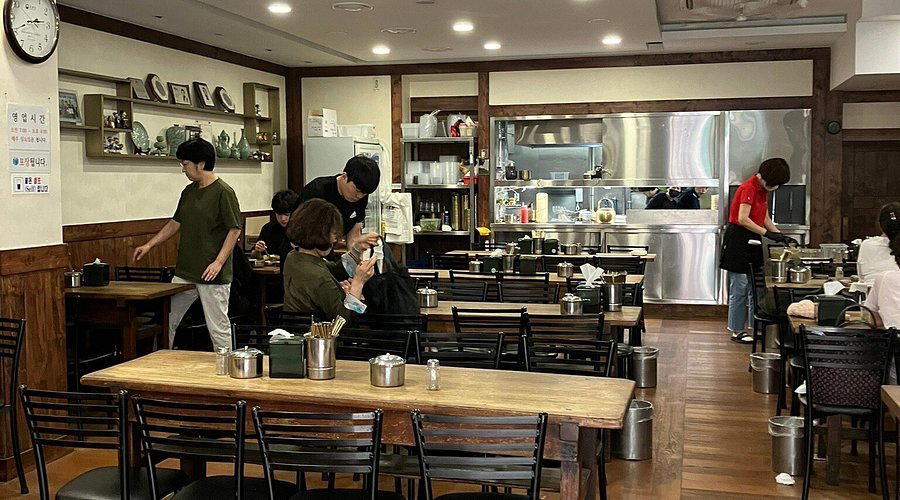
A Bowl That Has Outlasted Trends
Walk down Myeongdong 9-gil on a weekday morning and the queue outside Hadongkwan tells you something before you reach the door. Seoul's dining culture has accelerated dramatically over the past two decades, with tasting menus, fermentation-forward concepts, and Korean-European hybrids competing for international attention. Yet the line here is not for a new opening. It is for gomtang: a broth of beef bone and brisket, simmered for hours until it turns milky and dense, served in a wide bowl with a tangle of noodles or a scoop of rice. The setting is functional, the lighting flat, the menu essentially unchanged across generations. This is precisely the point.
In a city where restaurant formats evolve quickly, the venues that refuse to pivot carry a different kind of authority. Gomtang houses occupy a specific place in Seoul's food culture: they are canteen-scale operations built around a single, technically demanding preparation, and they earn loyalty through consistency rather than novelty. Hadongkwan, at its Jung District address, has been part of that tradition long enough that repeat customers number in the decades.
The Gomtang Tradition and Where This House Sits Within It
Gomtang is not a simple soup. The preparation requires sustained, low-heat extraction from beef bones, offal cuts, and brisket, producing a collagen-rich broth that reads as creamy without any dairy involvement. The colour is white to pale ivory, the flavour deeply bovine and clean at once. Seasoning, salt, typically, added by the diner, is intentionally minimal at the kitchen stage, placing the quality of the base stock at the centre of the experience. There is nowhere to hide in a bowl this stripped back.
Seoul's gomtang circuit has diversified in recent years. Newer operations like Gomtang Lab and Hapjeongok approach the format with a more contemporary lens, adjusting ratios, sourcing premium cuts, and presenting in a context that signals deliberate modernisation. Kyewol Gomtang similarly positions within this more considered tier. Hadongkwan does not participate in that conversation. The kitchen has not rebranded or reformatted; it has continued doing what it has always done, and the Michelin recognition sits alongside traditional houses rather than against their modernised counterparts. The comparison is not pejorative. It is simply a different argument: that lineage, repeated daily, is itself a form of excellence.
For context, Seoul's acclaimed tasting-menu circuit, Gaon, Kwon Sook Soo, and contemporary Korean-European hybrid programmes operate at higher price points. Hadongkwan sits at the opposite end of that range, priced at ₩, making it accessible across income brackets in a way that starred restaurants are not. Hadongkwan is recognised for quality cooking rather than fine-dining theatrics, which places it among precisely executed single-format kitchens.
Evolution by Staying Still
The editorial angle of evolution is an interesting one to apply to Hadongkwan, because its evolution is largely the story of what it did not change. Many Korean heritage restaurants underwent significant repositioning during the 2010s, as the international spotlight on Seoul's food culture created commercial pressure to modernise presentation, expand menus, or relocate to higher-footfall neighbourhoods. The Myeongdong location has itself changed dramatically around the house: the surrounding streets are now dominated by cosmetics retail, fast-fashion flagships, and international chain restaurants. Hadongkwan did not move and did not diversify. Its survival in that context, and its continued recognition by Michelin across multiple consecutive years, is a kind of editorial statement about what endures in Seoul's food culture when you strip away the noise.
The setting is unadorned, the service transactional by design, and the menu offers few options. For diners accustomed to Seoul's more polished dining experiences, this can read as spartan. For diners who understand what they are ordering, it reads as focus.
The Context of Korean Broth Culture in Seoul
Gomtang's continued presence in Seoul's culinary conversation is notable at a moment when Korean food is receiving more sustained international scrutiny than at any previous point. Restaurants like Mingles have demonstrated that Korean culinary identity can operate at a high-modernist register, while operations like Atomix in New York City have translated that identity for international fine-dining audiences. Yet the broth-focused traditions that predate those developments remain the foundation on which the broader narrative rests. Traditional houses comparable to Hadongkwan exist throughout South Korea: Hanwolgwan in Busan operates within a similar register, and temple food traditions at places like Baegyangsa Temple in Jangseong-gun point to a broader Korean culinary culture grounded in patience and subtraction rather than accumulation. Even internationally, the discipline of doing one thing with depth finds parallels in kitchens as different as Le Bernardin in New York City, where a similarly narrow focus on seafood has sustained decades of critical recognition.
Within Seoul, the seasonal dimension of gomtang is worth noting. The dish is eaten year-round, but consumption concentrates in the colder months, when the caloric weight and warming properties of the broth align with both physical need and cultural habit. Autumn and winter visits to Hadongkwan, when the queue extends into the cold and the interior becomes correspondingly warmer in contrast, reflect the dish at its most contextually appropriate. That said, the kitchen operates at consistent output regardless of season, which is part of what the Michelin recognition is effectively measuring.
Planning Your Visit
Hadongkwan sits at 12 Myeongdong 9-gil in Jung District, within walking distance of Myeongdong Station on Seoul Metro Line 4. The price point, at ₩ per person, places it among the more accessible Michelin-recognised venues in the city. Queuing is part of the format, particularly during lunch service on weekdays and across weekends, so factoring additional time before being seated is advisable. Reservations are recommended. Given the limited menu, decisions about what to order can be made in the queue.
Comparable Venues
Comparable venues nearby, for context on price, style, and recognition.
| Venue | Cuisine | Price | Notes |
|---|---|---|---|
| HadongkwanThis venue — the venue you are viewing | Traditional Korean Gomtang | $$ | Not listed |
| Bongmilga | Pyeongyang-Style Cold Buckwheat Noodles | $$ | 압구정동 |
| Sool052 | Modern Korean Gastropub | $$ | Doseon-dong |
| Tosokchon Samgyetang | Traditional Korean Samgyetang | $$ | 효자동 |
| Manjok Ohyang Jokbal | Traditional Korean Jokbal (Braised Pig's Trotters) | $$ | Sajik-dong |
| Baek Nyun Ok | Traditional Korean Tofu Specialist | $$ | 서초동 |
Recognition history
Dated appearances from independent guides and award organizations, with the underlying list record or original source where available.
Michelin Plate
Michelin
Opinionated About Dining Top Restaurants in Asia Recommended
Opinionated About Dining
Michelin Plate
Michelin
Michelin Plate
Michelin
Continue exploring
More in Seoul
Restaurants in Seoul
Browse all →
At a Glance
- Classic
- Well Known
- Cozy
- Casual Hangout
- Historic Building
Current opening hours
- Monday
- 7 AM–4 PM
- Tuesday
- 7 AM–4 PM
- Wednesday
- 7 AM–4 PM
- Thursday
- 7 AM–4 PM
- Friday
- 7 AM–4 PM
- Saturday
- 7 AM–4 PM
- Sunday
- Closed
Hours can change for holidays and private events. Last verified .
Rustic, nostalgic atmosphere with original wooden furniture and no-frills traditional Korean dining.