Gum Kuo Restaurant
Gum Kuo Restaurant operates out of Oakland's Chinatown corridor on 9th Street, a stretch that has anchored the Bay Area's Chinese dining community for generations. The address places it inside the dense, working-market grid where institutional Cantonese and regional Chinese kitchens have long set the pace for the surrounding neighborhood.
Pearl is the En Primeur Club membership app — saves, bookings, and concierge access live there. Same editors, same standards.
- Address
- 388 9th St STE 182, Oakland, CA 94607
- Phone
- (510) 268-1288
- Directions
- Get directions
 Saves & bookings on Pearl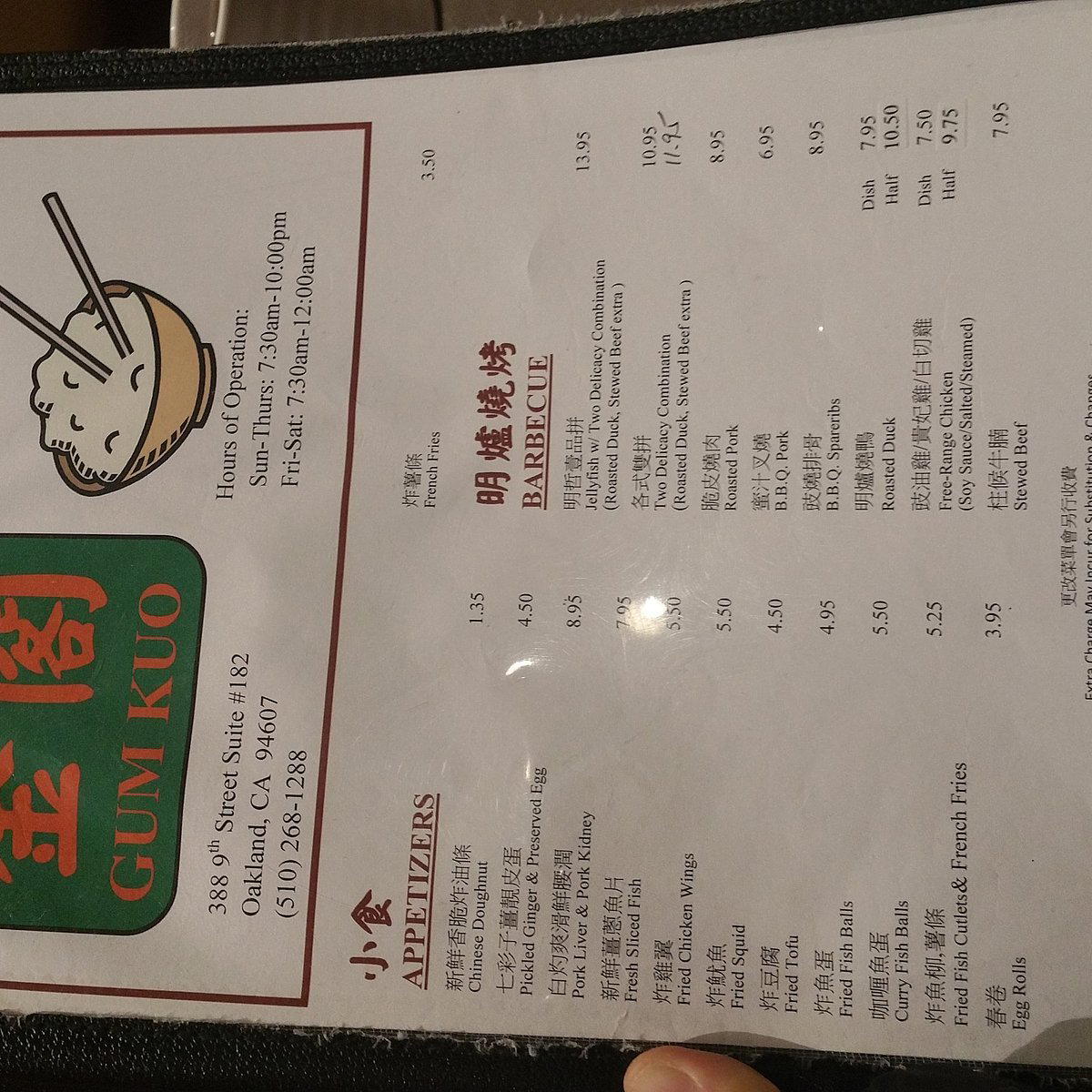
Oakland's Chinatown Table: What 9th Street Tells You About the Room
Gum Kuo Restaurant is a casual Cantonese Deli in Oakland Chinatown at 388 9th St STE 182, Oakland, CA 94607. The 9th Street corridor, where Gum Kuo Restaurant sits at number 388, operates on a different register entirely: suppliers, families, regulars, and the kind of lunch crowd that has been eating at the same table since the 1980s. Walking through that stretch on a weekday morning, the atmosphere is set by the produce vendors outside, the Cantonese spoken between staff and guests, and the particular rhythm of a dining room that moves quickly. The food here is for people who already know what they want.
That context matters when you try to place Gum Kuo within Oakland's broader dining picture. The Bay Area Chinese restaurant scene has split sharply in recent years. One track runs toward the tasting-menu adjacents and upscale regional formats that have proliferated in San Francisco and the South Bay. The other stays close to the Chinatown institutional model: volume, efficiency, and the kind of Cantonese cooking built around shared plates, rice, and soup that arrives fast and costs accordingly. Gum Kuo belongs to the second category, and that positioning is its clearest identity signal.
The Sensory Register of a Cantonese Dining Room
Cantonese dining rooms in the Oakland Chinatown mold carry a specific sensory vocabulary. Round tables with lazy Susans, the steam rising from clay pots near the kitchen pass, the sound of chopsticks against ceramic and conversation moving at table volume rather than whisper-level. These are not incidental details. They are the format itself. Dim sum halls and roast-meat-forward Cantonese houses built the social architecture of Chinese dining in California, and that architecture persists precisely because it is functional: shared dishes, rotating service, and portions calibrated for groups rather than individuals.
The 9th Street location places Gum Kuo squarely inside the original Chinatown grid, a neighborhood that predates most of what passes for Oakland dining culture today. For comparison, consider that Chinese immigrants established commercial kitchens in this part of Oakland in the late nineteenth century, making the neighborhood's culinary lineage longer than almost any other dining tradition in the city. What you encounter in a room like Gum Kuo's is not nostalgia, it is continuity.
Nearby, the same block and its immediate surroundings hold a cluster of restaurants that define the neighborhood's tone. 8th St Cafe 文記茶餐廳 represents the Hong Kong-style cha chaan teng format, milk tea, baked goods, and toast sets, operating just one block over. That format and the Cantonese restaurant tradition share a cultural base but serve different day-parts and appetites. Understanding both helps map the full range of what this corner of Oakland offers.
Oakland Chinatown in the Bay Area Dining Context
The Bay Area's premium dining conversation tends to orbit San Francisco and, further north, addresses like Single Thread Farm in Healdsburg or The French Laundry in Napa. Oakland's Chinatown operates at a structural remove from those conversations, and intentionally so. The dining rooms here are not competing with tasting-menu formats at places like Lazy Bear in San Francisco or the formal precision of Le Bernardin in New York City. They are competing with each other, on the basis of technique, freshness, and the loyalty of a community that eats Chinese food multiple times a week and notices the difference between a properly rendered clay pot and a short-cut version.
That is a different kind of pressure than the one applied by critics at Alinea in Chicago or Atomix in New York City. It is, in many ways, a more demanding one, built not on occasion dining but on daily use. Restaurants that survive for decades in Chinatown do so because they hold a standard with a community that eats critically, not ceremonially.
The Oakland dining scene more broadly has diversified significantly in the past decade. Spots like Agave Uptown and alaMar Dominican Kitchen represent the city's wider culinary breadth, while places like 3 Bottled Fish and Alem's Coffee speak to the neighborhood-specific character that defines Oakland dining at street level. Chinatown remains its own distinct zone within that picture, more self-contained, more community-driven, and less oriented toward the visitor appetite that shapes restaurant development elsewhere in the city. For a fuller view of where Oakland's dining stands, the EP Club Oakland restaurants guide maps the city's range across neighborhoods and formats.
Placing Gum Kuo in the Cantonese comparable set
Within the 9th Street corridor, the competition is other Cantonese houses and a small number of regional Chinese operators. This comparable set is defined less by formal awards, 8 1/2 Otto e Mezzo Bombana in Hong Kong, and more by the metrics that matter to the neighborhood: consistency, value, speed, and the specific quality of dishes that a regular can benchmark across a dozen visits. Formats like dim sum and roast meat require precise daily execution. A Peking duck that arrives correctly lacquered and portioned, a congee with the right texture and depth, steamed fish timed to the minute: these are the measures the neighborhood applies.
For visitors coming from outside Oakland's Chinatown, the adjustment is largely one of expectation-setting. The experience here is not configured for the solo diner working through a tasting arc. It is configured for groups, for shared ordering, and for the kind of meal where the table arrives hungry and leaves full, having spent time together rather than attending a performance. That is a legitimate and underrepresented category in the Bay Area's dining coverage, and one that addresses like Providence in Los Angeles, Addison in San Diego, Emeril's in New Orleans, Blue Hill at Stone Barns in Tarrytown, or The Inn at Little Washington are simply not built to serve.
Know Before You Go
Address: 388 9th St, Suite 182, Oakland, CA 94607
Neighborhood: Oakland Chinatown, on the 9th Street commercial corridor
Format: Cantonese dining room; suited to group dining and shared-plate ordering
Booking: Walk-in is standard for this format and neighborhood; peak lunch service can be busy on weekends
Getting There: The 9th Street address is in Oakland Chinatown on the 9th Street corridor.
Timing: Open hours are Monday, Tuesday, Thursday through Sunday from 8 AM to 7 PM, with Wednesday closed.
Cuisine and Credentials
Comparable venues nearby, for context on price, style, and recognition.
| Venue | Cuisine | Price | Notes |
|---|---|---|---|
| Gum Kuo RestaurantThis venue — the venue you are viewing | Cantonese Deli | $ | Not listed |
| Sun Sing Pastry | Chinese Dim Sum Bakery | $ | Chinatown |
| Huangcheng Noodle House | Shanxi Knife-Shaved Noodles | $$ | Old Oakland |
| Yung Kee Restaurant | Cantonese Chinese | $ | Chinatown |
| Best Taste Restaurant | Authentic Cantonese Dim Sum | $ | Chinatown |
| Big Dish Restaurant | Chinese Dim Sum and Rice Plates | $$ | Chinatown |
Continue exploring
More in Oakland
Restaurants in Oakland
Browse all →
Bars in Oakland
Browse all →
Hotels in Oakland
Browse all →




At a Glance
- Cozy
- Casual Hangout
- Standalone
Current opening hours
- Monday
- 8 AM–7 PM
- Tuesday
- 8 AM–7 PM
- Wednesday
- Closed
- Thursday
- 8 AM–7 PM
- Friday
- 8 AM–7 PM
- Saturday
- 8 AM–7 PM
- Sunday
- 8 AM–7 PM
Hours can change for holidays and private events. Last verified .