Our verdict
On Yaowarat Road in the heart of Bangkok's Chinatown, Guay Jub Ouan Pochana represents a category of street-rooted Thai-Chinese dining that the city's fine-dining boom has not displaced.

Pearl is the En Primeur Club membership app — saves, bookings, and concierge access live there. Same editors, same standards.
- Address
- 408 Yaowarat Rd, Chakkrawat, Chakkaphat, Bangkok 10100, Thailand
- Phone
- +66617824223
- Hours
- Mon ClosedTue–Sun 10:30 AM–12 AM
- Website
- wongnai.com
- Directions
- Get directions
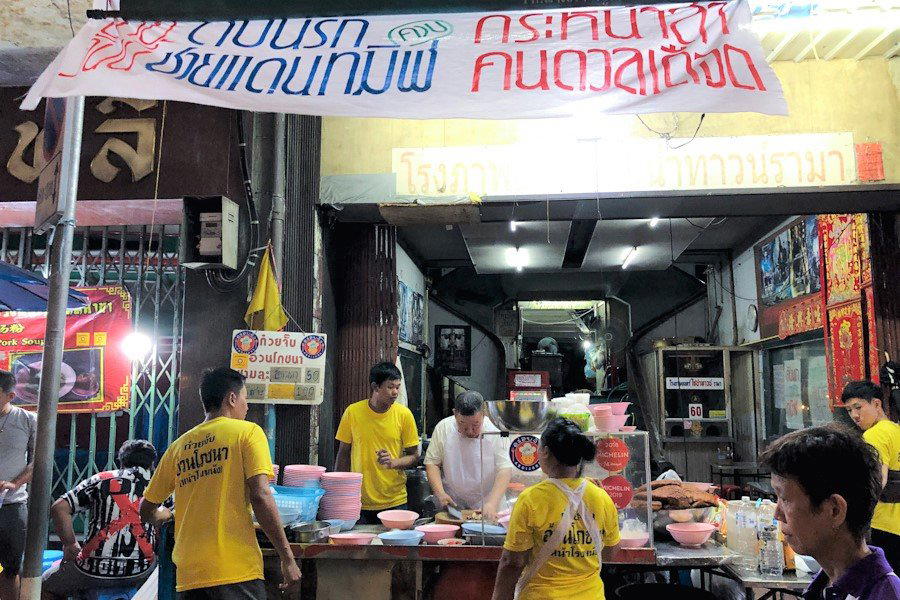
Yaowarat After Dark: What Chinatown Smells Like at Full Volume
Yaowarat Road at night operates on its own logic. The pavement narrows under hanging lanterns, exhaust mixes with char from wok burners, and the sound of Mandarin, Thai, and Teochew overlaps in a way that no amount of urban planning has managed to resolve or suppress. At 408 Yaowarat Rd, inside the Chakkrawat district, Guay Jub Ouan Pochana sits within this sensory density rather than apart from it. You find it by following the smell of white pepper and braised offal before you find it by signage.
This is Chinatown dining in its least curated form, which is precisely what makes it worth understanding. Bangkok's restaurant conversation in recent years has tilted heavily toward tasting-menu formats: Sorn (Southern Thai) and Baan Tepa (Thai contemporary) operate at the ฿฿฿฿ tier alongside internationally trained kitchens like Gaa (Modern Indian) and Sühring (German). Guay Jub Ouan Pochana belongs to a different register entirely, one measured not in courses or sommelier consultations but in decades of neighbourhood constancy and a bowl that locals return to on weekday mornings and late weekend nights alike.
The Dish That Defines the Address
Guay jub is not noodle soup in the generalised sense. The rolled rice noodles unravel slowly in a dark, pepper-forward broth, typically built from pork bones and seasoned with generous quantities of white pepper, coriander root, and garlic. The composition is Teochew Chinese in origin, a culinary lineage that runs through Bangkok's Chinatown community and accounts for much of the neighbourhood's most enduring street food. The broth's opacity comes from long simmering rather than added starch, and the dish is conventionally served with pork belly, offal cuts, and a soft-boiled egg, the richness of which the pepper cuts through rather than complements.
Within Bangkok's Chinese-Thai dining tradition, guay jub occupies a specific niche: it is a morning and late-night food, the kind eaten before the city fully wakes or after it has mostly gone to sleep. The concentration of guay jub specialists along Yaowarat is partly historical, a function of where Teochew immigrants settled in the nineteenth century, and partly commercial, as the dish travels poorly and is leading eaten within minutes of service. Ouan Pochana's address on Yaowarat places it at the geographic centre of that tradition.
Reading the Room: Atmosphere as Editorial Evidence
The atmosphere at a place like Guay Jub Ouan Pochana is not incidental to the experience; it is structural. Plastic stools, formica tables, and strip lighting are not compromises here but signals of a kitchen that directs all resources toward the product rather than the presentation. This is a pattern repeated across Bangkok's most durable street-food institutions, from the shophouse noodle counters of Bang Rak to the seafood operations along the river at Thonburi.
The noise level on Yaowarat Road itself functions as a kind of ambient seasoning. Traffic, vendors, and the steady percussion of woks form a backdrop that is inseparable from what the food tastes like in context. Removing Guay Jub Ouan Pochana from this environment and placing it inside a hotel dining room would not improve it; the setting is load-bearing. Compare this with Côte by Mauro Colagreco, which imports a Mediterranean register into a controlled hotel environment. Both are legitimate Bangkok dining experiences; they simply operate in entirely different registers of intention and context.
Bangkok's Chinatown corridor also connects outward to the city's broader hawker geography. Diners who spend time on Yaowarat often cross-reference it against other neighbourhood specialists, whether the Thai-Chinese seafood counters of Sampheng or the offal-forward stalls near Pak Khlong Talat. For coverage of how this tradition extends beyond Bangkok, the AKKEE in Pak Kret and regional institutions like Cherng Doi Roast Chicken in Chiang Mai show how local specificity anchors Thai food outside the capital as well.
Where It Sits in the Bangkok Dining Map
Bangkok's dining geography has stratified considerably over the past decade. The fine-dining tier, anchored by Michelin-starred addresses and internationally recognised chefs, now competes with the city's traditional street-food culture for the attention of travelling food writers. Both tiers are legitimate, and both are worth the reader's time. But they should not be evaluated against the same criteria.
Guay Jub Ouan Pochana is not competing with the tasting-menu formats at the top of the price bracket. This is a meaningful distinction. A bowl of guay jub on Yaowarat is not a cheaper substitute for dinner at a Michelin-starred Thai kitchen; it is a different form of culinary knowledge made edible.
For readers building a Bangkok itinerary that covers the full range, our full Bangkok restaurants guide maps both tiers, alongside neighbourhood context for Chinatown, Silom, and the riverside districts. Street food in Bangkok rewards sequential eating more than any other format: smaller portions, lower price points, and the density of options on a single street make it possible to move through three or four dishes in an hour. Yaowarat is the most concentrated example of this in the city.
Across Thailand more broadly, the same logic applies in different regional forms. PRU in Phuket and Loet Rot in Mueang Chiang Mai represent how regional Thai cooking is being formalised and repositioned, while addresses like Hoy Tord Chao Lay stay closer to the street-food register that produced them.
Planning a Visit: Practical Notes
Guay Jub Ouan Pochana is located at 408 Yaowarat Rd in the Chakkrawat subdistrict of Bangkok. The MRT Wat Mangkon station, which opened as part of the Blue Line extension, places Yaowarat Road within a short walk and has made the neighbourhood considerably more accessible from central Bangkok than it was a decade ago when the taxi approach through Chinatown's narrow sois was the primary option. Visiting during late evening, when Yaowarat transforms into a pedestrian-friendly night market corridor, gives the experience its fullest context, though the address draws consistent traffic at most hours. No booking infrastructure is indicated for a venue of this format; arrival timing and queue patience are the relevant variables. For readers also considering Bangkok's more formal dining tier, addresses like Hinata or Krua Laew Tae R-Rom in Pattaya offer a sense of how the broader Thai dining spectrum is mapped across the region.
Frequently asked questions
What should I order at Guay Jub Ouan Pochana?
How far ahead should I plan for Guay Jub Ouan Pochana?
What do critics highlight about Guay Jub Ouan Pochana?
Can Guay Jub Ouan Pochana handle vegetarian requests?
Is Guay Jub Ouan Pochana worth the price?
What makes Guay Jub Ouan Pochana different from other guay jub stalls on Yaowarat?
A Minimal comparable set
Comparable venues nearby, for context on price, style, and recognition.
| Venue | Cuisine | Price | Notes |
|---|---|---|---|
| Guay Jub Ouan PochanaThis venue — the venue you are viewing | Thai Guay Jub (Rolled Noodle Soup) | $1–10 | Not listed |
| Nai Mong Hoi Thod | Thai Crispy Oyster Omelette | $1–10 | Samphanthawong Khwaeng, Thai Crispy Oyster Omelette |
| Krua Pa & Ma Restaurant | Authentic Thai | $10–20 | Bom Phrap Satru Pai Khwaeng, Authentic Thai |
| Rung Rueng Noodles | Thai Tom Yum Pork Noodles | $1–10 | Klong Toei Khwaeng, Thai Tom Yum Pork Noodles |
| Thapthim Krop Wat Sutthi | Thai Dessert Shop | Not listed | Sathon, Thai Dessert Shop |
| Seng Potchana | Thai-Chinese Seafood | $20–30 | Sukhumvit (between Thong Lo and Phrom Phong), Thai-Chinese Seafood |

Details
- Lively
- Casual Hangout
- Late Night
- Standalone
- Street Scene
- A La Carte
Current opening hours
- Monday
- Closed
- Tuesday
- 10:30 AM–12 AM
- Wednesday
- 10:30 AM–12 AM
- Thursday
- 10:30 AM–12 AM
- Friday
- 10:30 AM–12 AM
- Saturday
- 10:30 AM–12 AM
- Sunday
- 10:30 AM–12 AM
Hours can change for holidays and private events. Last verified .
Bustling street cart atmosphere with a lively Chinatown night market vibe.