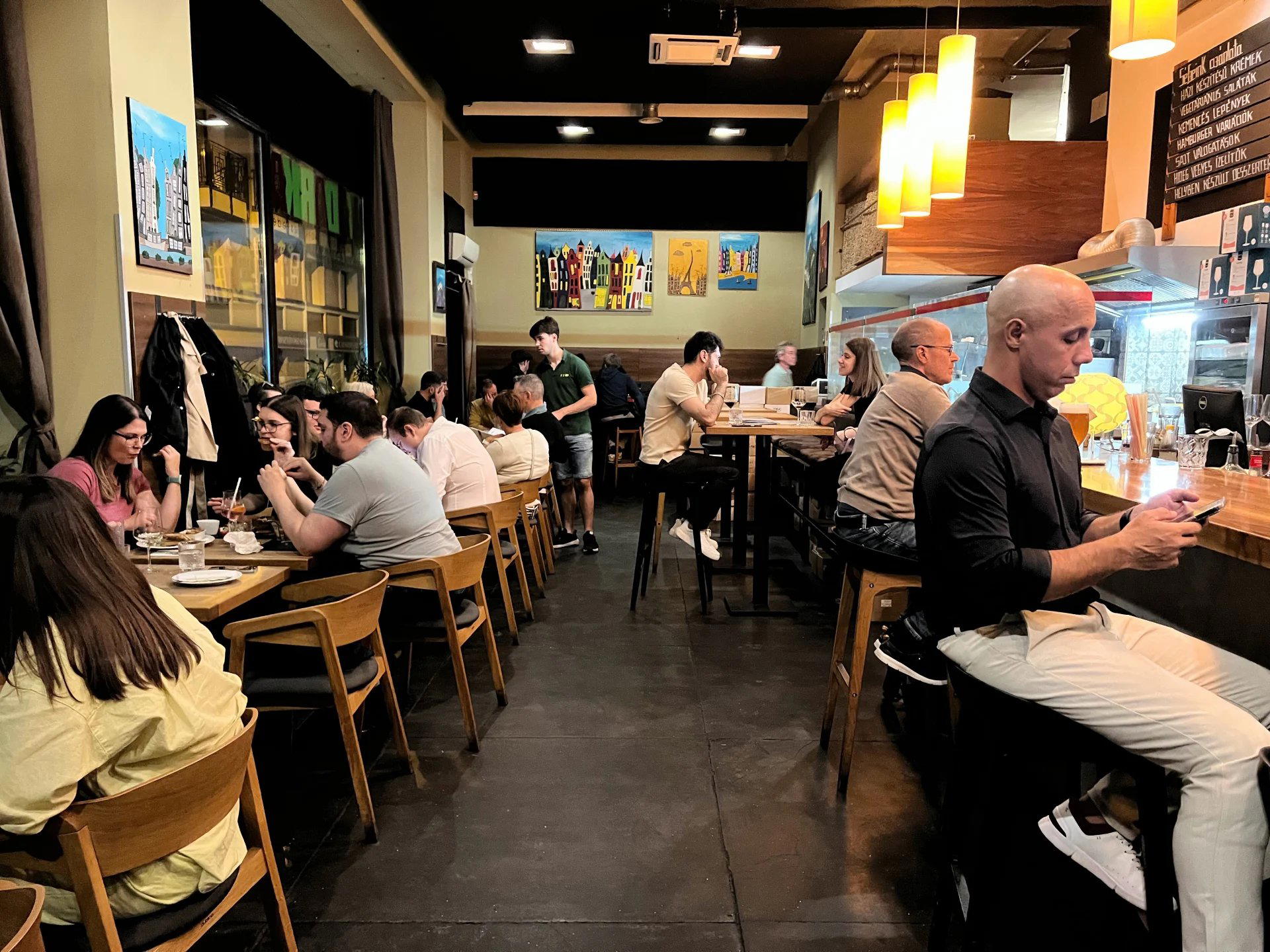
Fat Mama occupies a ground-floor address on Kazinczy utca, the spine of Budapest's Jewish Quarter bar and restaurant district. The kitchen positions itself in the casual-to-mid tier that sits below the city's Michelin-tracked fine dining circuit, drawing a neighbourhood crowd alongside visitors working through the ruin-bar strip. Booking ahead is advisable, particularly on weekend evenings when the street fills early.
Pearl is the En Primeur Club membership app — saves, bookings, and concierge access live there. Same editors, same standards.
- Address
- Budapest, Kazinczy u. 24, 1075 Hungary
- Phone
- +36202351897
- Website
- fatmama.hu
- Directions
- Get directions
 Saves & bookings on Pearl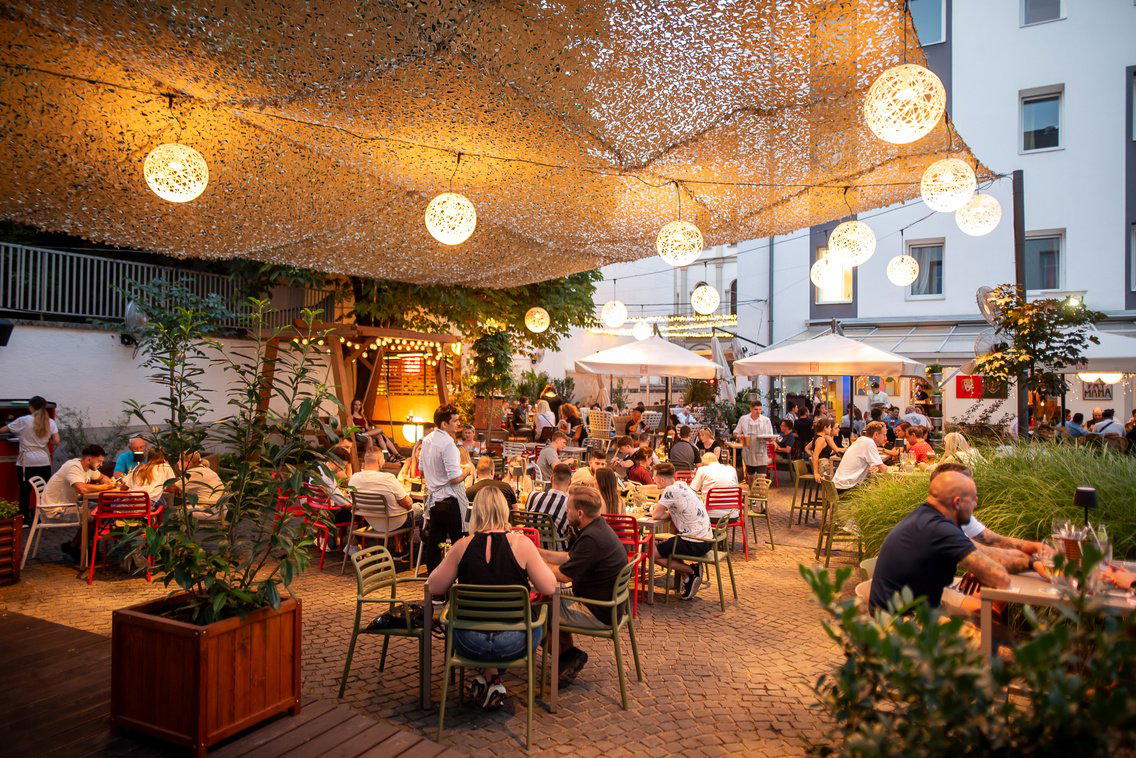
Kazinczy utca and the Restaurants That Grew Around It
Budapest's VII. district transformed over roughly fifteen years from a neglected residential quarter into one of Central Europe's more concentrated eating and drinking corridors. Kazinczy utca sits at the centre of that shift. The street is now dense with options from counter-service langos stands to wine-forward kitchens alongside the ruin bars. Fat Mama, at number 24, is part of this mid-tier layer: the restaurants that feed the neighbourhood's nightly foot traffic rather than court the destination-dining crowd that books months ahead for tables at Stand, Babel, or Costes.
That positioning matters. The fine dining tier in Budapest, anchored by places like Borkonyha Winekitchen and essência, operates with tasting menus, advance reservations, and pricing that aligns with western European peers. The district's casual layer, where Fat Mama sits, runs on a different logic: shorter menus, faster turns, and an audience that includes both locals eating on a Tuesday and tourists who have just finished a ruin-bar circuit and want something solid. Understanding which tier a restaurant occupies is the first thing a reader should clarify before booking in this part of the city.
What the Address Tells You Before You Walk In
Approaching Fat Mama along Kazinczy utca on a weekend evening, the context is immediately legible. The street is narrow enough that tables spill toward the pavement and competing music from adjacent bars bleeds into one another. The VII. district's dining character is defined less by quiet contemplation and more by the kind of convivial noise that comes from a street where nearly every ground-floor space is in the hospitality business. This is not the setting for a long, technically focused tasting menu; the neighbourhood conditions a more sociable, higher-tempo format. Restaurants that have tried to transplant fine-dining stillness onto Kazinczy have generally struggled against the ambient energy. The restaurant appears to work with the street rather than against it.
Menu Architecture and What It Signals
What can be read from a restaurant's structural choices, portion format, menu length, the ratio of shareable plates to individual mains, often reveals more about its operational logic than any individual dish does. In Budapest's mid-tier casual segment, particularly commercially durable formats tend toward either a focused traditional Hungarian menu with modern presentation, or a broader, less category-defined list that accommodates a mixed international crowd. Both approaches are present on Kazinczy utca, and both attract different types of return visitors.
Restaurants that succeed in the Jewish Quarter's foot-traffic corridor tend to offer menus short enough to execute consistently at volume, with enough variance in portion size to accommodate both solo diners at the bar and groups splitting dishes across the table. That architectural logic, where the menu's structure serves the room's sociology as much as the kitchen's ambitions, is the design problem that all mid-tier restaurants on high-footfall streets are solving, whether in Budapest, Warsaw, or Lisbon. For the reader planning a visit to the restaurant, the practical implication is that this is a place suited to a relaxed, group-friendly evening rather than a focused one-to-one tasting experience. For the latter, the city's formal dining tier, venues like Stand or Babel, is the appropriate choice.
Hungary's broader restaurant culture has also been renegotiating what a mid-tier meal can mean. Outside the capital, restaurants like Platán Gourmet in Tata, Pajta in Őriszentpéter, and Hosszú Tányér in Hosszúhetény have demonstrated that thoughtful, regionally grounded cooking does not require a Budapest address or a Michelin page. Within the capital, the mid-tier has become more competitive precisely because that national conversation is raising expectations. Places like Teyföl in Szentendre and Kővirág in Köveskál are part of the same wider shift. The restaurant sits inside that evolving context, though without published menu data it is not possible to specify where it places itself on the spectrum from tradition-forward to contemporary.
Planning a Visit
The restaurant is on Kazinczy utca 24 in the VII. district, within walking distance of Deák Ferenc tér and the main metro interchange. The street is most active from Thursday through Sunday; those planning a quieter experience should consider mid-week. Reservations are recommended, and the restaurant is open daily from 9 AM to 12 AM. The VII. district's dining density means that alternatives are always within a short walk, but the street's popularity also means that the better-known addresses fill by early evening on weekends.
For context on what the capital's most ambitious tables currently offer, the formal tier, Stand, Babel, Costes, operates at a significantly different price point and requires advance planning. Hungary's wine-country dining, represented by places like Sauska 48 in Villány, Petrányi Csopak in Csopak, and Öreg Prés in Mór, offers a different itinerary logic entirely for those building a multi-day trip around the country's dining geography. For international comparison on how casual-to-mid-tier restaurants structure menus for high-footfall urban streets, the contrast between Lazy Bear in San Francisco, a chef-driven communal format, and a neighbourhood street-corner address like Fat Mama illustrates how widely the category spans. Le Bernardin in New York City anchors the opposite end of that spectrum. The gap between those poles is where most restaurants actually operate, and Kazinczy utca is a strong place in Central Europe to find them.
Fish-focused regional cooking can also be found at Old Kőrössy Fish Restaurant in Szegedin for those interested in Hungarian culinary traditions beyond the capital, while Botanica in Dánszentmiklós represents the garden-to-table format that has gained traction in the countryside around Budapest over the past several years.
Cuisine Lens
Comparable venues nearby, for context on price, style, and recognition.
| Venue | Cuisine | Price | Notes |
|---|---|---|---|
| Fat MamaThis venue — the venue you are viewing | Hungarian BBQ Gastropub | $$ | Not listed |
| Macesz Bistro | Jewish-Hungarian Fusion Bistro | $$ | Belvaros |
| Remiz | Traditional Hungarian Gourmet | $$ | Huvosvolgy |
| Gettó Gulyás | Authentic Hungarian Stews | $$ | Belvaros |
| Franziska Pest | Healthy Brunch Cafe | $$ | Belvaros |
| DiVino Wine Bar | Hungarian Wine Bar with Tapas | $$ | Belvaros |
Continue exploring
More in Budapest
Restaurants in Budapest
Browse all →
Bars in Budapest
Browse all →
Hotels in Budapest
Browse all →

At a Glance
- Lively
- Cozy
- Group Dining
- Casual Hangout
- Brunch
- Open Kitchen
Current opening hours
- Monday
- 9 AM–12 AM
- Tuesday
- 9 AM–12 AM
- Wednesday
- 9 AM–12 AM
- Thursday
- 9 AM–12 AM
- Friday
- 9 AM–12 AM
- Saturday
- 9 AM–12 AM
- Sunday
- 9 AM–12 AM
Hours can change for holidays and private events. Last verified .
Lively and bustling atmosphere with a cool, easy-going vibe enhanced by the special charcoal oven ambiance.