Our verdict
On Wesselényi utca in Budapest's seventh district, Gettó Gulyás sits at the intersection of the Jewish Quarter's neighbourhood-kitchen tradition and the city's appetite for honest Hungarian cooking. The name signals the address as much as the concept: gulyás rooted in place, served without ceremony. For visitors mapping the city's dining spectrum from fine-dining counters to market-hall tables, this is the neighbourhood end of that range.

Pearl is the En Primeur Club membership app, where members save venues, book tables and use the concierge.

The Seventh District and Its Appetite for the Honest Plate
Budapest's seventh district has been pulling visitors for two decades now, first for its ruin bars, then for the hospitality layer that grew around them. Wesselényi utca sits at the quieter, more residential edge of that zone, away from the loudest stretches of Kazinczy and Király. The street has a particular rhythm: local greengrocers, a bakery or two, the kind of foot traffic that moves with purpose rather than curiosity. It is in this context that Gettó Gulyás operates, drawing on the neighbourhood's long identity as a working district with strong culinary instincts rather than positioning itself against the city's fine-dining circuit.
That circuit is worth mapping briefly. Budapest has a cluster of Michelin-recognised restaurants operating at price points comparable to Western European capitals: Stand (€€€€ · Modern Cuisine), Babel (€€€€ · Modern Cuisine), Costes (€€€€ · Modern Cuisine), and essência (€€€€ · Modern Cuisine) all sit in that upper bracket. Then there is a middle tier, exemplified by Borkonyha Winekitchen (€€€ · Modern Cuisine), where Hungarian ingredients meet contemporary technique under recognised culinary oversight. Gettó Gulyás occupies a different position altogether: the neighbourhood kitchen that the city needs as counterweight to destination dining, where the dish itself, rather than the format around it, carries the argument.
Gulyás as a Culinary Argument
Gulyás is one of the most misrepresented dishes in Central European food culture. Outside Hungary, it arrives as a thick stew, often overloaded with paprika to the point of opacity. Within the country, the authentic version is a soup: broth-forward, built on beef and onion, coloured by sweet paprika and sharpened with a smaller quantity of hot, finished with small pasta dumplings called csipetke. The distinction matters because it tells you something about how a kitchen approaches the dish. Serving gulyás correctly means respecting its texture and temperature balance, not converting it into a vehicle for richness. In this sense, a venue that stakes its identity on the dish is making a culinary statement before a single plate arrives at the table.
The seventh district has historical reasons to take Hungarian kitchen tradition seriously. The area's Jewish community contributed significantly to Budapest's food culture through the nineteenth and early twentieth centuries, with a particular emphasis on slow-cooked, paprika-inflected preparations that became part of the city's shared culinary vocabulary. A restaurant operating on Wesselényi utca with a name that references both the district's gettó history and a foundational Hungarian dish is participating in that conversation consciously, whether or not it makes the connection explicit in its room or its menu.
The Team Dynamic in a Neighbourhood Kitchen
In the city's recognised fine-dining rooms, the relationship between kitchen, floor, and wine service is formalised into separate roles with clear hierarchies. At Stand or Babel, the sommelier's selection is as much a feature of the evening as the chef's menu. In neighbourhood kitchens of the Gettó Gulyás type, that division of labour compresses. The person who takes your order often knows the cooking as well as the floor, and the wine, if there is a focused selection, tends to reflect personal relationships with producers rather than a cellar architecture. This compression is not a deficit; it is a different model, one where the team dynamic is horizontal rather than vertical, and where knowing the regulars counts for as much as knowing the wine list.
Hungary's wine scene has developed substantially in the past two decades, with regions like Tokaj, Eger, and Villány producing wines that now attract serious international attention. A venue in the seventh district drawing on that broader Hungarian dining identity would logically pair its kitchen with regional wines, whether from the volcanic soils of Somló, the lake-effect whites of the Balaton shore, or the structured reds of Villány. For context on the country's wider table scene, restaurants like Sauska 48 in Villány and Petrányi Csopak in Csopak show how Hungarian regional cooking and wine interact outside the capital.
Where Gettó Gulyás Sits in Budapest's Dining Spectrum
Budapest's dining options have diversified considerably since the mid-2010s. The ruin-bar wave created space for casual eating with architectural character, while a parallel movement pushed fine dining toward internationally competitive standards. What remained underserved for a period was the confident neighbourhood restaurant: the kind of place that serves traditional Hungarian dishes without either apology or reinvention, and that draws a mixed room of locals and visitors on equal terms. That gap has narrowed in recent years, and venues like Gettó Gulyás represent its continued closure.
For visitors building a broader picture of Hungarian cooking across the country, the EP Club network maps venues from the city's fine-dining tier to places like Platán Gourmet in Tata, Pajta in Őriszentpéter, Hosszú Tányér in Hosszúhetény, Kővirág in Köveskál, and Teyföl in Szentendre, each of which positions Hungarian culinary tradition differently depending on its regional context. The full Budapest restaurants guide covers the capital's range from that fine-dining cluster down to neighbourhood level.
Internationally, the question of what a neighbourhood kitchen owes to its culinary tradition is not uniquely Hungarian. At the serious end of the American spectrum, places like Lazy Bear in San Francisco have rebuilt the communal dinner format from the ground up, while Le Bernardin in New York City shows what happens when a single product, fish in that case, becomes the total organising principle of a kitchen. Gettó Gulyás operates at a different scale and price point, but the underlying logic, a dish as identity rather than decoration, connects across those different registers.
Planning Your Visit
Gettó Gulyás is located at Wesselényi utca 18, in the heart of Budapest's seventh district. The address is walkable from multiple metro stops on the M2 and M4 lines, and the street is easily navigated on foot from the major accommodation clusters in the sixth and seventh districts. Given the venue's size and neighbourhood character, walk-ins are possible on weekday evenings, though the more reliable approach for visitors with fixed schedules is to confirm availability in advance. For regional context beyond Budapest, Old Kőrössy Fish Restaurant in Szegedin, Öreg Prés in Mór, and Botanica in Dánszentmiklós offer additional reference points for Hungarian cooking outside the capital.
Frequently asked questions
Where is Gettó Gulyás located?
Gettó Gulyás is located at Budapest, Wesselényi utca 18, 1077 Hungary, Budapest.
Is Gettó Gulyás a good option for visitors wanting to eat where Budapest locals eat in the seventh district?
The seventh district has spent years working through the tension between its local identity and the tourism layer that grew out of the ruin-bar circuit. A kitchen on Wesselényi utca 18 that organises itself around traditional Hungarian gulyás rather than an internationally generic menu signals an orientation toward the neighbourhood rather than the visitor economy. That positioning does not guarantee a local crowd, but it reflects a culinary commitment to Budapest's own cooking traditions rather than an exported version of them.
What should I eat at Gettó Gulyás?
The name settles it: gulyás is the dish the kitchen has staked its identity on, and it should be the starting point for any visit. In Hungarian tradition, gulyás is a broth-forward preparation built on beef, paprika, and root vegetables, considerably lighter and more precise than the thick stew versions exported abroad. Order it first, then use the rest of the menu to fill out the meal.
How far ahead should I plan for Gettó Gulyás?
Gettó Gulyás sits in Budapest's seventh district, a neighbourhood where casual dining rooms at this format level generally do not require the advance booking windows demanded by the city's Michelin-tracked tables. That said, the seventh district draws consistent foot traffic, particularly in the evenings, so arriving without a plan on a weekend carries some risk. Checking availability the same week is usually sufficient.
What is Gettó Gulyás known for?
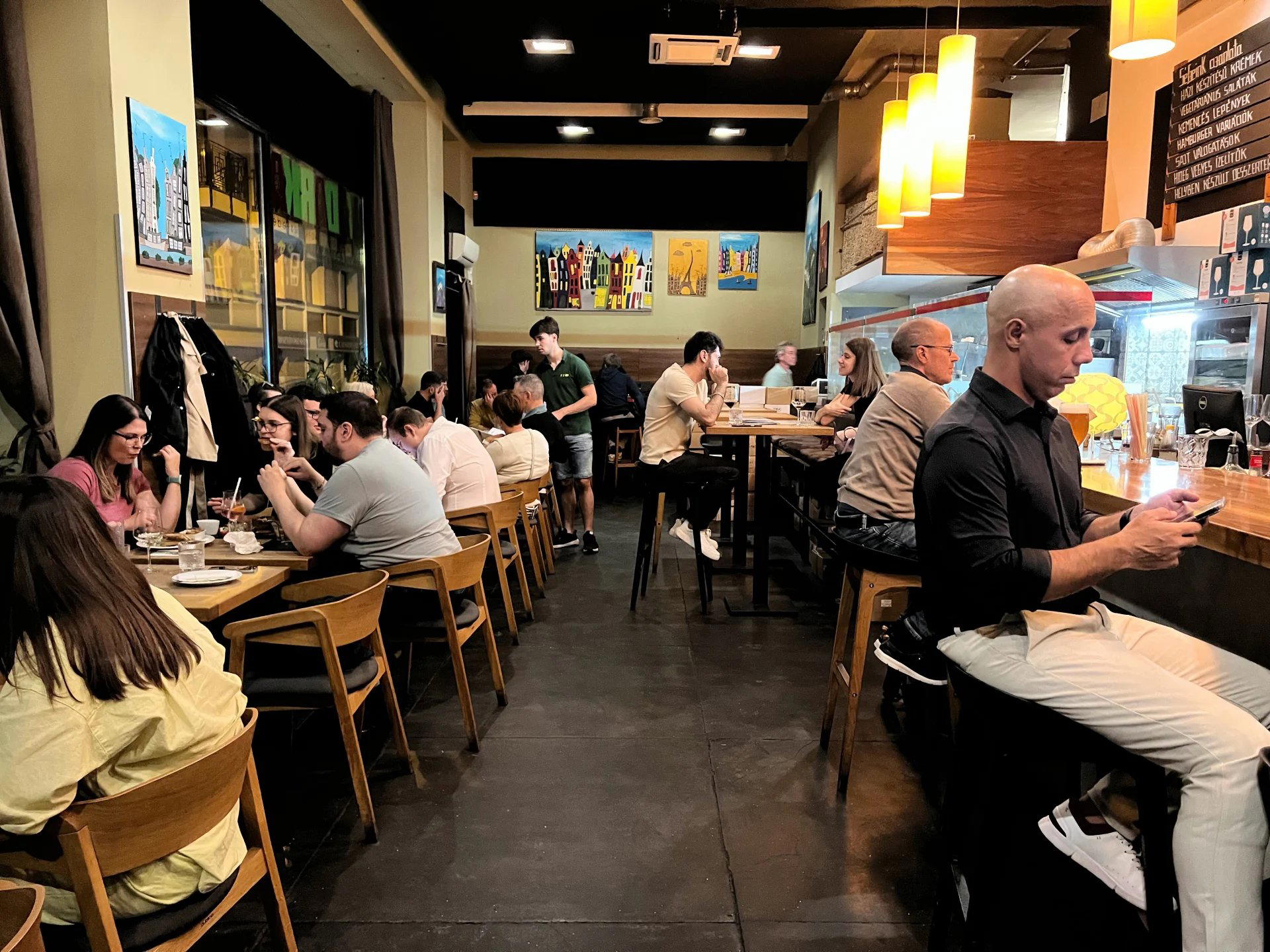
Gettó Gulyás is built around traditional Hungarian cooking in a neighbourhood-kitchen format at Wesselényi utca 18, in Budapest's seventh district. The venue's identity centres on gulyás as a serious, properly rendered dish rather than a tourist approximation, a distinction that matters in a part of the city where the ruin-bar era brought a wave of hospitality that was not always oriented toward the honest plate.
Can Gettó Gulyás accommodate dietary restrictions?
Traditional Hungarian cooking is built around meat and animal-based stocks, so gulyás in its standard form is not vegetarian. Guests with specific requirements should aim to check the venue's official channels before visiting, either in person or through any current social channels.
A Pricing-First Comparison
Comparable venues nearby, for context on price, style, and recognition.
| Venue | Cuisine | Price | Notes |
|---|---|---|---|
| Gettó GulyásThis venue (the venue you are viewing) | Authentic Hungarian Stews | $20–30 | Not listed |
| Franziska Pest | Healthy Brunch Cafe | $10–20 | Belvaros, Healthy Brunch Cafe |
| Café Kör | Traditional Hungarian Bistro | $20–30 | Varhegy, Traditional Hungarian Bistro |
| Kispiac | Traditional Hungarian Bistro | $30–50 | Terézváros, Traditional Hungarian Bistro |
| Kéhli Vendéglő | Traditional Hungarian | $20–30 | Obuda, Traditional Hungarian |
| DiVino Wine Bar | Hungarian Wine Bar with Tapas | $20–30 | Belvaros, Hungarian Wine Bar with Tapas |
Continue exploring
More in Budapest
Restaurants in Budapest
All restaurants in Budapest →
Bars in Budapest
All bars in Budapest →

Details
- Cozy
- Rustic
- Trendy
- Casual Hangout
- Group Dining
- Standalone
- A La Carte
- Vegetarian Friendly
- Vegan Options
- Gluten Free Options
Current opening hours
- Monday
- 12–11 PM
- Tuesday
- 12–11 PM
- Wednesday
- 12–11 PM
- Thursday
- 12–11 PM
- Friday
- 12–11 PM
- Saturday
- 12–11 PM
- Sunday
- 12–11 PM
Hours can change for holidays and private events. Hours as of .
Warm and inviting atmosphere with soft lighting and cozy decor.