Eataly London
Our verdict
Eataly London brings the Italian food hall format to the City of London at 135 Bishopsgate, combining retail counters, restaurants, and bars under one roof. The format, established in Turin in 2007 and now operating across three continents, places artisan Italian producers alongside sit-down dining in a sprawling market environment. For the Square Mile, it functions as both a daily provisioner and a destination for longer Italian-focused meals.

Pearl is the En Primeur Club membership app, where members save venues, book tables and use the concierge.

A Food Hall Format Built for Scale and Browsing
The Italian food hall model has a specific architectural logic: wide circulation paths between specialty counters, producer branding at eye level, and the deliberate blurring of the line between shopping and eating. When Eataly arrived at 135 Bishopsgate in the City of London, it brought that format into one of Europe's densest financial districts, a neighbourhood better known for expense-account restaurants than for retail food culture. The building occupies a substantial footprint, and the internal organisation follows the blueprint Eataly has used since its Turin debut in 2007: pasta, cheese, meat, seafood, and wine each occupy defined zones, with restaurants and bars embedded throughout rather than isolated at one end.
That spatial decision shapes how a visit unfolds. There is no single entrance point that funnels you toward a reservation. Instead, the floor plan encourages lateral movement, pulling visitors through the retail operation before or after a meal. For a district where most dining happens at a fixed table with a fixed bill, the format offers a different register: flexible, multi-stop, adjustable to time and appetite.
The Interior as Argument
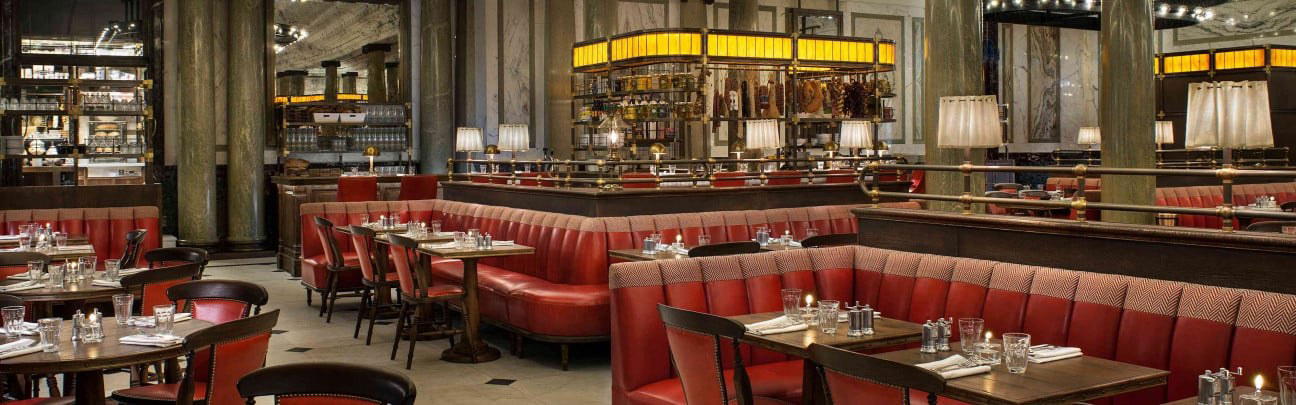
Eataly's design language across its global estate is consistent enough to be recognisable as a house style: exposed product displays, open kitchen counters, and the visual layering of packaged goods behind fresh produce. The London site at Bishopsgate follows this template, with the added context of its City surroundings. Tall ceilings and a generous ground-floor plan give the space a market hall quality, distinct from the compressed, corridor-style layouts of most food halls in central London.
The seating arrangements across the various restaurant counters are deliberately varied. Some spaces run along bar-style counters facing open preparation areas; others seat small groups at conventional tables. This variety matters practically: the format accommodates a solo lunch at a pasta counter as readily as a larger group gathering around a pizza or meat station. In the densely scheduled working culture of the City, that flexibility is a functional asset, not merely a design choice.
Producer branding throughout the retail floor reinforces the editorial position the Eataly group has held since its founding: that named Italian producers, presented in a legible retail environment, are the appropriate context for understanding what ends up on the plate. Whether that curatorial approach translates directly into the quality of cooked food is a separate question, but the physical environment makes the argument persistently.
Italian Food in the City: Where Eataly Sits in the Broader Scene
London's Italian restaurant offer spans an unusually wide range, from neighbourhood trattorias with decades of regulars to modern Italian-adjacent tasting menus at the ££££ tier occupied by venues such as CORE by Clare Smyth, Sketch, The Lecture Room and Library, and The Ledbury. Eataly occupies a different position entirely: it is not a single-chef restaurant competing within a tasting menu tier, and it is not a neighbourhood Italian with local regulars. It is a category of its own, a scaled food hall where the range of offer, from a quick espresso to a full seafood counter dinner, is the competitive advantage.
That positioning sets it apart from the formal end of London dining, where Restaurant Gordon Ramsay and Dinner by Heston Blumenthal operate with the structure and price point of destination restaurants requiring significant advance planning. Eataly's model is accessible in a different sense: the entry point is lower, the commitment per visit is variable, and the occasion range runs from a weekday lunch to a weekend browse with a bottle of Barolo from the retail shelf.
The Bishopsgate location also places it in conversation with London's broader food hall expansion over the past decade. From Borough Market's permanent traders to the newer market-hall formats in Canary Wharf and White City, London has absorbed the food hall model at scale. Eataly's version is more specifically curated around a single national cuisine than most of its British counterparts, which gives it a narrower but more coherent identity.
What the Format Delivers
The practical offer at a site like Bishopsgate covers several distinct use cases. The retail floor carries Italian groceries, wine, and specialty goods from named producers. The restaurant counters deliver cooked food across categories: pasta, pizza, meat, and seafood are the standard Eataly pillars, and the London site follows that structure. The bar areas carry Italian wine and aperitivo-focused drinks, positioning a pre-dinner Aperol or Negroni as a natural entry point before moving to a table.
For visitors interested in understanding Italian regional food beyond what a single-cuisine restaurant can show, the format has genuine depth. The range of pasta shapes, the selection of cured meats and aged cheeses at the deli counters, and the wine offer covering regions from Piedmont to Sicily create a breadth that no single kitchen operation can replicate. That breadth is the product's central argument, and it is most legible if you arrive prepared to move between counters rather than commit to a single seated experience.
For those interested in the higher end of the UK dining scene, EP Club covers the full range from City food halls to destination restaurants across Britain, including Waterside Inn in Bray, L'Enclume in Cartmel, Moor Hall in Aughton, Gidleigh Park in Chagford, Hand and Flowers in Marlow, hide and fox in Saltwood, Midsummer House in Cambridge, Opheem in Birmingham, Ynyshir Hall in Machynlleth, and Restaurant Andrew Fairlie in Auchterarder. Internationally, the food hall format as a serious dining destination has parallels at venues like Le Bernardin in New York City and community-focused destination dining at Lazy Bear in San Francisco. See our full London restaurants guide for broader coverage of the city's dining scene.
Planning Your Visit
Address: 135 Bishopsgate, London EC2M 3YD. Reservations: Individual restaurant counters within the site may take bookings; the retail floor and bar areas operate on a walk-in basis. Check with specific counters directly for booking availability. Timing: Weekday lunch periods draw the surrounding office population; weekend visits tend to draw more leisure-oriented visitors with time to browse the retail floor. Getting there: Liverpool Street station (Elizabeth line, Central line, Circle line, Hammersmith and City line, and National Rail) is the nearest interchange, a short walk from the Bishopsgate entrance.
Frequently asked questions
What should I order at Eataly London?
Do I need a reservation for Eataly London?
What is the signature at Eataly London?
Is Eataly London suitable for a business lunch in the City?
Reputation First
Comparable venues nearby, for context on price, style, and recognition.
| Venue | Cuisine | Price | Notes |
|---|---|---|---|
| Eataly LondonThis venue (the venue you are viewing) | Italian Food Hall | $30–50 | Not listed |
| Caffè Concerto Northumberland Avenue | Traditional Italian with French Influences | $30–50 | Covent Garden |
| Bernardi's | Modern Italian | $50–100 | Marble Arch |
| Quadrato | Modern Italian | $50–100 | Limehouse |
| Il Baretto | Authentic Italian with Robata Grill | Not listed | Marylebone |
| Caraffini | Classic Italian | $30–50 | Belgravia |
Continue exploring
More in London
Restaurants in London
All restaurants in London →
Bars in London
All bars in London →




Details
- Lively
- Trendy
- Energetic
- Industrial
- Group Dining
- Casual Hangout
- Brunch
- Open Kitchen
- Terrace
- Extensive Wine List
- A La Carte
- Small Plates
- Vegetarian Friendly
Current opening hours
- Monday
- 7 AM–11 PM
- Tuesday
- 7 AM–11 PM
- Wednesday
- 7 AM–11 PM
- Thursday
- 7 AM–11 PM
- Friday
- 7 AM–11 PM
- Saturday
- 9 AM–11 PM
- Sunday
- 9 AM–10 PM
Hours can change for holidays and private events. Hours as of .
Bustling and lively atmosphere with lively food hall energy, wood-fired grills, open kitchens, and an outdoor terrace for aperitivo.