Our verdict
D'Olivio sits on Voorshoventerweg in Maaseik, a town in Belgian Limburg where the dining scene punches above its size relative to the surrounding region. The address places it outside the immediate town centre, a positioning common among destination restaurants in this part of Flanders and Wallonia that rely on intention rather than foot traffic. Verified operational details remain limited, so prospective visitors should confirm current hours and booking availability directly before planning a visit.

Pearl is the En Primeur Club membership app, where members save venues, book tables and use the concierge.
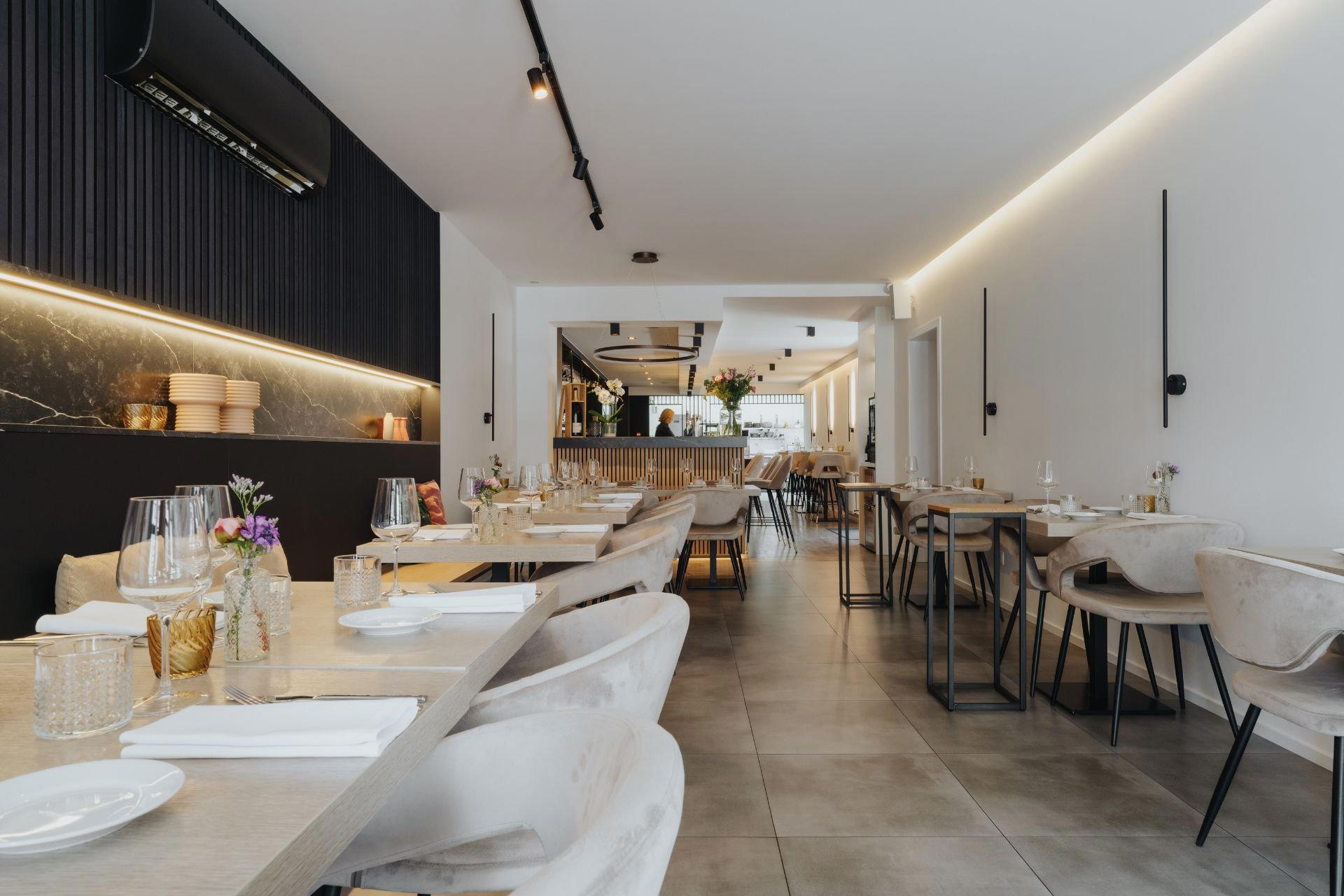
Maaseik and the Limburg Dining Context
Belgian Limburg sits in an odd position within the country's broader restaurant culture. Brussels, Ghent, and Antwerp absorb most of the critical attention, while the province's quieter towns carry a dining tradition that moves at a different pace and operates on different assumptions. Maaseik, close to the Dutch border along the Meuse, is a market town with a compact historic centre and a dining scene that has, over the past decade, developed a small but serious cohort of destination addresses. The pattern is familiar across provincial Belgium: a handful of kitchens working at a level that would draw notice in any European city, surrounded by a broader mid-range offer that serves the local population. D'Olivio, at Voorshoventerweg 18, operates at the edge of the town's restaurant geography, a placement that in this context signals a kitchen expecting guests to seek it out rather than stumble upon it.
For a broader picture of what Maaseik's dining scene currently offers, EP Club's full Maaseik restaurants guide covers the range of options across price tiers and cuisines.
Where d'Olivio Sits in the Local Picture
Bienvenue (Modern Cuisine) operates at the €€ tier with a modern cuisine format, establishing one reference point for what contemporary cooking looks like in the town. Bonaparte, De Bokkerijder, De Loteling, and Gastronomia Inglima fill out a scene that, for a town of Maaseik's size, represents a genuine concentration of dining options. What the address and positioning suggest is a destination model: a venue that draws guests from across the region rather than relying on passing custom.
The name, d'Olivio, carries an Italian resonance that appears in several Belgian restaurant contexts, sometimes reflecting a genuine Italian kitchen tradition, sometimes signalling a Mediterranean-inflected approach to classical technique. Belgian dining has absorbed Italian culinary influence over several decades, with pasta-forward and olive oil-driven menus finding a comfortable home in Flemish and Walloon towns alike.
The Cultural Weight of Italian Cooking in Belgian Dining
Italy's imprint on Belgian restaurant culture runs deeper than most outsiders assume. The postwar migration of Italian workers into Belgium's coal and steel regions created lasting culinary communities across Liège, Charleroi, and Limburg itself. That history produced a generation of Italian-Belgian restaurateurs who built kitchens around regional Italian traditions, often adapting to local produce while holding to the structural logic of Italian cooking: simplicity of technique, quality of raw material, restraint in composition. The best of those kitchens sit comfortably alongside Belgium's French-influenced gastronomic establishment while operating under entirely different aesthetic assumptions.
Belgium's broader fine dining tier, anchored by addresses like Hof van Cleve - Floris Van Der Veken in Kruishoutem and Zilte in Antwerp, operates in a French-Flemish register that dominates Michelin attention in the country. Italian-focused kitchens occupy a parallel track, recognised differently but valued by a loyal audience who find in that tradition a directness that French-influenced cooking sometimes subordinates to technique.
The Limburg Destination Model
Restaurants in smaller Belgian cities and towns that operate at a serious level have, over time, developed a destination model that differs from urban dining in one important respect: the guest has already made a decision before arrival. Nobody passes d'Olivio on a walk through Maaseik's centre and decides to stop in. The journey to Voorshoventerweg is an act of intention, and kitchens that occupy this type of address tend to structure their offer accordingly, with formats and service rhythms that reward the committed guest. This pattern repeats across provincial Belgium, from Ralf Berendsen in Neerharen to Cuchara in Lommel, both of which operate in a similar provincial-destination register within Limburg and the wider region.
The comparison to international formats is instructive here. Destination dining in smaller towns operates under a logic closer to Lazy Bear in San Francisco than to a typical urban restaurant: the format itself is the draw, and accessibility is deliberately limited. Belgian versions of this model rarely match the theatrical intensity of American chef-driven formats, but they share the core premise that the guest's commitment should be matched by the kitchen's.
Planning a Visit
The address at Voorshoventerweg 18, 3680 Maaseik positions the restaurant outside the immediate town centre, making private transport the practical approach for most guests arriving from outside the region. Maaseik itself is accessible from Hasselt and Genk by road, and from the Dutch side via Roermond. Guests travelling specifically for dinner should plan for the outbound journey and consider overnight options in the town or surrounding area. For comparable planning considerations across the region, La Durée in Izegem and d'Eugénie à Emilie in Baudour illustrate how destination kitchens across Belgium handle similar logistical dynamics. Internationally, Le Bernardin in New York City represents the end point of European culinary tradition transplanted to a major city, a useful contrast to the provincial Belgian model d'Olivio occupies.
Frequently asked questions
What's d'Olivio's location?
d'Olivio is located at Voorshoventerweg 18, 3680 Maaseik, Belgium.
Is d'Olivio a good choice for Italian dining outside Belgium's major cities?
Belgian Limburg sits well outside the critical orbit of Brussels, Antwerp, and Ghent, which means restaurants like d'Olivio in Maaseik serve a genuine local function rather than competing for press attention. Italy's influence on Belgian dining has deep postwar roots in the Limburg region specifically, giving Italian kitchens here a different cultural grounding than their urban counterparts.
What's the must-try dish at d'Olivio?
Check the venue's official channels at Voorshoventerweg 18, Maaseik, to ask what the kitchen is currently running, that conversation will tell you more than any static list.
Should I book d'Olivio in advance?
Booking ahead is the practical approach for any restaurant operating in a town of this size. Reach out directly to d'Olivio at Voorshoventerweg 18 to confirm availability and current reservation procedures.
Booking and Cost Snapshot
Comparable venues nearby, for context on price, style, and recognition.
| Venue | Cuisine | Price | Notes |
|---|---|---|---|
| d'OlivioThis venue (the venue you are viewing) | Mediterranean & Belgian Bistro | Not listed | Not listed |
| Bonaparte | Artisanal Chocolatier | Not listed | Sint Jansberg, Artisanal Chocolatier |
| De Bokkerijder | Traditional Belgian-French Brasserie | Not listed | Marktplein, Traditional Belgian-French Brasserie |
| De Loteling | Traditional Belgian Bistro | $50–100 | Aldeneik, Traditional Belgian Bistro |
| Smaakkamer Lavendel | French-Belgian with Eastern Influences | $50–100 | Markt, French-Belgian with Eastern Influences |
| TIFFANY'S BY PASCAL | Contemporary Classical French-Belgian | $50–100 | Maaseik, Contemporary Classical French-Belgian |
Continue exploring
More in Maaseik
Restaurants in Maaseik
All restaurants in Maaseik →
Bars in Maaseik
Browse all →

Details
- Date Night
- Brunch
- A La Carte
- Vegetarian Friendly
Current opening hours
- Monday
- Closed
- Tuesday
- Closed
- Wednesday
- 6 PM–12 AM
- Thursday
- 6 PM–12 AM
- Friday
- 12–2 PM, 6 PM–12 AM
- Saturday
- 6 PM–12 AM
- Sunday
- 12–2 PM, 5:30–10 PM
Hours can change for holidays and private events. Hours as of .
Cozy and welcoming with friendly service.