Michelin Plate
Our verdict
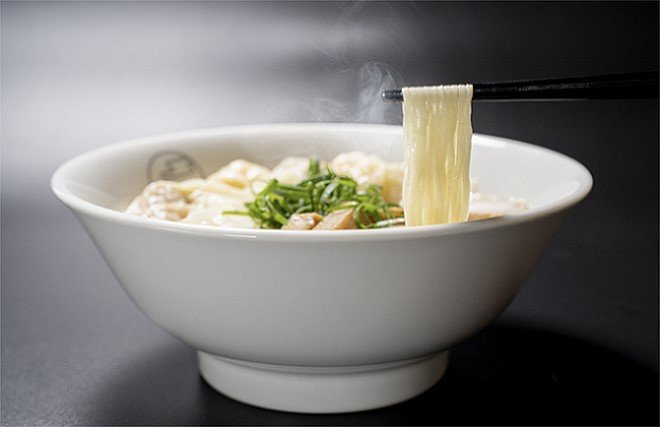
A 24-hour noodle and congee shop in Minhang District earning a 2024 Michelin Plate, Ding Te Le Zhou Mian Guan draws a loyal following for its shredded pork noodles with scallions, yellow croaker noodles with pickled vegetables, and deep-fried pork chops. At the single-yuan price tier, it represents the category of Shanghai street-level cooking that Michelin inspectors have increasingly chosen to document alongside the city's fine-dining tier.

Pearl is the En Primeur Club membership app, where members save venues, book tables and use the concierge.
The menu
What to order
- Yellow Croaker Noodles with Pickled Vegetables
- Shredded Pork Noodles with Scallions
- Deep-fried Pork Chops
The Alley Counter as Shanghai Institution
Shanghai's noodle and congee category operates on a different logic from the city's headline restaurant scene. Where a two-Michelin-star room like Fu He Hui (Vegetarian) or a modern European counter like Taian Table (Modern European, Innovative) asks visitors to plan weeks ahead and spend accordingly, the city's braised-noodle and jook shops ask almost nothing in advance. They reward proximity, early hours, and a working knowledge of what to order, and they have sustained entire neighbourhoods for generations. Ding Te Le Zhou Mian Guan, at 243 Ziteng Road in Minhang District, belongs to that tradition. From the street, the shopfront reads as one more modest counter in a dense residential pocket. The Michelin Plate it received in 2024 is a signal that the inspectors disagree with that reading.
What the Michelin Plate Signals Here
The Michelin Plate designation sits below the star tier but carries a specific meaning in the Guide's framework: the kitchen produces cooking that is consistently good, worth knowing about, and not yet refined to the one-star bracket. In Shanghai, that bracket includes a number of Chinese and regional-focused rooms, but the Plate list extends further down the price register, into exactly the kind of single-dish specialist that the city's food culture has always depended on. Receiving a Plate at the ¥ price tier, where a full meal typically costs under 50 RMB, places Ding Te Le in a peer group defined by cooking consistency rather than ambiance or service design. The comparison is less with 102 House (Cantonese) and more with Hong Kong's Ho Hung Kee Congee & Noodle, a Michelin-recognised noodle institution that operates in a structurally similar position within that city's food hierarchy.
Shanghai's own Ho Hung Kee occupies the Cantonese congee and noodle niche in a slightly more formal register. Ding Te Le is further toward the street-counter end of that spectrum, and the cooking it produces in that context is what drew inspector attention.
The Menu Logic of a Single-Dish Specialist
The kitchen here is built around a short repertoire executed at volume. Shanghai's noodle tradition pulls from several regional streams: the yellow croaker and pickled-vegetable combination is distinctly local, drawing on the Huangpu River and Yangtze Delta fishing traditions that gave the city its affinity for river fish and preserved-vegetable pairings. Pickled mustard greens cut the richness of the fish broth; the noodles absorb both. The shredded pork with scallion version follows a different logic, leaner and more aromatic, with the scallion doing more structural work than garnish. These are not dishes that require elaborate sourcing or long preparation windows, but they do require consistency of timing and a broth base that holds across a 24-hour service window.
The deep-fried pork chop is the third anchor of the menu and belongs to a Shanghai snack tradition that predates the city's international food moment by several decades. Thick-cut, fried to a crust, and typically served either separately or alongside noodles, the preparation is closer to comfort food than to refinement, and that is precisely its function in the meal structure. Congee, rice, and smaller snack items round out the offering, making this a place where the order of eating can follow almost any sequence without the kitchen missing a beat.
Getting There and Getting a Seat
Minhang District address at 243 Ziteng Road places this shop well outside the central Puxi and Pudong dining corridors that most visitors anchor to. Minhang is a residential and commercial district in the city's southwest, accessible by metro but requiring a deliberate journey rather than a casual detour from the Bund or Xintiandi. That distance functions as a filter: the clientele skews local, the atmosphere skews functional, and the overhead stays low enough to keep prices at the ¥ tier. For a visitor arriving from the central hotel zones, the metro ride is the clearest path. Ride-hailing via Didi is the alternative and adds flexibility around timing.
24-hour operating format is the single most important logistical fact about this venue. In a city where late-night eating options at this quality tier are not consistently documented, a round-the-clock counter with Michelin recognition addresses a real gap. Arrival in the small hours is not a workaround, it is a legitimate way to experience the shop at a different pace, with fewer tables turning and more time to sit with the bowl. Mid-morning and lunchtime will draw heavier foot traffic from the surrounding neighbourhood. No reservation infrastructure exists at this level of operation; you arrive, you queue if necessary, and you order at the counter.
Planning the visit means knowing the address and the menu rather than coordinating with a reservations team. This is the opposite of the booking experience at a venue like Xin Rong Ji (West Nanjing Road), which operates in a more formal Taizhou seafood register and requires advance coordination. At Ding Te Le, the planning burden sits entirely with the visitor: get to Minhang, know what to order, and arrive with cash or a local mobile payment method active.
Positioning Within the Wider Shanghai Food Map
Shanghai's food scene in 2024 spans a range that few cities match. At one end, tasting-menu rooms compete with regional Chinese fine-dining destinations across the country, venues comparable to Xin Rong Ji (Xinyuan South Road) in Beijing or Ru Yuan in Hangzhou. At the other end, the city's congee and noodle tradition continues largely outside the spotlight that falls on that upper tier. Michelin's decision to document Ding Te Le in its 2024 Guide is part of a broader editorial direction the Guide has taken in multiple Asian cities: treating street-level and counter-format cooking as worthy of the same attention given to white-tablecloth rooms. The same logic drives recognition of venues like Khao Tom Thanon Di Buk in Phuket, a congee and noodle specialist operating in a structurally similar format in a very different city.
For visitors building a Shanghai itinerary across multiple price tiers, this shop belongs in a different session from the fine-dining appointments at venues like Imperial Treasure Fine Chinese Cuisine in Guangzhou or Chef Tam's Seasons in Macau. It works as a standalone meal or as a late-night addition to a day that began in a different register entirely. The distance from central Shanghai is the main practical obstacle, but for anyone spending more than three or four days in the city, the Minhang trip is worth the metro ride.
For broader planning across the city's full hospitality range, our full Shanghai restaurants guide, our full Shanghai hotels guide, our full Shanghai bars guide, our full Shanghai wineries guide, and our full Shanghai experiences guide cover the broader picture across all categories and neighbourhoods.
What to Order at Ding Te Le Zhou Mian Guan
What should I order at Ding Te Le Zhou Mian Guan?
Start with the yellow croaker noodles with pickled vegetables, which is the dish that most directly expresses the Shanghai river-fish tradition and the reason Michelin inspectors flagged this kitchen in 2024. The shredded pork noodles with scallions are the leaner, faster alternative and work well as a secondary order if you are eating with company. The deep-fried pork chop is worth adding as a side, particularly outside of peak hours when the fry comes out at its crispest. Congee is available for those who want something lighter or are visiting in the early hours when a rice-based bowl suits the timing better than a full noodle portion. Avoid arriving with a long list of unfamiliar snack items to decode; the three anchor dishes are the reason the shop has the recognition it does, and ordering directly from that short list is the approach that makes the visit productive rather than exploratory.
Frequently asked questions
Is Ding Te Le Zhou Mian Guan more mid-range or high-end?
Pricing at Ding Te Le Zhou Mian Guan is listed as ¥.
What cuisine category does Ding Te Le Zhou Mian Guan fall under?
What's Ding Te Le Zhou Mian Guan known for in terms of accolades?
Ding Te Le Zhou Mian Guan has received recognition including: To the passer-by, this simple shop hidden in an alley on Huaihai Road looks pretty much like any other. What sets it apart, however, are the authentic noodles it serves. It is particularly famous for its shredded pork noodles with scallions….
What should I order at Ding Te Le Zhou Mian Guan?
The three dishes the shop is known for are the shredded pork noodles with scallions, the yellow croaker noodles with pickled vegetables, and the deep-fried pork chops. All three appear in the Michelin Plate-recognised menu and represent the core of Shanghai's local noodle tradition. Congee, rice, and snacks round out the options for those eating outside conventional meal hours, given the kitchen runs 24 hours.
A short peer table to compare basics side-by-side.
| Venue | Cuisine | Price | Awards | Notes |
|---|---|---|---|---|
| Ding Te Le Zhou Mian GuanThis venue (the venue you are viewing) | Shanghainese Noodle Shop | $10–20 | Michelin Plate | Not listed |
| Fu He Hui | Modern Seasonal Vegetarian Fine Dining | $200–300 | 2 Michelin Stars · World's 50 Best #11 | Vegetarian |
| Ming Court | Cantonese with Shanghainese Influences | $30–50 | 1 Michelin Star · Black Pearl 1 Diamond | Cantonese |
| Polux | French Bistro | $30–50 | Michelin Bib Gourmand | French |
| Royal China Club | Cantonese Dim Sum | $100–150 | Michelin Plate · The Good Food Guide GFG Good | Chinese, Cantonese |
| Scarpetta | Refined Italian Pasta & Pizza | $50–100 | Michelin Plate · Wine Spectator Best of Award of Excellence | Italian |
Recognition history
Dated appearances from independent guides and award organizations, with the underlying list record or original source where available.
Michelin Plate
Michelin
Full recognition history (2 entries)
Michelin Plate
Michelin