De Vijfhoek
De Vijfhoek sits on the Mechelsesteenweg in Sint-Katelijne-Waver, a Flemish town positioned between Mechelen and Antwerp in the heart of some of Belgium's most productive agricultural land. The surrounding region supplies a dense network of specialist producers, placing ingredient provenance at the centre of what Belgian cooking in this corridor does well. For visitors making the drive from either city, it represents the kind of address that rewards the detour.
Pearl is the En Primeur Club membership app — saves, bookings, and concierge access live there. Same editors, same standards.
- Address
- Mechelsesteenweg 248, 2860 Sint-Katelijne-Waver, Belgium
- Phone
- +3215552425
- Website
- devijfhoek.be
- Directions
- Get directions
 Saves & bookings on Pearl
Between Two Cities, on Farming Ground
Sint-Katelijne-Waver occupies a particular stretch of the Mechelen-Antwerp corridor that has long been associated with commercial horticulture and market gardening. The municipality sits in the province of Antwerp, surrounded by glasshouse operations and open fields that supply vegetable and fruit produce across Belgium and into the Netherlands. For a restaurant positioned on the Mechelsesteenweg, the main arterial road threading through this agricultural zone, proximity to that production network is not a marketing footnote. It is a structural advantage that shapes what arrives in the kitchen and when.
Belgian fine dining at this level increasingly organises itself around sourcing geography. Look at the comparable set: Boury in Roeselare works West Flemish coastal producers into a creative French-Flemish framework; Vrijmoed in Gent builds its modern Flemish identity around direct supplier relationships in the Ghent hinterland. The pattern across the country's serious kitchens is consistent: the restaurants with staying power tend to be the ones that have locked in supply chains that a kitchen in Brussels or Antwerp cannot easily replicate from a central address. Sint-Katelijne-Waver, with its density of specialist growers, provides that kind of use for a restaurant willing to use it.
The Approach and the Setting
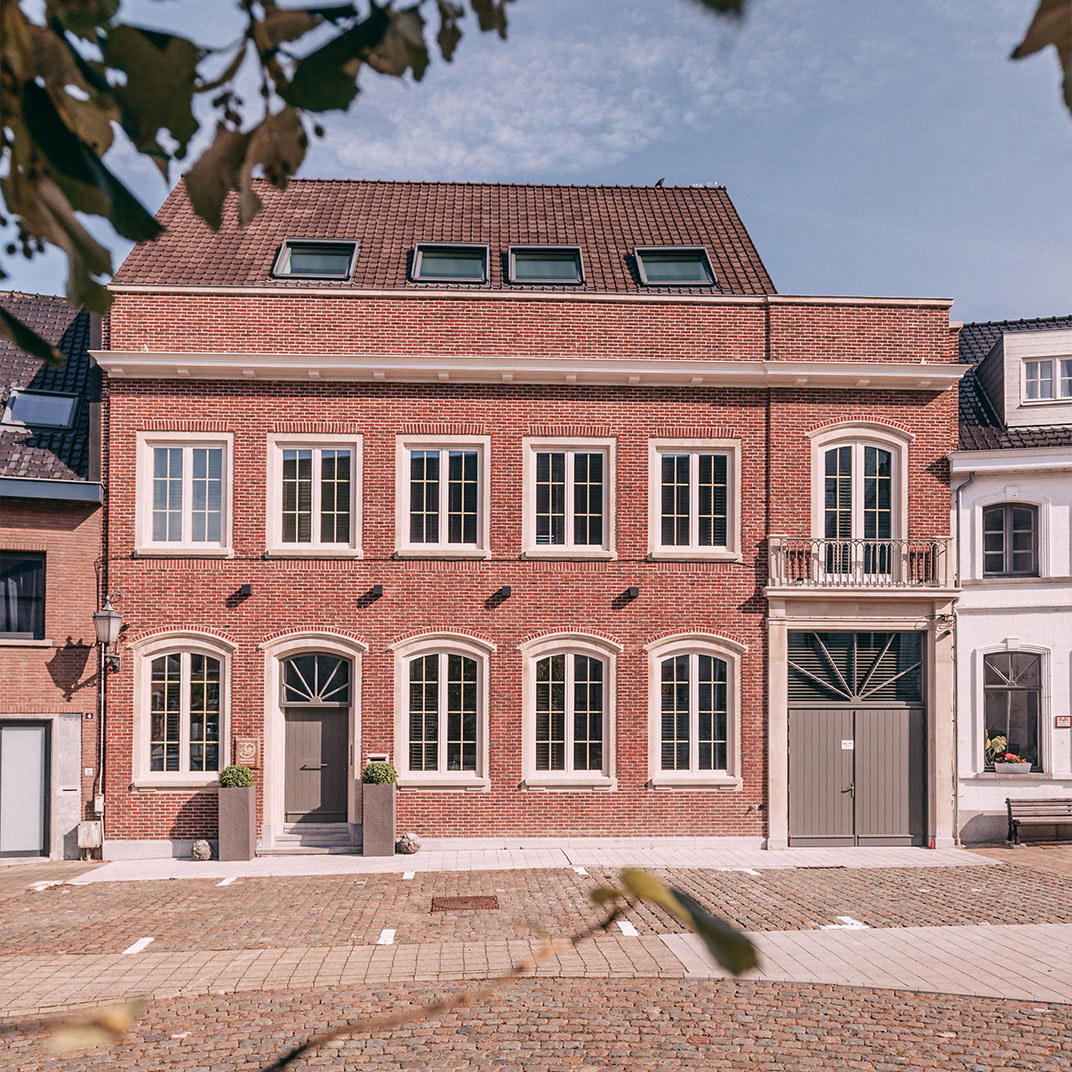
Arriving along the Mechelsesteenweg, the address places De Vijfhoek in a stretch of road that carries traffic between Mechelen to the south and Antwerp to the north, roughly equidistant from both. The surrounding built environment is characteristic of this part of Flanders: low-density, interspersed with nurseries and agricultural plots, without the urban density of Ghent or the port-city scale of Antwerp. Restaurants in this kind of setting tend to draw a regional clientele, regulars who drive from both city catchments and who expect a certain level of consistency in return for the journey. That pattern is recognisable across Flemish provincial dining: Hof van Cleve in Kruishoutem operates on a similar geographic logic, drawing from Ghent and Kortrijk without being in either. Ralf Berendsen in Neerharen occupies the Limburg equivalent of the same positioning.
Names tied to local geography are common across Belgian provincial restaurants, and they carry a particular signal: that the address is embedded in its specific place rather than constructed for a general market. It is a small but consistent indicator of the kind of restaurant that prioritises returning local guests over destination tourism.
What Belgian Provincial Kitchens Do with Proximity
The agricultural belt between Mechelen and Antwerp is among the more productive in Belgium. The region around Sint-Katelijne-Waver is particularly associated with strawberry cultivation, it accounts for a significant share of Belgian strawberry production, as well as chicory, leeks, and a range of protected greenhouse crops. Kitchens that draw from this zone have access to produce at harvest intervals that a city supplier, working through wholesalers, cannot match. A strawberry that moves from field to kitchen within hours carries different culinary properties than one that has spent two days in a cold chain.
This kind of sourcing specificity is what separates the better Belgian provincial restaurants from their urban counterparts on certain ingredients, even when the urban kitchens carry higher awards totals. The comparison is useful: Zilte in Antwerp works at the summit of Belgium's awards tier and has access to notable suppliers, but its sourcing operates through city-adapted logistics. A kitchen in Sint-Katelijne-Waver can, in principle, shorten that chain considerably on the produce categories where this region excels.
Belgian cuisine in this part of Flanders also leans on a strong tradition of classical technique applied to regional ingredients. The French-Belgian culinary tradition, visible across restaurants from Le Chalet de la Forêt in Uccle to La Paix in Anderlecht, provides the technical scaffolding, while Flemish ingredient identity supplies the local specificity. Restaurants in the Mechelen orbit, historically a city with strong gastronomic traditions of its own, tend to operate within that French-Flemish grammar.
Where It Sits in the Regional Context
Sint-Katelijne-Waver does not appear in the primary circuit of Belgian destination dining in the way that Ghent, Bruges, or Antwerp do. That is partly a function of scale and partly a function of how food media maps the country. The result is that serious provincial addresses in this corridor tend to be known primarily within their own regional catchment, which suits a clientele of regulars but means they rarely accumulate the critical visibility of their city peers. Compare this to the positioning of De Jonkman in Sint-Kruis or Castor in Beveren, both of which operate in similarly non-urban Flemish settings and draw from defined regional catchments.
For visitors arriving from outside Belgium, one efficient route to Sint-Katelijne-Waver is via Mechelen, which sits on the main Brussels-Antwerp rail axis and is served by direct trains from both cities at high frequency. From Mechelen station, the address on the Mechelsesteenweg requires onward transport. Arriving from Antwerp, the drive runs south along the E19 before turning into the municipality. For those building a broader Belgian itinerary, Sint-Katelijne-Waver fits naturally as an excursion from Mechelen or as a stop between Brussels and Antwerp, with reference points in the broader dining map including Bozar Restaurant in Brussels to the south or Willem Hiele in Oudenburg further west.
For context on how Belgian restaurants in non-urban settings function at the summit of the market internationally, the structural comparison extends even further: Le Bernardin in New York City and Lazy Bear in San Francisco both demonstrate how location-driven identity, when executed with discipline, can define a restaurant's positioning across markets. The principle applies at smaller geographic scales too: what a kitchen does with its immediate sourcing geography tends to be its most durable editorial claim.
Planning a Visit
De Vijfhoek is located at Mechelsesteenweg 248, 2860 Sint-Katelijne-Waver. Reservations are recommended, and the restaurant is typically open Wednesday and Thursday from 11 AM to 12 AM, Friday from 11 AM to 12 AM, Saturday from 5 PM to 12 AM, and Sunday from 11 AM to 12 AM; it is closed Monday and Tuesday. The address is most practical for guests with access to a car, given the suburban-rural character of the immediate surroundings. Those assembling a multi-restaurant itinerary across this part of Belgium may also find value in reviewing addresses across the wider regional field, including La Durée in Izegem, Cuchara in Lommel, d'Eugénie à Emilie in Baudour, and La Table de Maxime in Our, which together outline the range of creative and classical formats operating across the Belgian provinces.
How It Stacks Up
Comparable venues nearby, for context on price, style, and recognition.
| Venue | Cuisine | Price | Awards | Notes |
|---|---|---|---|---|
| De VijfhoekThis venue — the venue you are viewing | Traditional Belgian Bistro | $$ | Not listed | Not listed |
| Centpourcent | Modern French-Belgian Fine Dining | $$$$ | Michelin 1 Star | Sint-Katelijne-Waver |
| Fernand Obb Delicatessen | Belgian Delicatessen | $$ | Not listed | Sint-Pieters Woluwe |
| Canapé | Modern Belgian Small Plates | $$ | Not listed | Tervuren |
| Délice | Belgian Bistro | $$ | Not listed | Putte |
| Fredo | Seasonal Belgian Vegetable-Focused | $$ | Not listed | Berchem |
Continue exploring
More in Sint-Katelijne-Waver
Restaurants in Sint-Katelijne-Waver
Browse all →
Bars in Sint-Katelijne-Waver
Browse all →
Hotels in Sint-Katelijne-Waver
Browse all →
At a Glance
- Cozy
- Classic
- Rustic
- Casual Hangout
- Group Dining
- Family
- After Work
- Terrace
- Standalone
- Beer Program
- Local Sourcing
Current opening hours
- Monday
- Closed
- Tuesday
- Closed
- Wednesday
- 11 AM–12 AM
- Thursday
- 11 AM–12 AM
- Friday
- 11 AM–12 AM
- Saturday
- 5 PM–12 AM
- Sunday
- 11 AM–12 AM
Hours can change for holidays and private events. Last verified .
Warm and welcoming with a cozy, authentic bistro setting featuring two large terraces; intimate and unpretentious with a neighborhood café feel.