Our verdict
De Herten occupies a quiet address on Kampveldstraat in Oostkamp, a small Flemish municipality where the restaurant scene punches above its size relative to the surrounding West Flanders countryside.

Pearl is the En Primeur Club membership app, where members save venues, book tables and use the concierge.
The menu
What to order
- Goujonettes with homemade tartare sauce
- Grilled bavette with herb salad and bearnaise
- Grilled belly pork with sake
Oostkamp's Dining Scene and Where De Herten Sits Within It
West Flanders has quietly assembled one of the more interesting regional dining corridors in Belgium. The province that gave the country Boury in Roeselare and sits within reach of De Jonkman in Sint-Kruis is not short of serious cooking ambitions, and those ambitions have filtered outward from the larger cities into smaller municipalities. Oostkamp, a compact Flemish town south of Bruges, fits that pattern. Its restaurant addresses are spread across residential streets and semi-rural roads rather than concentrated in a historic centre, which means dining here tends to feel deliberate: you come because you chose to, not because you stumbled past a terrace.
De Herten occupies Kampveldstraat 20, a street address that places it firmly in that quieter, neighbourhood-oriented register. The name itself, Dutch for "the deer", carries the kind of rural, forested connotation common to Flemish restaurants that anchor themselves to local landscape and seasonal produce. Whether that framing extends to the menu format or the interior character is something the venue's limited public profile does not yet confirm, but the naming convention is a consistent signal across Flemish dining culture: it places the restaurant in a tradition that values regional rootedness over cosmopolitan branding.
The Flemish Culinary Tradition This Address Represents
Belgium's restaurant culture has long operated on a paradox: a country of eleven million people holds more Michelin stars per capita than almost anywhere else in Europe, yet a significant share of that recognition is distributed outside the major cities. Hof van Cleve in Kruishoutem and Willem Hiele in Oudenburg are instructive cases: both operate in small Flemish municipalities, both attract destination diners willing to make a specific journey, and both sit within a tradition that treats local produce, seasonal discipline, and proximity to farmland as structural advantages rather than marketing positions.
That tradition shapes what dining in a town like Oostkamp tends to mean. The restaurants that establish themselves here generally do so by building around the surrounding agricultural supply rather than importing a metropolitan format. Laurel & Hardy, the farm-to-table operator in the same town, represents one version of that model at a mid-to-upper price point. Choc'atelier occupies a different category altogether. De Herten adds another address to a small cluster that collectively gives Oostkamp more dining range than its population size would suggest. For a broader map of what the town offers, the full Oostkamp restaurants guide covers the current options in detail.
Reading the Belgian Provincial Restaurant Format
Across Belgium's provincial dining circuit, certain format patterns recur with enough consistency to function as useful orientation tools. Restaurants operating on residential or semi-rural streets tend to run tighter seatings, shorter weekly schedules, and more advance booking requirements than their urban counterparts. This is partly a staffing reality and partly a deliberate calibration: smaller operations in quieter locations sustain themselves through repeat local clientele and occasional destination visitors rather than through volume or walk-in traffic.
The contrast with urban formats elsewhere is instructive. Zilte in Antwerp and Vrijmoed in Gent operate inside cities where footfall, hotel proximity, and tourism infrastructure support different commercial models. A restaurant on Kampveldstraat in Oostkamp operates without those supports, which typically translates into a more considered dining pace and a clientele that has made an active choice to be there. That dynamic shapes the atmosphere in ways that urban restaurants rarely replicate: the room tends to be quieter, the service rhythm less pressured, and the sense of occasion more self-contained.
For comparison across the broader Belgian fine-dining range, venues like Bozar Restaurant in Brussels, Le Chalet de la Forêt in Uccle, and Raffiné in Oostkamp itself illustrate the range of formats operating within the country's premium tier. Further afield, La Durée in Izegem, Cuchara in Lommel, Ralf Berendsen in Neerharen, and d'Eugénie à Emilie in Baudour show how Belgium's provincial restaurant culture sustains serious cooking well outside the capital and Antwerp. Internationally, Le Bernardin in New York City and Lazy Bear in San Francisco represent analogous cases of destination-format restaurants that operate with deliberate limitations on access and scale.
Planning a Visit to De Herten
Oostkamp is accessible by car from Bruges in under fifteen minutes and sits within reasonable reach of Ghent. Public transport connections to the specific address on Kampveldstraat are limited, which is consistent with the semi-rural character of the neighbourhood and reinforces the case for arriving by car or taxi. Visitors coming from further afield, particularly those combining De Herten with other West Flanders addresses, would do well to plan Bruges as a base, given its accommodation density and transport links.
Provincial Belgian restaurants at the more considered end of the dining spectrum frequently operate on reduced weekly schedules, sometimes closing two or three days per week, and reservation lead times can extend several weeks during busier periods.
Frequently asked questions
Can I bring kids to De Herten?
De Herten is based in Oostkamp, a small West Flemish municipality where restaurant culture tends toward the unhurried and family-inclusive side of the Belgian provincial format.
What's the vibe at De Herten?
Oostkamp's dining scene operates in the Belgian provincial register: grounded, ingredient-focused, and without the performative edge of city-centre restaurants. De Herten at Kampveldstraat 20 sits within that tradition, suggesting a setting where the food does the talking rather than the room. Expect a pace calibrated to the town rather than to a Bruges tourist schedule.
How does De Herten fit into the broader West Flanders dining scene?
West Flanders holds a concentration of serious regional restaurants unusual for a Belgian province of its size, with names like Boury in Roeselare carrying Michelin recognition and raising expectations across the corridor. De Herten in Oostkamp occupies the same geographic band, placing it within reach of diners already planning time in Bruges or Ghent. Whether it aligns with that decorated peer group is a question the venue's own record does not yet answer definitively.
What's the must-try dish at De Herten?
West Flemish kitchens of this profile typically anchor around seasonal produce and regional proteins, but confirming current dishes requires checking directly with the restaurant at Kampveldstraat 20, Oostkamp.
What's De Herten's location?
De Herten is located at Kampveldstraat 20, 8020 Oostkamp, Belgium, Oostkamp.
Is De Herten reservation-only?
Given its location in Oostkamp rather than a high-footfall urban centre, walk-ins may be possible, but provincial Belgian restaurants at this level commonly fill weekend covers in advance. Reaching out before your visit is the practical approach.
Budget and Context
Comparable venues nearby, for context on price, style, and recognition.
| Venue | Cuisine | Price | Awards | Notes |
|---|---|---|---|---|
| De HertenThis venue (the venue you are viewing) | Classical Belgian Seasonal Cuisine | $50–100 | Not listed | Not listed |
| Choc'atelier | Belgian Chocolatier | $10–20 | Not listed | Oostkamp, Belgian Chocolatier |
| Laurel & Hardy | Modern Belgian Fine Dining | Not listed | Michelin Plate | Oostkamp, Modern Belgian Fine Dining |
| Raffiné | Modern French-Belgian Bistro | $50–100 | Not listed | Hertsberge, Modern French-Belgian Bistro |
| Luzt | Contemporary Belgian | $50–100 | Not listed | Adegem, Contemporary Belgian |
| De Kokkel | Modern Belgian Fine Dining | $150–200 | Not listed | Sint-Idesbald, Modern Belgian Fine Dining |
Continue exploring
More in Oostkamp
Restaurants in Oostkamp
All restaurants in Oostkamp →
Bars in Oostkamp
Browse all →

Hotels in Oostkamp
Browse all →
Wineries in Oostkamp
Browse all →
Details
- Rustic
- Quiet
- Cozy
- Classic
- Date Night
- Special Occasion
- Standalone
- Garden
- Farm To Table
- Local Sourcing
- Organic
- Garden
- A La Carte
- Small Plates
- Organic Focus
- Vegetarian Friendly
Current opening hours
- Monday
- 12–10 PM
- Tuesday
- Closed
- Wednesday
- Closed
- Thursday
- 5 PM–12 AM
- Friday
- 5 PM–12 AM
- Saturday
- 5 PM–12 AM
- Sunday
- 12–10 PM
Hours can change for holidays and private events. Hours as of .
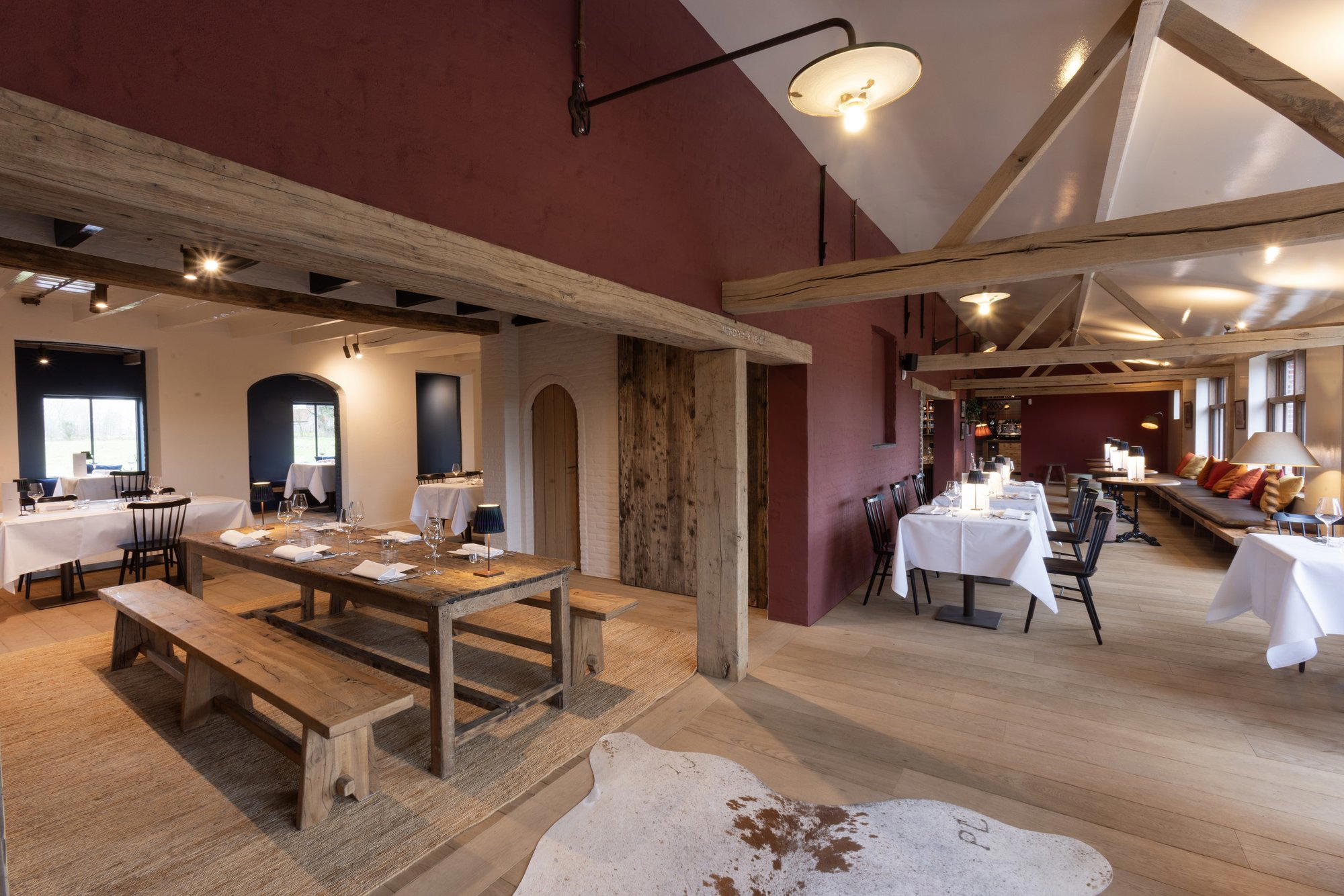
Warm, pleasant, and quiet setting with a rustic aesthetic in a rural environment, featuring friendly service from a young team.