Tabelog 100
Our verdict
CIVITAS places the Tokyo kissaten tradition inside Kamata’s department-store orbit rather than the city’s specialty-coffee circuit. Its Tabelog Kissaten 100 selections in 2021 and 2022, plus a 50-seat format and pancake-cafe identity, make it a useful counterpoint to Tokyo’s smaller reservation-led counters: accessible, old-school in rhythm, and rooted in everyday coffee-shop culture.

Pearl is the En Primeur Club membership app — saves, bookings, and concierge access live there. Same editors, same standards.
The menu
What to order
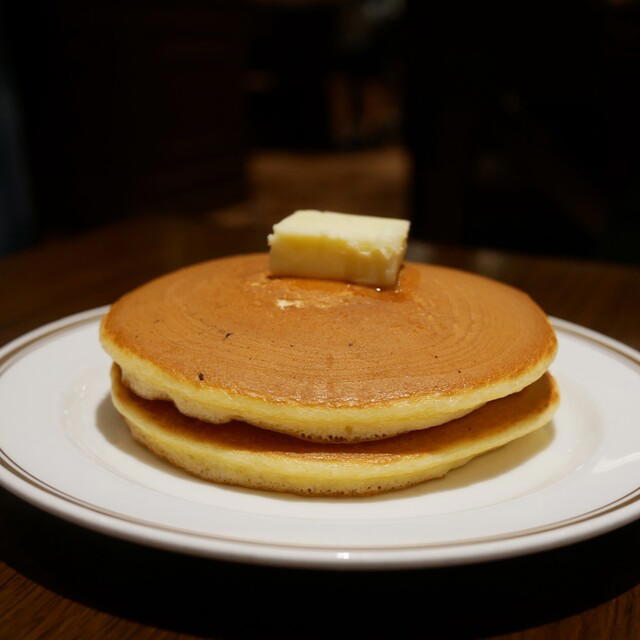
- Thick copper-plate pancakes
- Blend coffee
- Pancake set with salad and fruit
Tokyu Plaza Kamata changes the usual Tokyo coffee-shop arrival. Instead of a lanterned side street or discreet wooden door, the approach follows the escalator logic of a station-side department store: shoppers, commuters, families, and the low hum of a floor built for daily use. Here, CIVITAS belongs to a category Tokyo often protects better than it explains: the kissaten, where coffee, pancakes, counter seating, and unhurried repetition form a parallel dining culture to the city’s tasting-menu rooms.
Read it not as a café competing with third-wave espresso bars, but as a coffee-shop format shaped by Japan’s long habit of importing technique and domesticating it. Pancakes are not indigenous to Japanese cooking, yet the kissaten made Western-style sweets and coffee part of urban routine decades before latte art became a global language. The tension is imported forms, local pace. The room sits inside a commercial building, but the appeal is closer to postwar Tokyo coffee culture than lifestyle café design.
Kamata's kissaten culture favours routine over spectacle
Kamata helps explain why this kind of place matters. Less polished than Ginza and less style-driven than Aoyama, it has a food culture built around railway convenience, local regulars, and compact specialisms. Nearby comparisons tell the story: Grill Suzukou works the Western-influenced yoshoku lane, Tonkatsu Aoki Kamata honten anchors the fried-pork reputation, and Tonkatsu Aoki no Curry Ya Ippekoppe Kamata honten extends that logic into curry. CIVITAS fits the same neighbourhood grammar: not a destination built around ceremony, but an everyday format with enough recognition to draw people tracking Japan’s older coffee-shop canon.
That recognition matters because kissaten are often judged through nostalgia rather than discipline. Tabelog selected CIVITAS for its Kissaten “Tabelog 100” list in both 2021 and 2022, a stronger signal than social-media volume for this category. Its Tabelog score is 3.72, where local enthusiasm and category credibility overlap. In a city where sushi counters can be defined by lineage and French restaurants by cellar depth, a kissaten earns attention through consistency, opening rhythm, and turning modest items into habit.
The cuisine categories are plain but revealing: kissa, pancake, café. The trio places the venue closer to Japanese coffee-shop tradition than a pastry atelier. Pancakes are the global technique, but the structure is local: seated service, broad-daytime cadence, no private-room theatre, and a non-smoking room reflecting the modern cleanup of a form once associated with heavier air and longer ashtrays. It is Tokyo’s old coffee culture edited for current use.
Pancakes as imported technique, kissaten as local discipline
Tokyo’s better kissaten are not trying to win the same argument as specialty coffee bars. They focus on texture, timing, and comfort at a repeat-visit scale. CIVITAS has 50 seats and counter seating, changing the social contract. This is not the tiny counter economy of omakase, where scarcity drives experience, nor the oversized chain café model built for laptop drift. It sits between them: enough seats for steady flow, enough category focus to avoid anonymity.
The local-ingredient angle is subtler than at a farm-to-table restaurant. Kissaten cooking absorbs foreign forms, then recalibrates them for Japanese urban life: coffee service, pancakes, toast, custards, and sweets moving through a dining room where the meal can be breakfast, late lunch, or an errand break. That is why the format travels badly when reduced to aesthetics. The value is not only the plate, but how the place lets Western café habits behave according to Japanese expectations of order, quiet, and repetition.
For travellers building a Tokyo eating week, CIVITAS corrects a schedule overloaded with counters and set menus. It belongs beside, not below, formal choices. A day might move from a Kamata coffee-shop stop to a sharper city-centre meal, or from this older café grammar to contemporary visual café culture at 2D Cafe. The point is contrast. Tokyo’s dining intelligence often shows in maintaining separate lanes for pleasure: tonkatsu, curry, yakitori, kissaten, and highly designed café rooms need not collapse into one another.
That separation is visible across Tokyo. A meal at 124. KAGURAZAKA (Yakitori) or 12/10 Shinjuku ten asks the diner to think about counter timing and a more directed kitchen rhythm. 3 Chome no Curry Ya San points to specialist curry culture, while . 鮪と炭火焼き うお炭 秋葉原店 works a different register of casual intensity. CIVITAS is calmer, more domestic in scale, and more useful for reading how Tokyo absorbs Western café forms without surrendering local structure.
How to place it in a Tokyo itinerary
Use it in daytime, especially if you want a Tokyo food day that does not begin at full force. Its place in Kamata Station’s department-store ecosystem makes it more convenient than many destination cafés and less dependent on weather, neighbourhood wandering, or taxi choreography. Payment flexibility, family-friendly positioning, and stroller acceptance broaden the audience without turning the experience into a theme-park kissaten.
Accessibility has limits. The setting is not the romance of an old independent shop on a quiet lane, and travellers seeking a chef-led narrative will not find one. That is partly the point. Tokyo dining is too often sold abroad through extremes: auction-fresh sushi, hushed kaiseki, neon ramen, cocktail precision. The kissaten sits outside those clichés. It is a slower civic format, and CIVITAS has enough third-party recognition to deserve more than “convenient coffee stop.”
Use it within a broader Tokyo study, not as a single-purpose pilgrimage. The full city picture is easier to read alongside Our full Tokyo restaurants guide, with drinking context in Our full Tokyo bars guide, hotel planning through Our full Tokyo hotels guide, regional context via Our full Tokyo wineries guide, and cultural scheduling in Our full Tokyo experiences guide. For cross-city comparisons, the same question of imported forms and local editing appears at.cafe in Osaka.know in Kumamoto, (Shoku) Vietnam in Kawasaki, [Curry Senmon Ten] Maruyama Kyoju. in Sapporo, [ki:] in Kyoto, -Grilled beef Sukiyaki- KAMAKURA TANUKIAN 鎌倉 たぬき庵 in Kamakura, Jōdo Saké Bar in Los Angeles, and Onigiri Time in Pasadena.
Frequently asked questions
What's the price range at CIVITAS?
Pricing at CIVITAS is listed as - JPY 999 JPY 1,000 - JPY 1,999 View spending breakdown.
When is CIVITAS open?
Hours at CIVITAS: Mon: 10 AM–7:30 PM; Tue: 10 AM–7:30 PM; Wed: 10 AM–7:30 PM; Thu: 10 AM–7:30 PM; Fri: 10 AM–7:30 PM; Sat: 10 AM–7:30 PM; Sun: 10 AM–7:30 PM.
Where is CIVITAS located?
CIVITAS is located in Tokyo.
What's the defining dish or idea at CIVITAS?
CIVITAS is defined by the kissaten format: a Japanese coffee shop with pancake and cafe categories, not a full-service dining room. Its Tabelog 100 Kissaten selection for 2022 places it among Tokyo’s notable traditional coffee shops, and the 50-seat room with counter seating suits a daytime stop in Kamata.
Cuisine Context
Comparable venues by cuisine and price in the same metro.
| Venue | Cuisine | Price | Awards | Notes |
|---|---|---|---|---|
| CIVITASThis venue (the venue you are viewing) | Japanese kissaten cafe & pancakes | $10–20 | Tabelog 100 | Not listed |
| Verde | Traditional Japanese kissaten & cafe | $10–20 | Tabelog 100 | Shibuya |
| pointage | Bakery, bistro & café with French-influenced home cooking | $10–20 | Tabelog 100 #45 | Minato |
| JOHANN Honten | Japanese Cheesecake Shop | $1–10 | Tabelog 100 #57 | Meguro |
| Boulangerie Sudo | Artisan Japanese-French Bakery | $10–20 | Tabelog 100 #10 | Setagaya |
| Jensen | Danish-style bakery and cake shop | $1–10 | Tabelog 100 #90 | Shibuya |
Recognition history
Dated appearances from independent guides and award organizations, with the underlying list record or original source where available.
Tabelog 100
Tabelog · Tabelog 100 - Kissaten - 2026
Full recognition history (2 entries)
Tabelog 100 #86 · No. 86
Tabelog · Tabelog 100 - Kissaten - 2022