Michelin Plate
Our verdict
At the $$$ price tier, it sits below the city's three-star Italian flagships while clearly operating with ambitions that exceed its modest address. For diners tracking where the city's Italian contemporary scene is heading, it warrants attention.

Pearl is the En Primeur Club membership app, where members save venues, book tables and use the concierge.
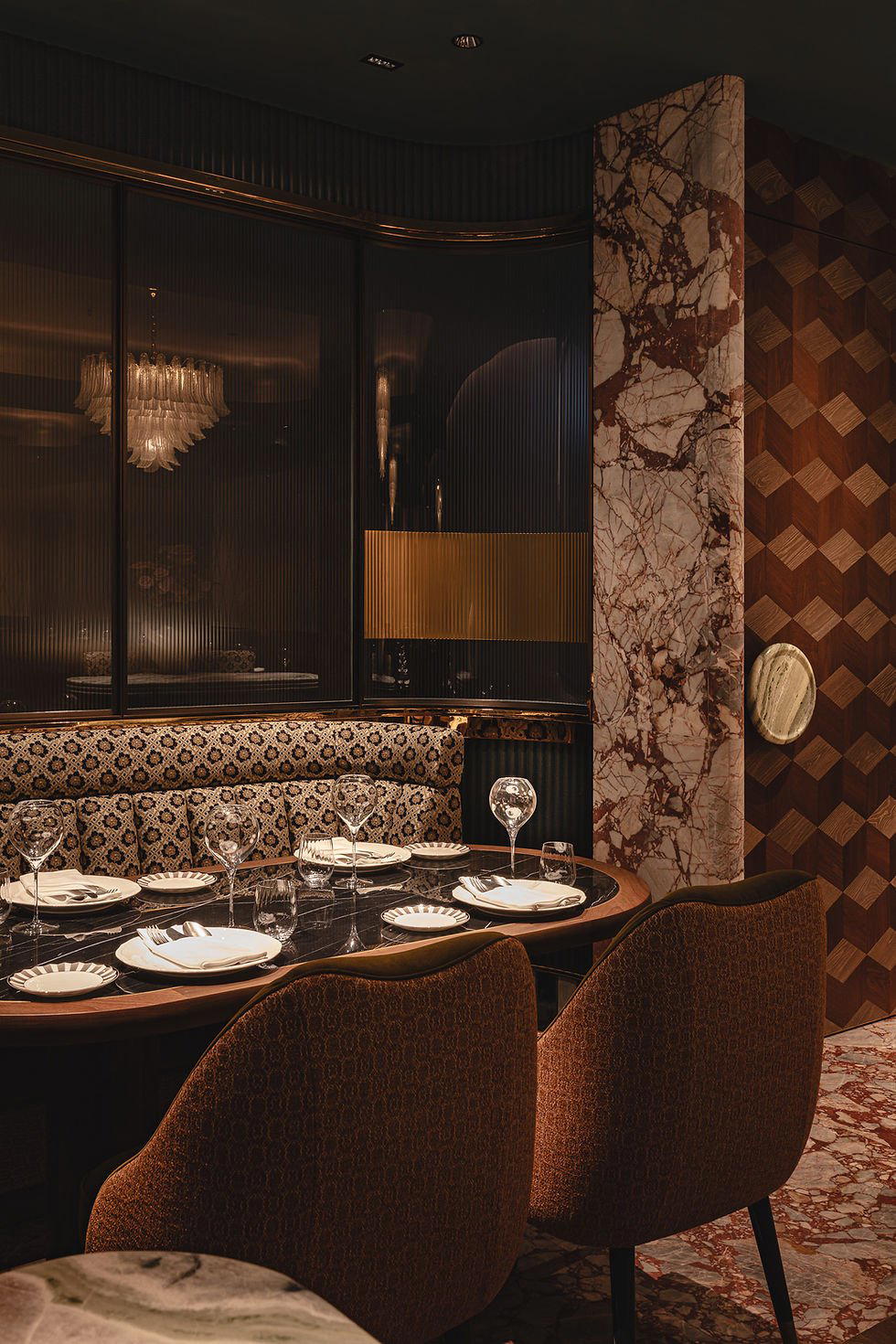
The menu
What to order
- Smoked bagna cauda
- Seasonal organic vegetable smoke bagna cauda
- Crab pasta
- Pasta alla checca
Hong Kong's contemporary Italian tier has long been dominated by addresses with grand dining rooms and correspondingly grand price structures. 8½ Otto e Mezzo Bombana holds three Michelin stars and operates at the $$$$ ceiling. Estro, the wine-bar-inflected Italian in Wan Chai, carries a Michelin star at the $$$$ tier.
Italian Contemporary in a Japanese-Influenced City
Contemporary Italian cooking in Asia has taken on its own character over the past decade. The genre's most interesting practitioners in cities like Tokyo, Singapore, and Hong Kong have absorbed local ingredient logic, seasonal rhythm, and a preference for precision without abandoning the Italian structural instincts around acidity, fat, and produce-led simplicity. Buona Terra in Singapore is one regional example of how Italian contemporary cooking adapts to an Asian context while retaining Italian credibility. Citrino da Yoshinaga Jinbo, with its hybrid name signalling both Italian citrus brightness and Japanese provenance, positions itself within that broader cross-current.
That positioning matters when you compare it against the wider Italian contemporary field. Restaurants such as Agli Amici in Rovinj, Bracali in Ghirlanda, and Atto di Vito Mollica in Florence each demonstrate how the Italian contemporary category rewards restraint and ingredient specificity over technical display. In Hong Kong, where the dominant luxury dining ethos often skews toward the demonstrably expensive, a room that operates at the $$$ tier with Michelin-level attention is filling a gap the city actually needs. Amber and Caprice represent the French end of the city's high-end spectrum, both operating with three Michelin stars and the scale that comes with hotel anchoring. Ta Vie, the Japanese-French hybrid nearby, holds three stars and demonstrates that the city's most sophisticated cooking often works precisely in the space between culinary traditions. Noi by Paulo Airaudo offers another contemporary European reference point at the high end of the market.
Against that backdrop, Citrino da Yoshinaga Jinbo does not compete for the same diner on the same night. At this scale, with this pricing, the kitchen's work is evaluated closely: every cover matters, and the consecutive Michelin Plate citations confirm that the guide's inspectors have found consistency worth noting across two separate assessment cycles.
Sourcing, Restraint, and the Sustainability Question
Contemporary Italian cooking's strongest trend globally has shifted toward shorter supply chains and a more candid relationship with what producers can and cannot offer by season. The Italian contemporary restaurants that have earned sustained critical attention in recent years, from Ca' Matilde in Rubbianino to Amistà in Corrubbio and L'Olivo in Anacapri, tend to share an orientation toward seasonal discipline and producer relationships that reduce waste by constraining choice.
In Hong Kong, a city that imports the vast majority of its food, a kitchen operating at Citrino da Yoshinaga Jinbo's price tier faces a structural challenge that three-star rooms with larger budgets can absorb more easily. The most credible response to that challenge, across the city's more thoughtful restaurants, has been to reduce the number of ingredients in play, extend the use of whole products across multiple courses, and source from suppliers already embedded in the city's Japanese-influenced fine dining networks. What the consecutive Michelin recognition does imply is that the kitchen has found a repeatable, considered approach rather than one that depends on expensive imported luxury goods alone. At the $$$ tier, that kind of constraint is often the mother of the most interesting cooking.
The Italian contemporary category internationally has also become more candid about fish and seafood sourcing as Mediterranean and global stocks shift. Restaurants like Antonello Colonna Labico have built reputations in part on honest communication about ingredient provenance. In a city where the seafood supply chains are complex and the premium for perceived rarity is high, a kitchen that treats provenance as a culinary argument rather than a marketing one occupies a more credible position. For the wider city context across categories, our full Hong Kong restaurants guide maps the complete dining landscape, while our Hong Kong hotels guide, bars guide, wineries guide, and experiences guide cover the broader visit. Given the room's scale and the specificity of its audience, booking ahead is advisable rather than optional.
Frequently asked questions
What distinctions does Citrino da Yoshinaga Jinbo have?
Citrino da Yoshinaga Jinbo has received recognition including: Michelin Plate (2025); Michelin Plate (2024).
What's Citrino da Yoshinaga Jinbo's location?
Citrino da Yoshinaga Jinbo is located at 2F, On Lan 18, 18 On Lan St, Central, Hong Kong, Hong Kong.
What's the best thing to order at Citrino da Yoshinaga Jinbo?
Citrino da Yoshinaga Jinbo holds a Michelin Plate for 2024 and 2025, which reflects consistent kitchen execution rather than a single standout dish. The contemporary Italian format suggests a menu built around composed courses rather than à la carte crowd-pleasers. For a room at this level in Central, following the kitchen's own sequencing, whatever the current tasting or set menu offers, is the more reliable approach than singling out one item.
Is Citrino da Yoshinaga Jinbo focused on a specific cuisine style?
What's the pricing like at Citrino da Yoshinaga Jinbo?
Pricing at Citrino da Yoshinaga Jinbo is listed as $$$.
Awards and Standing
A small set of peers for context, based on recorded venue fields.
| Venue | Cuisine | Price | Awards | Notes |
|---|---|---|---|---|
| Citrino da Yoshinaga JinboThis venue (the venue you are viewing) | Nippon-Italian Fine Dining | $150–200 | Michelin Plate | Not listed |
| 8 1/2 Otto e Mezzo Bombana (Hong Kong) | 3 Michelin-Star Italian Fine Dining | $200–300 | 3 Michelin Stars · World's 50 Best #94 | Italian |
| Ta Vie | Modern French-Japanese Fine Dining | $300–500 | 3 Michelin Stars · World's 50 Best #68 | Japanese - French, Innovative |
| Caprice | Contemporary French Fine Dining | $200–300 | 3 Michelin Stars · World's 50 Best #35 | French, French Contemporary |
| Feuille | Modern Vegetable-Forward French | $200–300 | 1 Michelin Star · World's 50 Best #93 | French Contemporary |
| Neighborhood | Modern French with Asian Influences | $50–100 | 1 Michelin Star · World's 50 Best #24 | International, European Contemporary |
Recognition history
Dated appearances from independent guides and award organizations, with the underlying list record or original source where available.
Michelin Plate
Michelin
Full recognition history (3 entries)
Michelin Plate
Michelin
Michelin Plate
Michelin