Cioppino's
Cioppino's sits at 400 Jefferson Street in San Francisco's Fisherman's Wharf, the neighborhood that gave the city's signature fish stew its name and its myth. The address places it squarely within the tradition of waterfront seafood dining that defined San Francisco's culinary identity long before the Michelin era arrived. For visitors tracing the origins of California coastal cooking, the location carries its own argument.
Pearl is the En Primeur Club membership app — saves, bookings, and concierge access live there. Same editors, same standards.
- Address
- 400 Jefferson St, San Francisco, CA 94109
- Phone
- +14157759311
- Website
- cioppinosf.com
- Directions
- Get directions
 Saves & bookings on Pearl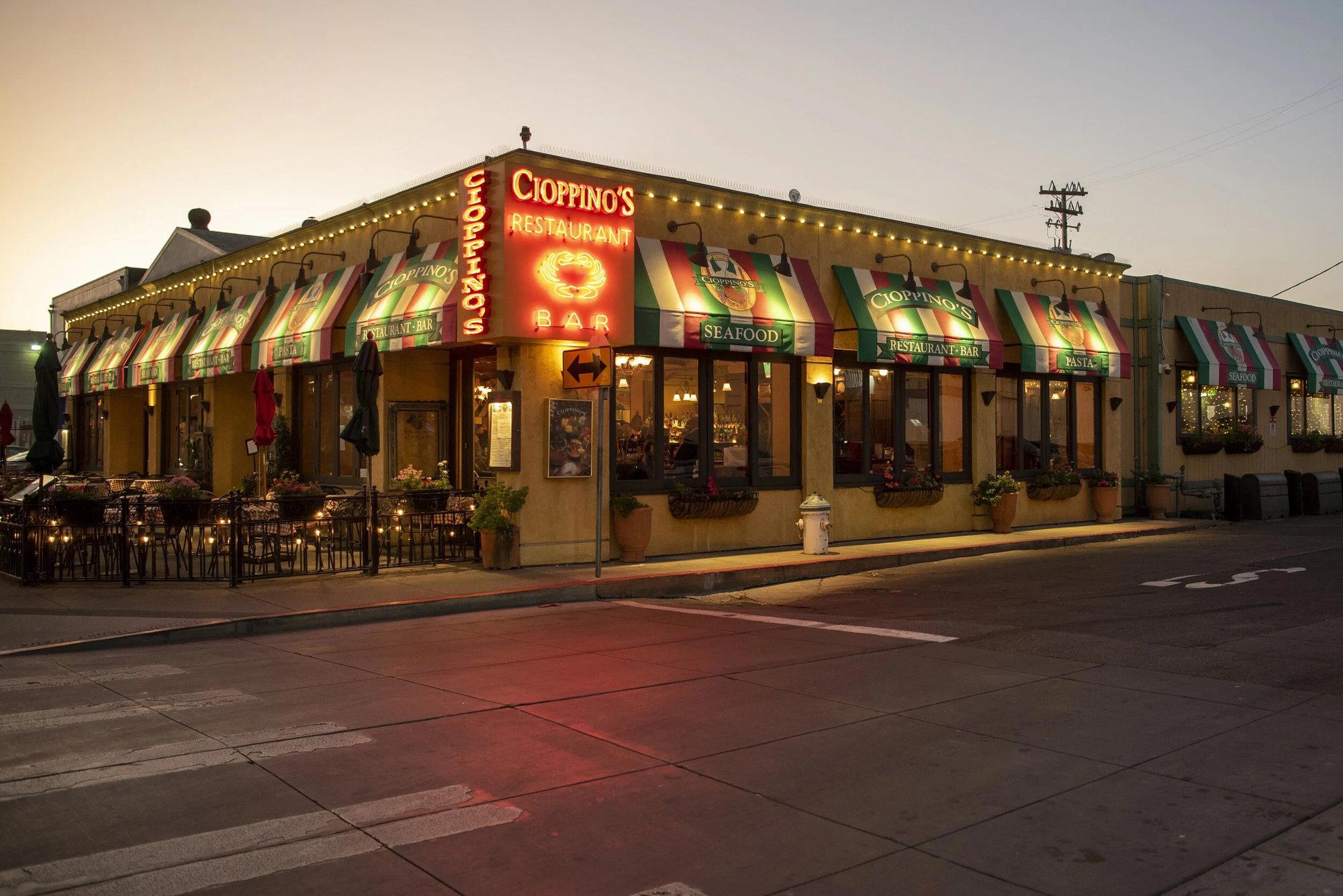
Where the Stew Was Born: San Francisco's Waterfront Seafood Tradition
Fisherman's Wharf is one of those rare addresses that functions as both a place and a cultural argument. The fog comes off the Bay in the morning with enough weight to feel deliberate, and the smell of the water arrives before you see it. Jefferson Street, running along the wharf's commercial spine, has housed the kind of cooking that predates the city's current fine-dining conversation by several generations. This is where San Francisco's fishing community fed itself and, eventually, everyone else. The restaurants along this stretch are not operating in opposition to the city's contemporary food culture at Lazy Bear or Atelier Crenn, they are its origin point.
Cioppino's, at 400 Jefferson Street, occupies that tradition directly. The name itself is the story: cioppino, the tomato-and-wine fish stew assembled from the daily catch by Italian and Portuguese immigrant fishermen in the late nineteenth century, is as close to a native San Francisco dish as the city has produced. It predates the farm-to-table rhetoric, predates the tasting menu format that now defines establishments like Benu and Quince, and predates the wine-pairing consciousness that shapes rooms like Saison. A restaurant named for that dish, on that street, is making a specific claim about where it sits in the city's cooking history.
The Sensory Register of the Wharf
Walking toward Cioppino's on Jefferson, the atmospheric cues are cumulative. The wharf's working character has softened considerably over the decades as tourism consolidated around sourdough bread bowls and crab stands, but the underlying logic of the place, proximity to the water, kitchens built around whatever came off the boats, has not entirely disappeared. The light along this stretch changes fast, filtered through sea air in a way that gives the late afternoon a particular flatness. By evening, the pedestrian energy shifts: the day-trip crowds thin and the people who remain tend to be there with a specific meal in mind.
The address places Cioppino's inside the wharf's most concentrated seafood corridor, where the cooking has always been organized around the same core proposition: dungeness crab, clam, mussel, shrimp, and fin fish, brought together in a broth built from tomato, wine, and patience. That combination is not a menu innovation, it is a regional protocol, one that connects this stretch of San Francisco to the cooking of the Italian Riviera and the Azores by way of immigration and adaptation. The same logic, applied with more institutional ambition, drives acclaimed seafood programs at Le Bernardin in New York City and Providence in Los Angeles, though the registers are entirely different.
Cioppino in the City That Named It
The dish's origin story is debated, as origin stories tend to be. What is documented is that the stew became associated with San Francisco's Italian immigrant fishing community, particularly in the North Beach and Fisherman's Wharf neighborhoods, by the early twentieth century. The name likely derives from a Ligurian dialect word for chopped or mixed fish. In its original form it was a pragmatic dish, whatever the catch provided, combined with pantry staples, and that flexibility is still reflected in how different kitchens along the wharf interpret it today. Some run heavy on Dungeness crab in season (peak season typically runs November through June); others anchor the bowl with clams and mussels and treat the fin fish as secondary.
For context on how regional American cooking traditions hold their ground against the current tasting-menu dominance, it is worth noting what happens in comparable coastal cities. New Orleans has institutions like Emeril's that hold the line between tradition and contemporary technique. Napa's The French Laundry operates in an entirely different register, but the wine country's farm-driven ethos and the wharf's catch-driven ethos are not as far apart philosophically as the price gap suggests. Places like Single Thread Farm in Healdsburg and Blue Hill at Stone Barns make source-proximity the center of the argument; Fisherman's Wharf has been doing a version of that longer than either.
Where Cioppino's Sits in the San Francisco Dining Picture
San Francisco's current dining conversation is largely conducted at the summit of the price register. The city's Michelin-starred cohort, including the restaurants linked throughout this piece, operates in the $$$$ bracket and competes on technique, seasonal programming, and wine depth. The restaurant at 400 Jefferson sits outside that conversation, positioned instead within the city's coastal-casual and heritage-seafood tier: a category that has its own logic, its own regulars, and its own relationship to the city's food history that the tasting-menu rooms do not replicate.
That positioning matters for how a visitor should think about the visit. This is not the right address if the goal is to benchmark San Francisco's contemporary fine-dining output against peers like Smyth in Chicago, Addison in San Diego, Frasca Food and Wine in Boulder, Atomix in New York City, or The Inn at Little Washington. It is the right address if the goal is to eat a dish in the neighborhood that gave it its name, with the water close enough that the context is part of the meal. Those are different purposes, and neither is wrong, they just require different expectations walking in.
For a fuller map of the city's dining options across price tiers and cuisines, the EP Club San Francisco restaurants guide covers the range from the wharf to the Mission to SoMa's destination kitchens. Italian-leaning rooms with a different approach to the same tradition appear at Atelier Moessmer Norbert Niederkofler in Brunico, where the Alpine-Italian sourcing philosophy shares a commitment to place-specificity, if not much else.
Planning Your Visit
The restaurant is located at 400 Jefferson Street, San Francisco, CA 94109, in the Fisherman's Wharf district. Reservations are recommended. Timing: Dungeness crab season (November through June) is the period when the dish most closely reflects its original form; visiting outside that window means the crab component may be sourced differently. Dress: Casual. Budget: About $30 per person.
Price and Recognition
Comparable venues nearby, for context on price, style, and recognition.
| Venue | Cuisine | Price | Notes |
|---|---|---|---|
| Cioppino'sThis venue — the venue you are viewing | North Beach, Italian Seafood | $$ | Not listed |
| Vega | Not listed | $$ | Bernal Heights, Authentic Italian with Pizza and Pasta |
| Per Diem - Financial District | Not listed | $$ | Financial District/South Beach, Californian-Italian |
| Bruno's | Not listed | $$ | Financial District/South Beach, Italian Pizza and Grill |
| Montesacro SoMa | South of Market, Roman Pinseria | $$ | Not listed |
| Original Joes | Not listed | $$ | West of Twin Peaks, Classic Italian-American |
Continue exploring
More in San Francisco
Restaurants in San Francisco
Browse all →
Bars in San Francisco
Browse all →
Hotels in San Francisco
Browse all →
At a Glance
- Classic
- Well Known
- Special Occasion
- Family
- Historic Building
- Extensive Wine List
- Local Sourcing
- Sustainable Seafood
- Street Scene
Current opening hours
- Monday
- 11 AM–9:30 PM
- Tuesday
- 11 AM–9:30 PM
- Wednesday
- 11 AM–9:30 PM
- Thursday
- 11 AM–9:30 PM
- Friday
- 11 AM–10 PM
- Saturday
- 11 AM–10 PM
- Sunday
- 11 AM–9:30 PM
Hours can change for holidays and private events. Last verified .
Classic seafood house atmosphere celebrating San Francisco's fishing heritage with fresh catches and Italian influences.