
Open since 1894, Chocolatería San Ginés occupies a narrow pasadizo off Calle Arenal and has become the fixed point around which Madrid's late-night eating culture orbits. The format is unchanged: porras and churros served with thick drinking chocolate, around the clock, to a crowd that runs from tourists at noon to club-goers at 4am. Booking is not an option, you queue, you sit, you order.
Pearl is the En Primeur Club membership app — saves, bookings, and concierge access live there. Same editors, same standards.
- Address
- Pasadizo de San Ginés, 5, Centro, 28013 Madrid, Spain
- Phone
- +34 913 65 65 46
- Website
- chocolateriasangines.com
- Directions
- Get directions
 Saves & bookings on Pearl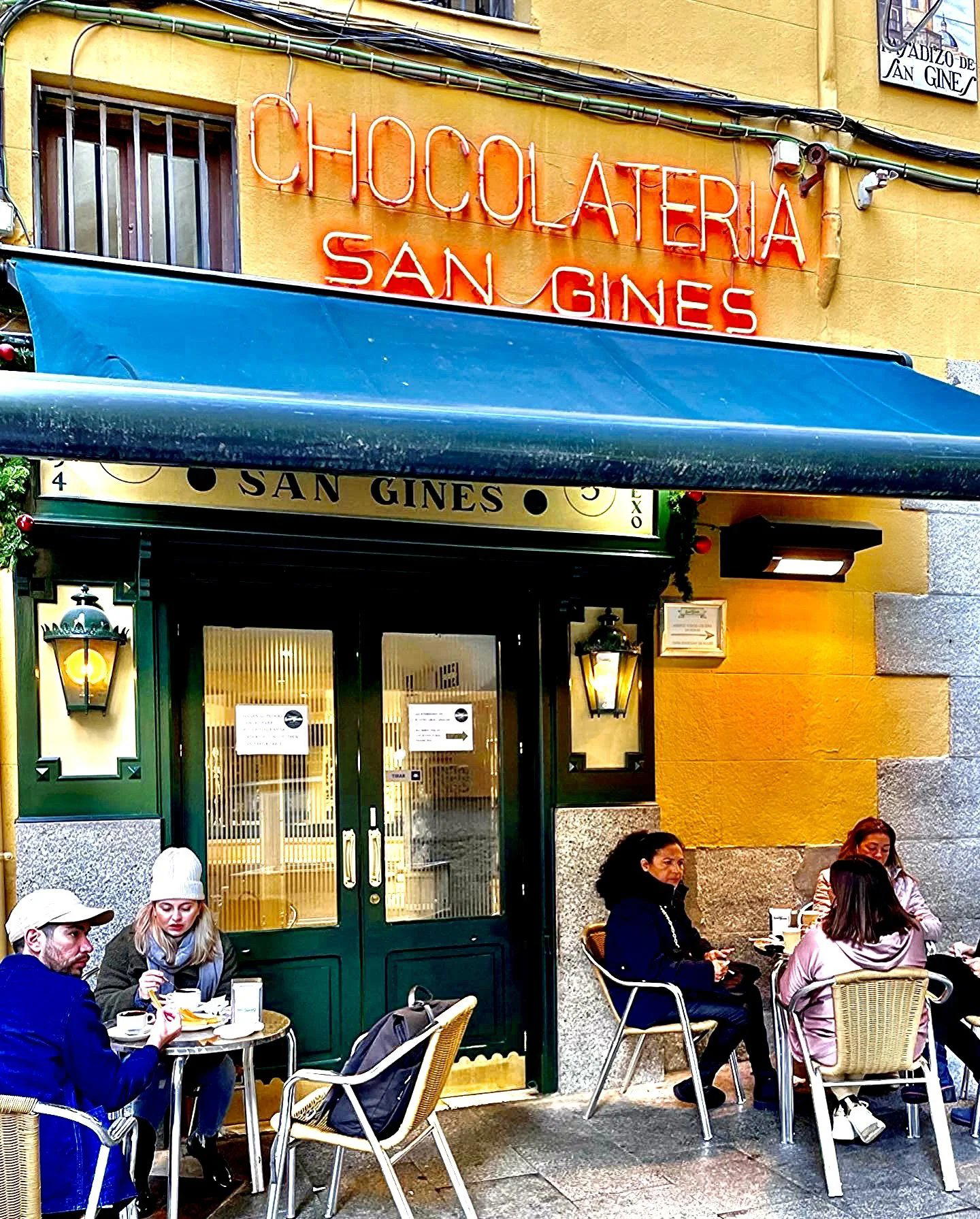
The Pasadizo at Any Hour
Approach Pasadizo de San Ginés from Calle Arenal on a winter night and the scene arranges itself before you reach the door: a narrow alley lit in warm yellow, marble-topped tables visible through glass, and a counter working at speed regardless of the hour. The building has served chocolate and fried dough since 1894, and the interior holds that history without performing it. Green and white tilework, mirrored walls, and a pressed-tin ceiling give the room a density that newer cafés in the Centro neighbourhood tend to imitate without replicating. The physical environment is the product of continuity, not renovation.
Madrid's relationship with churrerías is distinct from the tourist shorthand of "Spanish breakfast." In a city where dinner rarely begins before 10pm and clubs close at dawn, the chocolatería functions as a social pivot point across three separate eating occasions in a single calendar day: late breakfast, afternoon merienda, and post-club sustenance. San Ginés operates continuously through all of them. That 24-hour model, sustained for well over a century, is what separates it from the dozens of competent churrerías scattered across the city's barrios.
What the Format Actually Is
The menu at San Ginés is narrow by design, which is a feature of the tradition rather than a limitation. Churros (thin, ridged sticks) and porras (thicker, crispier cylinders) come alongside cups of chocolate espeso, a drinking chocolate so thick it holds a spoon upright. The combination is not sweetness stacked on sweetness: the chocolate's bitterness calibrates against the fried dough in a way that rewards unhurried eating. That pairing has remained structurally unchanged since the 19th century, and the establishment's longevity is partly a function of resisting the urge to complicate it.
For the broader context of Spain's fine-dining circuit, San Ginés operates in an entirely different register. Madrid's contemporary restaurant scene includes some of the country's most technically demanding tables: DiverXO holds three Michelin stars with a progressive Asian-Spanish format, Coque and Deessa represent modern Spanish creativity at the leading price bracket, and DSTAgE and Paco Roncero anchor the city's tasting-menu tier. San Ginés exists completely outside that competitive set. Its peer group is the institution: Café de Mahón, the old-school cafeterías of Moncloa, the churrerías of La Latina on Sunday mornings. The comparison that matters is durability, not technique.
The Booking Question, and Why It Doesn't Apply Here
San Ginés does not take reservations. This is not an oversight or an operational failure; it is the defining logistical fact of visiting. Walk-in queuing is standard at all hours, though the dynamics of the queue shift significantly depending on when you arrive. Midday on a weekend puts you in a line dominated by international visitors who have read the same guides. Late afternoon on a weekday is faster, the crowd more mixed. Between midnight and 4am, particularly on Friday and Saturday, when the surrounding streets empty and refill as the club circuit turns over, the room runs at full capacity with a different kind of energy entirely: post-Kapital, post-Joy Eslava, post-wherever, with orders placed quickly and tables turned fast.
For visitors planning a broader Madrid eating itinerary, the temporal logic matters. San Ginés works as a closer rather than an opener: pair it with a late dinner in the Centro or Malasaña neighbourhoods, then walk to the pasadizo when other kitchens have stopped. The establishment's location, steps from Puerta del Sol and a short walk from the Ópera metro station, makes it geographically central enough to anchor the end of almost any evening route in the city's core.
The wider Spanish dining circuit
Visitors to Madrid who treat San Ginés as a single stop in a wider Spanish food trip will find it sits at one extreme of the country's dining range. At the other end, Spain's three-star circuit includes Quique Dacosta in Dénia, Arzak in San Sebastián, Azurmendi in Larrabetzu, and Martín Berasategui in Lasarte-Oria. Regional institutions like Aponiente in El Puerto de Santa María, Cocina Hermanos Torres in Barcelona, El Celler de Can Roca in Girona, Ricard Camarena in València, Mugaritz in Errenteria, and Atrio in Cáceres represent the breadth of what serious Spanish dining now covers. San Ginés belongs to none of those conversations, which is precisely the point. It belongs to a different tradition: the café institution that persists through cultural change rather than responding to it.
Internationally, the comparison cases are similarly outside fine dining. Le Bernardin in New York City and Lazy Bear in San Francisco operate in the tasting-menu tier where advance booking, timed arrival, and format discipline define the experience. San Ginés operates on precisely the opposite logic: no booking, no tasting menu, no chef narrative, no seasonal programme. The continuity of the format is the programme.
Planning Around It
The practical case for visiting San Ginés is strongest during winter months, when the cold outside makes the warm interior and hot chocolate feel calibrated to the season rather than simply traditional. Spring and summer bring the pasadizo's tables into sharper competition with Madrid's terrace culture, and the volume of visitors increases accordingly. In January and February, when post-holiday tourism drops and the city returns to a more local rhythm, the queue is shorter and the experience closer to what the room has been for most of its 130-year history.
Peers Worth Knowing
Comparable venues nearby, for context on price, style, and recognition.
| Venue | Cuisine | Price | Notes |
|---|---|---|---|
| Chocolatería San GinésThis venue — the venue you are viewing | Traditional Spanish Churros con Chocolate | $ | Not listed |
| La Tita Rivera | Modern Spanish Tapas | $ | Chueca |
| Casa Toni | Traditional Spanish Tapas | $ | Sol |
| El Escaldon | Traditional Canarian | $$ | La Latina |
| Fismuler | Modern Spanish with Nordic influences | $$ | Almagro |
| Castizo Serrano | Traditional Spanish Tapas | $ | Recoletos |
Recognition history
Dated appearances from independent guides and award organizations, with the underlying list record or original source where available.
Opinionated About Dining Newly Added European Restaurants
Opinionated About Dining
Opinionated About Dining Cheap Eats in Europe Ranked #61
Opinionated About Dining
Continue exploring
More in Madrid
Restaurants in Madrid
Browse all →
Bars in Madrid
Browse all →
Hotels in Madrid
Browse all →


At a Glance
- Classic
- Well Known
- Cozy
- Historic
- Late Night
- Casual Hangout
- Brunch
- Historic Building
- Terrace
- Street Scene
Current opening hours
- Monday
- Open 24 hours
- Tuesday
- Open 24 hours
- Wednesday
- Open 24 hours
- Thursday
- Open 24 hours
- Friday
- Open 24 hours
- Saturday
- Open 24 hours
- Sunday
- Open 24 hours
Hours can change for holidays and private events. Last verified .
Traditional atmosphere with marble counters, green walls, historic photos, and tiled features evoking old Madrid.