
Among Barcelona's oldest restaurants, Can Culleretes has anchored Catalan cooking in the Barri Gòtic since 1786, making it one of the longest-operating restaurants in Spain. Where the city's creative fine-dining scene chases novelty, Can Culleretes holds to the repertoire of traditional Catalan cuisine, stews, salt cod preparations, and game dishes executed with the consistency that only institutional continuity can produce.
Pearl is the En Primeur Club membership app — saves, bookings, and concierge access live there. Same editors, same standards.
- Address
- Carrer d'en Quintana, 5, Ciutat Vella, 08002 Barcelona, Spain
- Phone
- +34933173022
- Website
- culleretes.com
- Directions
- Get directions
 Saves & bookings on Pearl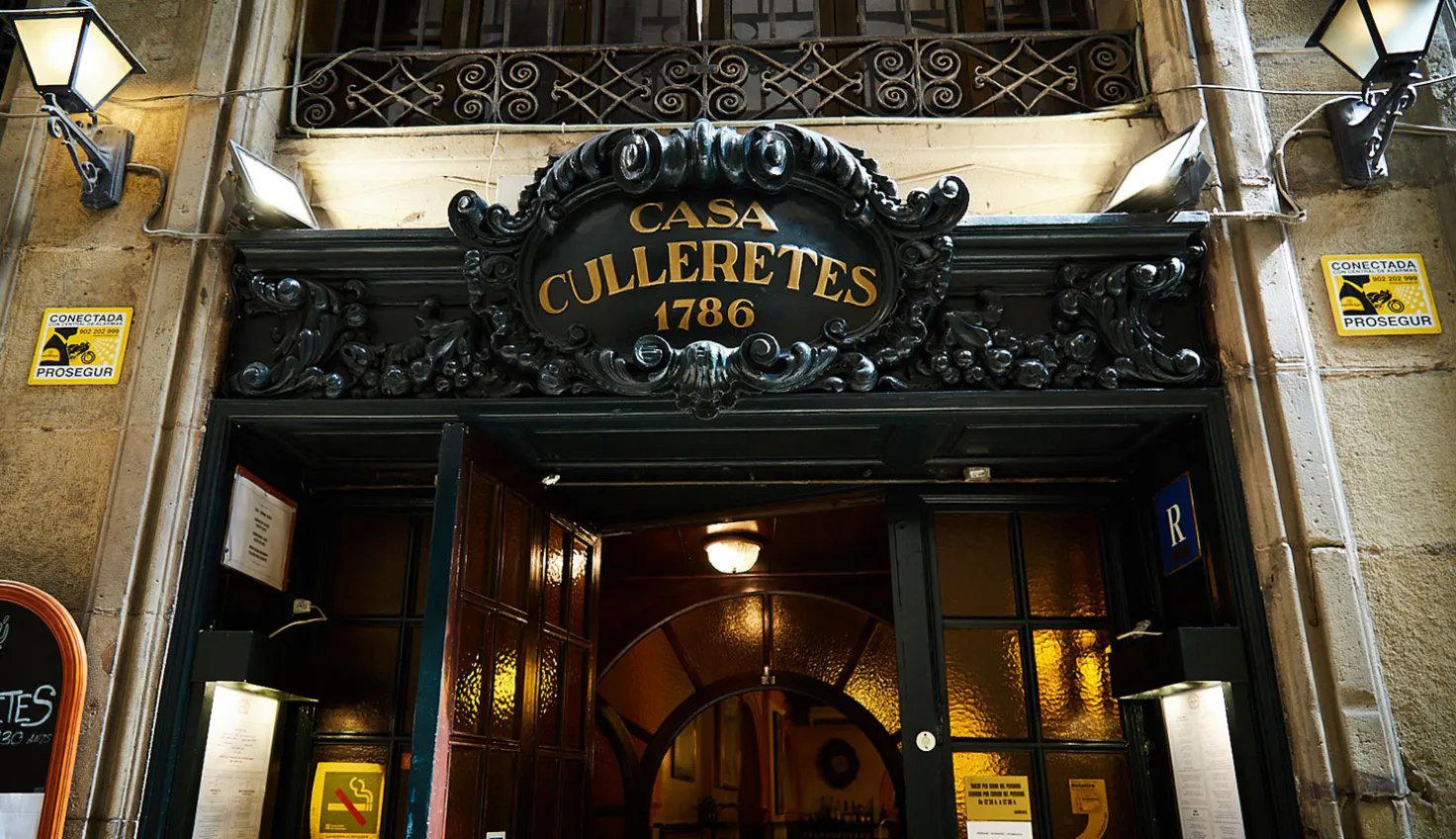
A Dining Room That Predates the Modern Restaurant
Barcelona's Barri Gòtic accumulates centuries in layers, and Carrer d'en Quintana sits deep inside that compression. Can Culleretes occupies a building that has been operating as a restaurant since 1786, placing it among the oldest continuously running dining establishments in Spain, and in the Guinness World Records for that distinction. Approaching from the narrow street, the facade is neither grand nor theatrical. Inside, the dining rooms are dense with framed photographs, ceramic tiles, and the particular patina that accumulates over decades of service rather than a week of interior design. The room reads as a document before a single dish arrives.
This physical environment matters editorially because it is not a reproduction. The Barri Gòtic has absorbed a great deal of tourist-facing reconstruction, and restaurants that trade on a manufactured version of old Catalonia are easy to find. Can Culleretes is not trading on an aesthetic; the aesthetic is a byproduct of operating continuously in the same neighbourhood for more than two centuries. That distinction is what separates institutional restaurants from heritage-themed ones, and it is why the Guinness recognition lands as context rather than marketing.
The Catalan Repertoire and Where It Sits in Barcelona's Dining Map
Barcelona's premium dining conversation today is dominated by progressive and creative formats: Disfrutar (Progressive, Creative), Cocina Hermanos Torres (Creative), ABaC (Creative), Lasarte (Progressive Spanish, Creative), and Enigma (Creative) all operate in a tier defined by tasting menus, Michelin recognition, and the expectation of technical transformation. That tier is strong and growing. What it does not do is preserve the Catalan cooking that existed before that era of transformation. Can Culleretes operates in a different position entirely, closer to what Spanish food historians would recognise as cuina de la mare, the domestic-turned-professional register of dishes that are built around slow processes, seasonal protein, and the sauces that have defined Catalan cooking for generations.
The repertoire includes preparations associated with traditional Catalan cooking: escudella i carn d'olla (a slow-cooked meat and vegetable broth), salt cod in its various forms, and game dishes in autumn. These are not innovations or reinterpretations. They are the dishes cooked in this region for generations, produced here with the consistency of an operation that has refined the same recipes over time rather than overhauling its menu seasonally in response to trends. Across Spain, the restaurants maintaining this kind of fidelity are rarer than they should be. El Celler de Can Roca in Girona operates at the opposite creative extreme while still citing traditional Catalan flavour as its foundation; Can Culleretes provides the foundation itself, without the transformation.
Service as Continuity: The Team Dynamic at an Institutional Restaurant
The team dynamic between chef, sommelier, and front-of-house applies differently at an institutional restaurant than at a contemporary tasting-menu counter. At venues like Quique Dacosta in Dénia or Mugaritz in Errenteria, the collaboration between kitchen, cellar, and floor is choreographed around a progressive format where each element is designed to reinforce the others. At the restaurant, the team dynamic is built around a different kind of collaboration: the transmission of practice across generations of the same family.
The restaurant has been operated by successive generations of the Agut family, which provides a structural continuity that most restaurants, however technically accomplished, cannot replicate. The front-of-house knowledge at a multigenerational institution accumulates differently from staff training at a newly opened venue. Long-serving servers at places like this carry institutional memory: which dishes are ordered together, which wines from the Catalan region pair with specific preparations, which tables regulars prefer. That depth of operational knowledge is a form of service intelligence that does not appear on a wine list or a press release, but it is legible to a regular diner within the first ten minutes of a meal. Across Spain, the restaurants that sustain this kind of family-led continuity include Arzak in San Sebastián and Martin Berasategui in Lasarte-Oria, both multigenerational in their own ways, though operating at the Michelin three-star tier with a fundamentally different format and price point.
The wine programme at the restaurant, as would be expected from a Catalan institution, draws on the region's own appellations. Penedès and Priorat are the obvious reference points for Catalan wine, but a serious house list at this level of institutional longevity also tends to include older vintages of Catalan producers rarely seen outside specialist cellars. That kind of depth, if present, distinguishes a restaurant from a dining room that simply stocks local wine for proximity reasons. Comparative examples across Europe, Le Bernardin in New York City and Lazy Bear in San Francisco, illustrate how front-of-house and sommelier collaboration defines the experience tier even when the cuisine styles differ radically.
Can Culleretes in the Wider Spanish Context
Spain's restaurant conversation is often framed around its creative avant-garde, and with good reason: DiverXO in Madrid, Aponiente in El Puerto de Santa María, Azurmendi in Larrabetzu, and Atrio in Cáceres represent a level of creative ambition that has made Spanish cooking among the more discussed in the world over the past three decades. Ricard Camarena in València adds a regional dimension to that creative conversation. But behind that contemporary tier sits a set of older houses that formed the culinary culture those chefs grew up in and, in many cases, were trained against. The restaurant is one of the clearest surviving examples of that foundational layer in Catalonia. It does not compete with the creative tier; it pre-dates it.
For a traveller whose Barcelona itinerary already includes a tasting menu at one of the city's progressive counters, a meal at the restaurant provides an instructive contrast rather than a redundant one. The same Catalan ingredients, salt cod, game, legumes, the sofregit base, appear in both contexts, and seeing where the tradition sits before it is transformed makes the transformation legible.
Know Before You Go
- Address: Carrer d'en Quintana, 5, Ciutat Vella, 08002 Barcelona, Spain
- Neighbourhood: Barri Gòtic, central Barcelona
- Cuisine: Traditional Catalan
- Price range: Around $30 per person
- Reservations: Essential
- Hours: Tue: 1–3:30 PM; Wed: 1–3:30 PM; Thu: 1–3:30 PM, 8–10 PM; Fri: 1–3:30 PM, 8–10 PM; Sat: 1–3:30 PM, 8–10 PM; Sun: 1–3:30 PM
- Established: 1786
Just the Basics
Comparable venues nearby, for context on price, style, and recognition.
| Venue | Cuisine | Price | Notes |
|---|---|---|---|
| Can CulleretesThis venue — the venue you are viewing | Barri Gotic, Traditional Catalan | $$ | Not listed |
| Irati Taverna Basca | Barri Gotic, Authentic Basque Pintxos | $$ | Not listed |
| El Pintxo De Petritxol | Not listed | $$ | Barri Gotic, Authentic Basque Pintxos & Spanish Tapas |
| Pepa Tomate Parlament | Sant Antoni, Modern Catalan Tapas | $$ | Not listed |
| Restaurant Pasa Tapas | Not listed | $$ | Sant Pere, Santa Caterina i la Ribera, Traditional Spanish Tapas & Paella |
| Demo Gastrobar | Not listed | $$ | la Vila de Gracia, Modern Spanish Gastrobar Tapas |
Recognition history
Dated appearances from independent guides and award organizations, with the underlying list record or original source where available.
Macarfi 6.7 Food Rating
Macarfi
Continue exploring
More in Barcelona
Restaurants in Barcelona
Browse all →
Bars in Barcelona
Browse all →
Hotels in Barcelona
Browse all →
At a Glance
- Classic
- Historic
- Well Known
- Cozy
- Special Occasion
- Group Dining
- Family
- Historic Building
- Local Sourcing
Current opening hours
- Monday
- Closed
- Tuesday
- 1–3:30 PM
- Wednesday
- 1–3:30 PM
- Thursday
- 1–3:30 PM, 8–10 PM
- Friday
- 1–3:30 PM, 8–10 PM
- Saturday
- 1–3:30 PM, 8–10 PM
- Sunday
- 1–3:30 PM
Hours can change for holidays and private events. Last verified .
Warm and spacious historic interior with ornate tiled walls, classic murals, wooden chairs, white tablecloths, and bright landscape paintings creating a comfortable, familial atmosphere.