One of Central Europe's most historically anchored café institutions, Café Gerbeaud has occupied the same corner of Budapest's Vörösmarty tér since 1858. The grand interiors, marble-topped tables, and steady calendar of visitors place it firmly in the tradition of the Viennese-Hungarian coffeehouse, a format that shaped urban intellectual life across the region for over a century. This is where Budapest's café culture becomes architecture, ritual, and civic space simultaneously.
 Discover on Pearl
Pearl is the En Primeur Club membership app — saves, bookings, and concierge access live there. Same editors, same standards.
- Address
- Budapest, Vörösmarty tér 7-8, 1051 Hungary
- Phone
- +36 1 429 9000
- Website
- gerbeaud.hu
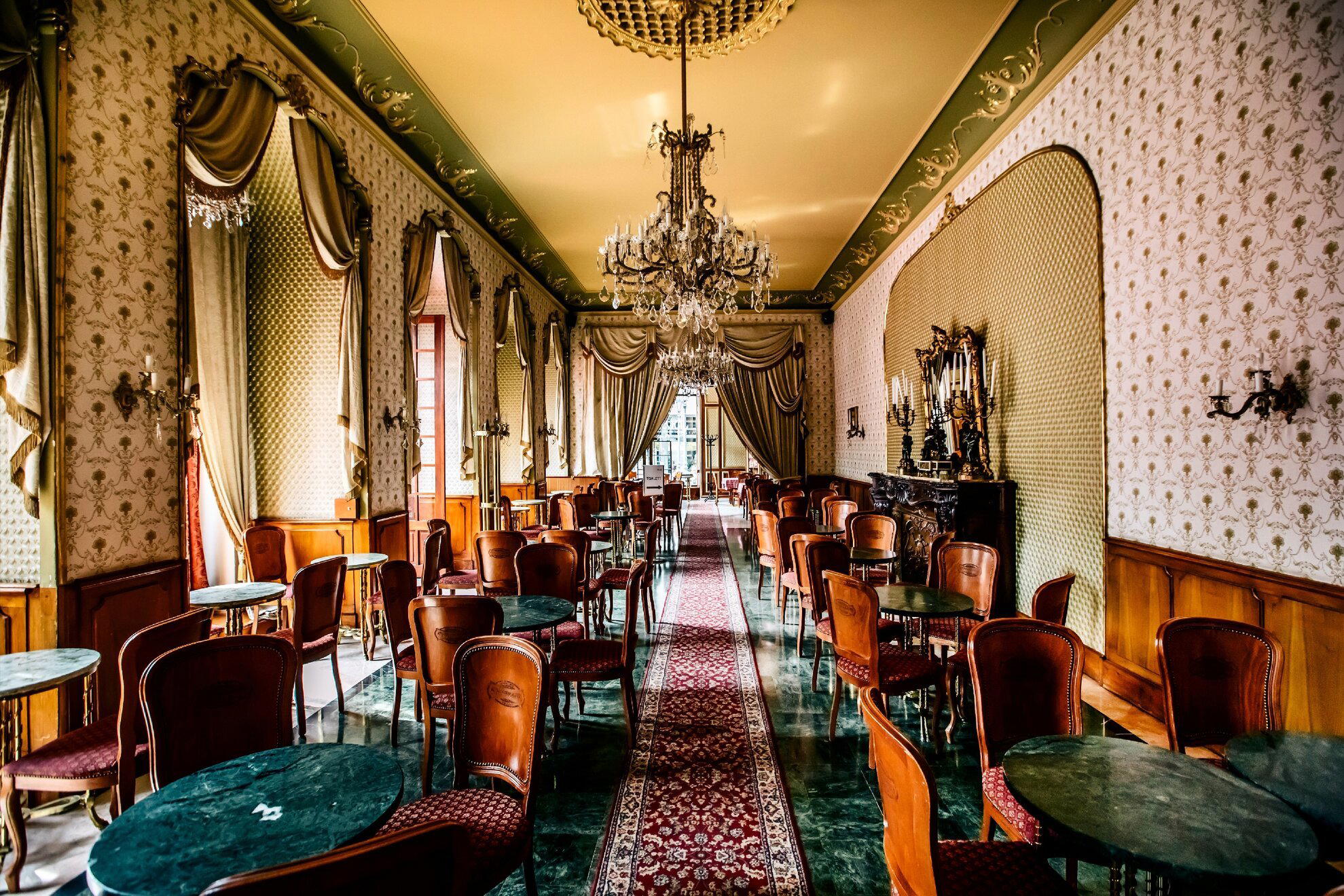
Where Budapest's Café Culture Became Architecture
Vörösmarty tér, the pedestrianised square at the Pest end of the Váci utca shopping corridor, functions as one of Budapest's few genuine civic gathering points. In summer it fills with market stalls and tourist foot traffic; in winter it hosts the city's most photographed Christmas market. At its northern edge, Café Gerbeaud has held its position since 1858, making it one of the longest-running continuously operating café institutions in Central Europe. Its three-storey neoclassical building with gilded signage facing the square explains why the venue appears in virtually every historical account of Budapest's coffeehouse era.
The Central European coffeehouse was never simply a place to drink coffee. From Vienna to Prague to Budapest, these institutions functioned as extensions of public intellectual life: spaces where newspapers were read aloud, political arguments ran long past midnight, and the line between social visiting and intellectual work dissolved entirely. Budapest's coffeehouse culture reached its height in the late nineteenth and early twentieth centuries, when the city was expanding rapidly as the junior capital of the Austro-Hungarian Empire. Gerbeaud sits within that tradition as a physical survivor, not a recreation or a heritage concept, but a building and institution that has operated through the Hapsburg period, two world wars, four decades of Communist administration, and the post-1989 reopening to tourism.
The Interior as the Experience
The rooms at Gerbeaud are the argument for visiting. Dark wood panelling, crystal chandeliers, painted ceilings, and marble-topped tables create an interior that reads as a compressed museum of Austro-Hungarian bourgeois taste. The scale is significant: the café occupies multiple connected rooms across the ground floor of a corner building, and the combined seating capacity means it absorbs large numbers of visitors without the atmosphere collapsing entirely into a canteen. That said, the crowd at any given hour on a weekend will be overwhelmingly tourist-facing, and anyone expecting the quiet regulars-only hum of a neighbourhood coffeehouse should recalibrate before arrival. Gerbeaud operates at the scale and visibility of a civic monument, and the atmosphere reflects that positioning.
Budapest's café scene has bifurcated in recent decades. The historic grand-café format, Gerbeaud, the New York Café, the Central Kávéház, draws visitors who understand these spaces as part of a larger architectural and cultural itinerary. A younger, separate tier of specialty coffee bars has emerged in the Seventh District and along the Nagykörút, with a different clientele and a different relationship to the city's coffeehouse history. Gerbeaud belongs entirely to the first category, and engaging with it on those terms produces a more satisfying visit than approaching it as a contemporary café.
Planning a Visit: What the Logistics Actually Look Like
Unlike the tightly controlled booking structures found at Budapest's upper-tier restaurants, Stand (€€€€ · Modern Cuisine) and Costes (€€€€ · Modern Cuisine) both require advance reservations and operate within rigid service formats, Gerbeaud functions as a walk-in café institution. Tables turn continuously, and the venue's size means that even on peak-season weekends, waiting times are measured in minutes rather than months. The booking friction that defines access to venues like Babel (€€€€ · Modern Cuisine) or essência (€€€€ · Modern Cuisine) is simply absent here. The decision to visit is made at street level, in real time.
The practical trade-off is that peak hours bring both crowds and service pressure. Staff move through large numbers of covers, and the experience at those times has more in common with a busy museum café than with a contemplative coffeehouse sitting. Arriving on a weekday morning, or during the quieter shoulder months of March and November, produces a materially different experience. The city's Christmas market season, when Vörösmarty tér operates as a major draw from late November through December, creates its own distinct context: the square fills early, but the café itself can offer relative calm relative to the outdoor activity surrounding it.
For visitors structuring a broader Budapest food itinerary, Gerbeaud occupies a different tier and function than the city's Michelin-recognised restaurants. Borkonyha Winekitchen (€€€ · Modern Cuisine) holds a Michelin star and requires planning weeks in advance; Gerbeaud requires no planning at all. The two experiences are not in competition, they answer different questions about what Budapest eating can mean. Those extending their Hungary trip beyond the capital will find a different register of food culture at venues like Sauska 48 in Villány, Platán Gourmet in Tata, or Kővirág in Köveskál, each of which represents Hungary's regional dining scene in a form quite distant from the urban coffeehouse tradition.
The Menu's Cultural Register
Hungarian café culture runs on a specific repertoire: layer cakes (rétes, dobos torta, Esterházy torta), pastries, coffee prepared in the Central European style, and a mid-weight menu of savoury dishes that functions as a lunch option for visitors mid-itinerary. Gerbeaud's pastry programme sits within this tradition, and the cakes are the primary draw for most tables. The dobos torta, a stacked sponge with caramel and chocolate buttercream, originally from the 1880s, appears on tables throughout the room and represents the kind of dish that carries genuine historical weight in Hungarian confectionery. This is where the venue earns its place as context rather than mere backdrop: ordering within its established repertoire is how the visit becomes meaningful rather than transactional.
Visitors who approach Gerbeaud primarily as a coffee stop, treating the pastries as optional, tend to leave with a thinner impression of what the institution offers. The coffee is competent but not the reason this address has endured since 1858. The layered cakes, the room, the square outside, these three elements together constitute the actual experience.
Where Gerbeaud Fits in Budapest's Wider Eating Calendar
Budapest's restaurant scene has developed considerable depth at the upper end over the past decade. The city now holds multiple Michelin-starred addresses and a broader tier of serious modern-Hungarian cooking. Our full Budapest restaurants guide maps that scene in detail, covering the full range from destination tasting menus to neighbourhood bistros. Gerbeaud operates outside that competitive set entirely, which is precisely what makes it useful on a multi-day visit. It answers the mid-morning or mid-afternoon question, where do you sit for an hour in a building that carries 165 years of continuous operation?, in a way that no tasting menu restaurant can.
Visitors planning extended food itineraries across Hungary will also find relevant context at Teyföl in Szentendre, Hosszú Tányér in Hosszúhetény, and Petrányi Csopak in Csopak, each of which demonstrates how Hungarian culinary identity expresses itself outside the capital. For an international reference point on how heritage-anchored restaurants balance legacy with contemporary relevance, Le Bernardin in New York City and Lazy Bear in San Francisco each represent a different axis of that problem in their own markets. Gerbeaud's answer is conservative, but it has held for over a century and a half.
Comparable Spots, Quickly
Comparable venues nearby, for context on price, style, and recognition.
| Venue | Cuisine | Price | Awards | Notes |
|---|---|---|---|---|
| Café GerbeaudThis venue — the venue you are viewing | Hungarian Café & Pastries | $$$ | , | |
| KAA Mixology | High-End Mixology Bar | $$$ | , | Belvaros |
| Búsuló Juhász | Hungarian Bourgeois Cuisine | $$$ | , | Gellerthegy |
| Náncsi Néni | Traditional Hungarian | $$$ | , | Pesthidegkut |
| Marumba | Modern Vegetarian Hungarian | $$$ | , | Belvaros |
| Jardinette | Traditional Hungarian | $$ | , | Martonhegy |
Continue exploring
More in Budapest
Restaurants in Budapest
Browse all →
Bars in Budapest
Browse all →
Hotels in Budapest
Browse all →
At a Glance
- Classic
- Elegant
- Iconic
- Sophisticated
- Brunch
- Special Occasion
- Historic Building
- Street Scene
Grand chandeliers, ornate decor, and old-world European charm creating a sophisticated, timeless atmosphere.