Buddha Bowl occupies a central Hanover address on Pferdestraße, placing it within easy reach of the city's core dining corridor. The name signals a plant-forward, bowl-based format that has gained steady traction across German mid-market dining in recent years. For visitors working through Hanover's restaurant options, it represents a lighter, grain-and-vegetable counterpoint to the city's more formal European dining rooms.
Pearl is the En Primeur Club membership app — saves, bookings, and concierge access live there. Same editors, same standards.
- Address
- Pferdestraße 11, 30159 Hannover, Germany
- Phone
- +4951122863444
- Website
- sites.google.com
- Directions
- Get directions
 Saves & bookings on Pearl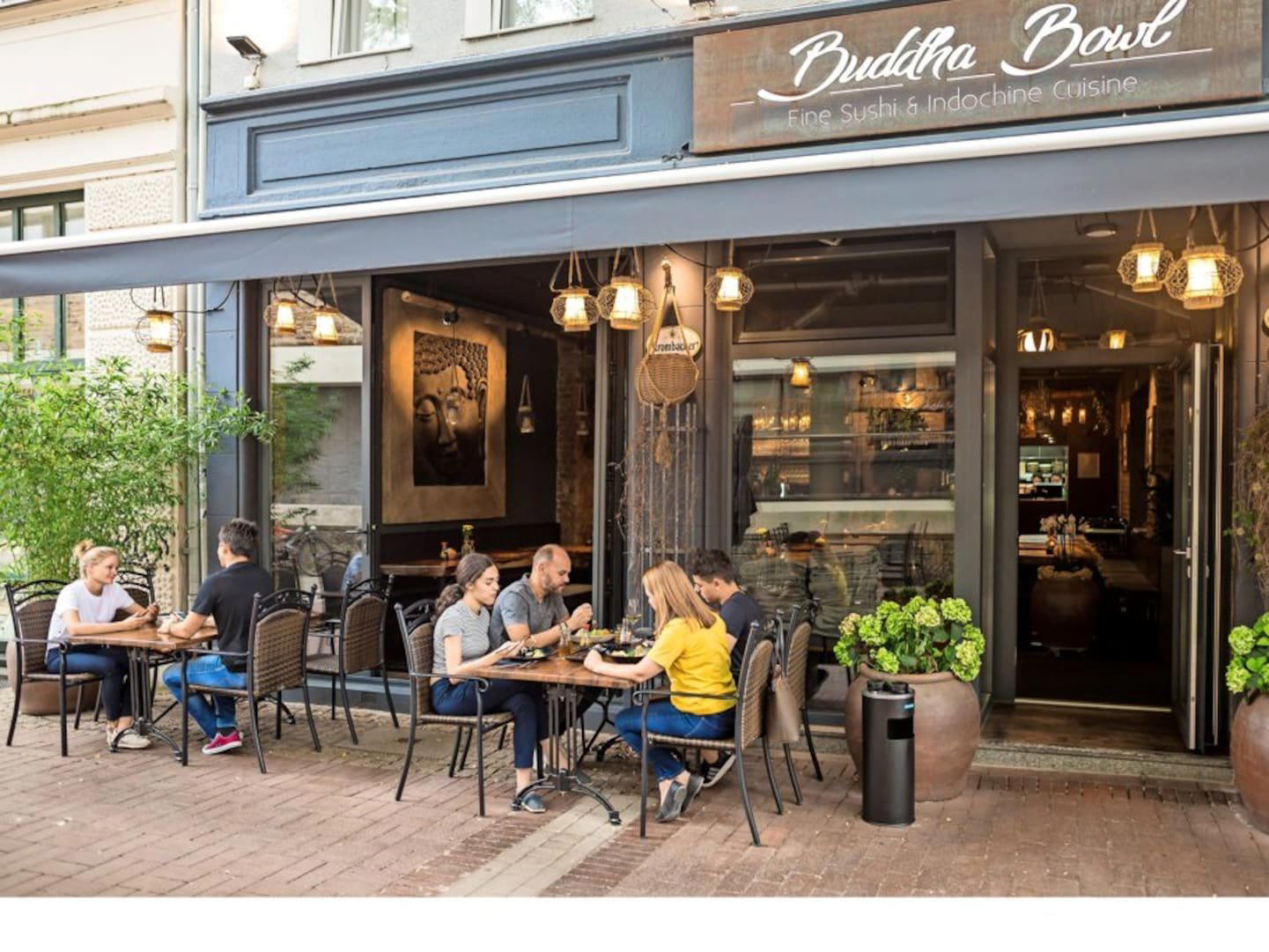
Where Bowl-Format Dining Sits in Hanover's Eating Culture
Hanover is a city where casual, mid-market dining carries much of the day-to-day traffic, and Buddha Bowl fits that role at Pferdestraße 11 in the 30159 postcode. What Hanover does have is a compact, functional city centre and a dining population that has absorbed the bowl-format trend faster than many comparable German cities. Buddha Bowl, at Pferdestraße 11 in the 30159 postcode, sits in that city-centre corridor where office lunch traffic, university-age diners, and visitors navigating the area between the Hauptbahnhof and the Kröpcke converge.
The bowl format itself arrived in German cities on the back of a broader European shift away from plate-service casual dining toward assembled, customisable meals built around grains, legumes, roasted vegetables, and protein options. It is a format that trades the narrative arc of a multi-course dinner for something more immediate: visual abundance, textural contrast within a single vessel, and a price point that sits below the €€€ tier occupied by restaurants like Marie or Handwerk. In that sense, Buddha Bowl addresses a gap in Hanover's daytime and early-evening offering that the city's more structured European dining rooms are not designed to fill.
The Structure of a Bowl-Format Meal
Eating through a bowl-format menu follows a different logic than a tasting progression at somewhere like Jante or CODA Dessert Dining in Berlin. There is no kitchen-controlled sequence, no palate reset between courses, no building arc from light to rich. Instead, the progression is spatial rather than temporal: the eye moves across a single bowl in which multiple components, typically a grain base, a roasted or raw vegetable element, a legume or protein, and a sauce, occupy their own zones before being combined by the diner.
This format rewards composition. When a kitchen gets the component balance right, the result is a meal with genuine textural range: the give of cooked grain against the resistance of raw vegetable, the weight of a tahini or miso dressing anchoring lighter elements. When it falls short, the bowl becomes a sum of underdressed parts. The bowl format's honesty is precisely this: there are fewer places to hide than in a plated tasting menu, and the quality of individual components reads more directly than it might when buried in a sauce or presented as a single garnish.
For visitors comparing options across Hanover's eating scene, the bowl format occupies a distinct position. The creative, more technically demanding cooking at Votum or the structured European approach at Albertz. involves a different kind of attention and a different time commitment. Buddha Bowl, by contrast, is a format built for flexibility, in timing, in dietary requirement, in budget.
Hanover's Mid-Market Dining and Where This Format Fits
Germany's mid-market casual dining tier has consolidated around a handful of reliable formats over the past decade: the burger restaurant, the ramen bar, the pizza-by-the-slice operation, and the bowl concept. Of these, the bowl format has proven most adaptable to plant-forward eating, a shift that has moved from niche preference toward mainstream expectation in German city centres. Cities like Berlin and Munich absorbed this shift earliest; Hanover followed with a smaller but consistent set of bowl-focused operators.
The broader German fine-dining context, from the three-Michelin-star precision of Schwarzwaldstube in Baiersbronn to the technically exacting tasting menus at JAN in Munich or Victor's Fine Dining by Christian Bau in Perl, operates at significant remove from bowl-format casual dining. These are not competing tiers. A visitor to Hanover might eat at Restaurant Haerlin in Hamburg one evening and want something low-key and plant-focused for a midday meal the next day. The restaurant speaks to the second occasion, not the first.
The Pferdestraße address is central enough to function as a practical midday stop. The street sits within the city's pedestrian and commercial zone, meaning access on foot from the main station or from the central shopping area is direct.
What the Format Signals About Plant-Forward Dining in Germany
Rise of bowl-format restaurants in German city centres tracks a measurable shift in how urban diners approach a midday meal. Research across German urban dining markets has consistently shown growth in plant-forward options as a share of casual dining revenue, with grain bowls and vegetable-led assemblies gaining at the expense of more protein-heavy traditional formats. This is not a Hanover-specific story: it plays out similarly in Frankfurt, Düsseldorf, and Stuttgart.
What distinguishes the better operators in this format is sourcing specificity and sauce composition. A bowl built on generic mixed grains with a generic dressing reads as commodity food regardless of how well it is presented. The formats that have retained customer loyalty are those where the grain base has identity (freekeh rather than white rice; red quinoa rather than standard), where roasted vegetables carry caramelisation rather than steam, and where the dressing does active flavour work rather than providing moisture alone. The restaurant's appeal lies in a casual, accessible format rather than fine-dining technique.
For a comparative point of reference outside Germany, the bowl-and-sharing format has evolved considerably in American markets: Lazy Bear in San Francisco and Le Bernardin in New York City operate at price tiers and ambition levels far beyond what the bowl format targets, but they illustrate how much range exists between casual assembly and technical precision in the broader dining spectrum. The restaurant sits firmly in the casual, accessible register of that range, which is the register most relevant to its address and its likely audience.
Planning Your Visit
The restaurant is located at Pferdestraße 11, 30159 Hannover, within the city centre on foot from the Kröpcke transit hub. The restaurant is recommended for reservations and typically opens Monday to Friday from 11:30 AM to 2:30 PM and 4:30 PM to 11 PM, Saturday from 12 PM to 11 PM, and Sunday from 1 PM to 11 PM. Given the bowl format's typical service model, walk-in access during off-peak hours is generally more reliable than during the lunch rush in central locations of this type. For visitors spending a day in Hanover across multiple dining occasions, this address works as a daytime option while reservations at higher-tier rooms like ES:SENZ in Grassau or Schanz in Piesport require advance planning. In Hanover itself, Waldhotel Sonnora in Dreis and the city's own structured dining rooms represent the more formal end of the local spectrum.
Standing Among Peers
Comparable venues nearby, for context on price, style, and recognition.
| Venue | Cuisine | Price | Notes |
|---|---|---|---|
| Buddha BowlThis venue — the venue you are viewing | Pan-Asian Sushi & Indochinese | $$$ | Not listed |
| THE LIVING - room - | Modern European Fine Dining | $$$ | Hannover Mitte |
| Leonardo | Authentic Italian Fine Dining | $$$ | Mitte |
| Aspera | Authentic Turkish-Mediterranean | $$$ | Mitte |
| Roy's | Italian Mediterranean | $$$ | Oststadt |
| Francesca & Fratelli | Italian Pizza | $$ | Oststadt |
Continue exploring
More in Hanover
Restaurants in Hanover
Browse all →
Bars in Hanover
Browse all →
Hotels in Hanover
Browse all →

At a Glance
- Cozy
- Relaxed
- Serene
- Modern
- Casual Hangout
- Group Dining
- Solo
- Family
- Open Kitchen
- Beer Program
Current opening hours
- Monday
- 11:30 AM–2:30 PM, 4:30–11 PM
- Tuesday
- 11:30 AM–2:30 PM, 4:30–11 PM
- Wednesday
- 11:30 AM–2:30 PM, 4:30–11 PM
- Thursday
- 11:30 AM–2:30 PM, 4:30–11 PM
- Friday
- 11:30 AM–2:30 PM, 4:30–11 PM
- Saturday
- 12–11 PM
- Sunday
- 1–11 PM
Hours can change for holidays and private events. Last verified .
Serene and calming with natural materials like wood and stone, green plants, and Buddha-inspired decor creating a relaxing retreat in the heart of the Altstadt.