
Commissioned in 1570, Schlosshotel Münchhausen occupies a Weser Renaissance castle outside Hamelin, offering 67 rooms across a meticulously restored estate with landscaped parkland, multiple dining venues, two golf courses, and a spa. At around $235 per night, it sits in the tier of German historic-castle hotels that trade on architectural authenticity rather than international-brand polish, a category that rewards visitors who read the building as part of the experience.
Pearl is the En Primeur Club membership app — saves, bookings, and concierge access live there. Same editors, same standards.
- Address
- Schloß Schwöbber, Schwöbber 9, 31855 Aerzen
- Phone
- +49 5154 70600
- Directions
- Get directions
 Saves & bookings on Pearl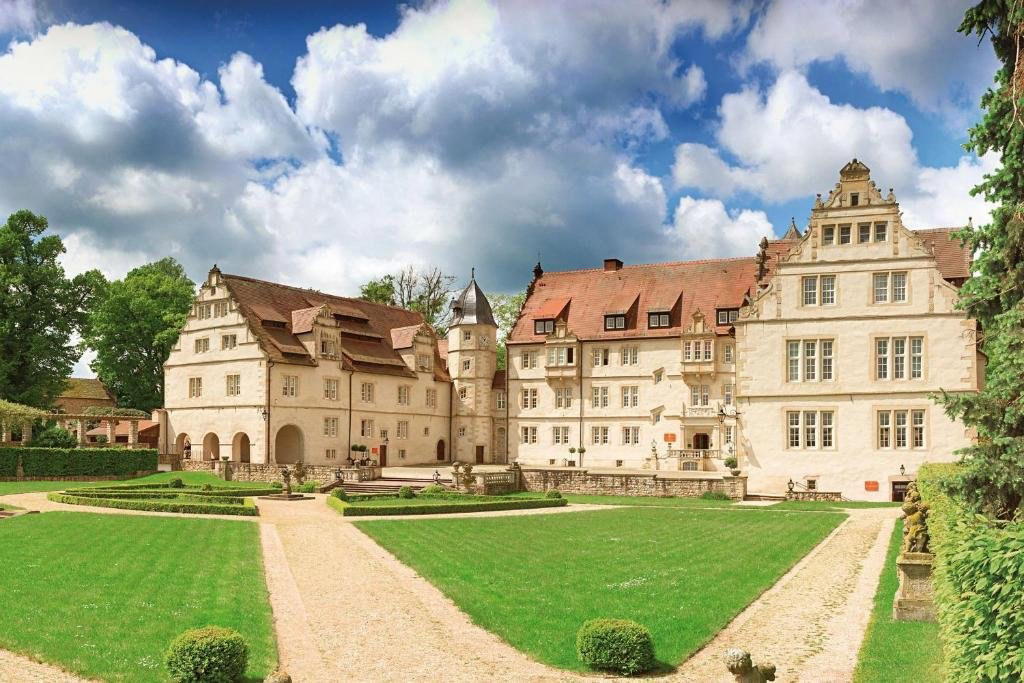
A Castle That Earns Its Age
The approach to Schlosshotel Münchhausen along the Weser uplands already signals the register you are entering. Before the facade comes into view, the parkland does, a composition of mature trees, formal hedgerows, and open lawn that frames the castle as something discovered rather than arrived at. The structure itself is Weser Renaissance, a regional architectural style that flourished across Lower Saxony and Westphalia in the late sixteenth and early seventeenth centuries, characterised by ornamental gables, symmetrical window rhythms, and a particular fondness for sandstone detailing that softens rather than hardens the facade. Schloss Schwöbber, commissioned in 1570 by Hilmar von Münchhausen, is one of the better-preserved examples of the form, and the hotel's restoration has kept its architectural grammar intact rather than smoothing it into a generic heritage-property aesthetic.
That distinction matters more than it might first appear. Germany has many castles converted to hotels, but the quality of those conversions varies enormously. Many prioritise period atmosphere in the public rooms while relegating guest accommodation to a standardised comfort tier that could belong to any four-star property. At Schloss Schwöbber, the architectural continuity extends through the interior: vaulted ceilings, parquet floors, and museum-calibre antiques carry the sixteenth-century idiom through spaces that are meant to be inhabited, not just admired. The result is a property that sits closer to the Bülow Palais in Dresden or Excelsior Hotel Ernst in Cologne in terms of architectural seriousness than to resort properties that simply happen to occupy old buildings.
Weser Renaissance in Practice
The Weser Renaissance style that defines Schloss Schwöbber was never a purely decorative exercise. It developed at a moment when the Protestant nobility of Lower Saxony was consolidating wealth and demonstrating cultural reach through architecture, which explains why the buildings of the period so often feel less like fortifications and more like intellectual statements in stone. The Münchhausen family, one of the region's prominent aristocratic houses, built accordingly. The result is a castle that reads as a venue for gathering, for thinkers, collectors, and guests, rather than a defensive structure. That original programming, a place designed for reception and discourse, maps surprisingly well onto what a hotel does now.
Inside, the layering of periods is handled with restraint. The vaulted spaces have not been overwrought with period-detail theatrics, and the antiques function as furniture rather than props. This is an approach that some German castle properties get wrong, filling rooms with reproduction pieces or staging period detail so heavily that the guest feels like a visitor to a museum after hours. Here, the architectural bones carry the weight, and the decoration fills in around them. For travellers comparing this against properties like Schloss Elmau in the Bavarian Alps, another estate hotel built around the idea of cultural gathering, the key difference is typological: Elmau is a purpose-built retreat house, while Schloss Schwöbber is a genuine sixteenth-century commission with the architectural record to prove it.
What the Property Offers Beyond the Building
At 67 rooms, Schlosshotel Münchhausen occupies a scale that allows individual attention without the intimacy becoming claustrophobic. It is large enough to support multiple dining venues and two full golf courses set within the surrounding parkland, which means the estate functions as a self-contained destination rather than a base for external excursions. The spa adds a wellness dimension that has become close to non-negotiable for this tier of German country-house hotel, properties like Das Kranzbach in Kranzbach and Hotel Bareiss in Baiersbronn have established wellness programming as a core expectation rather than an amenity.
The golf offer is worth noting specifically. Two courses on an estate of this size and in this topography, the Weser uplands are gently rolling, not dramatic, provide a low-intensity golfing proposition that suits guests who want the sport without the competitive pressure of a destination golf resort. It aligns the property with a particular kind of leisure: unhurried, property-anchored, unhurried again.
At roughly $235 per night, the pricing positions Schlosshotel Münchhausen in the mid-tier of Germany's premium country-house hotel category. It is above standard four-star rural accommodation but below the upper bracket occupied by properties such as Althoff Seehotel Überfahrt or Mandarin Oriental Munich. For what the rate buys, a restored sixteenth-century castle, 67 rooms, multiple dining options, two golf courses, and a spa, the value equation is credible. Comparable estate hotels in France or the UK at equivalent architectural pedigree typically price considerably higher.
Location and Getting There
The hotel sits outside Aerzen, a small municipality in Lower Saxony, close to the medieval town of Hamelin, the same Hamelin of the Pied Piper legend, which remains a cultural draw and is worth a half-day visit for its intact medieval streetscape and Weser Renaissance civic buildings that mirror the castle's own architectural period. The proximity is not incidental: Hamelin and Schloss Schwöbber are products of the same regional moment, and seeing both together gives the architectural context a depth that either alone would lack.
Hanover, the nearest major city, is accessible within an hour by road, making the property reachable by rail-and-car combinations for international visitors flying into Hanover Airport. Guests coming from further afield, Frankfurt or Hamburg, should factor in roughly two to three hours of travel. The property is not on the route between two major centres, which is typical of German Schlosshotel properties; the journey is directional, which means guests tend to commit fully to the estate rather than treating it as a stopover.
Properties in this category, German castle hotels that function as estate destinations rather than city-adjacent retreats, tend to draw guests who have already moved through the international-brand tier and are looking for a different kind of specificity. The comparison set spans quite different geographies: Weissenhaus Private Nature Luxury Resort on the Baltic coast, Villa Contessa in Bad Saarow, and Landhaus Stricker on Sylt each offer a version of design-led or estate-anchored German hospitality that sits outside the international-brand framework. Schlosshotel Münchhausen's particular claim within that set is the oldest architectural pedigree of the group.
Planning Your Stay
The parkland and golf courses are at their leading from late April through October, when the Lower Saxony landscape is in full leaf and the weather supports outdoor use of the estate. Winter visits centre more heavily on the interior architecture, the spa, and the dining programme, which suits guests for whom the building is the primary draw. Advance booking for peak summer weekends is advisable, and rooms at Schloss Schwöbber's scale can move quickly for high-demand dates.
Quick Comparison
Comparable venues nearby, for context on price, style, and recognition.
| Venue | Cuisine | Price | Awards | Notes |
|---|---|---|---|---|
| Schlosshotel MünchhausenThis venue — the venue you are viewing | Historic castle estate with landscaped parkland and modern spa facilities | $$$$ | Michelin 1 Key | Not listed |
| Das James | Urban city and holiday hotel blending historical charm with modern luxury | $$$$ | Michelin 1 Key | Sonwik |
| Hotel Landhaus Wachtelhof | Turreted castle-style boutique hotel | $$$$ | Michelin 1 Key | Rotenburg an der Wumme |
| Hardenberg BurgHotel | Castle-side luxury retreat with premium amenities | $$$$ | Michelin 1 Key | Nörten-Hardenberg |
| Lieser Castle, Autograph Collection | Restored 19th-century castle blending historic grandeur with modern luxury | $$$$ | Michelin 1 Key | Lieser |
| Do & Co Hotel Munich | Luxurious boutique hotel blending modern design with central historic location | $$$$ | Michelin 1 Key | Altstadt |
Recognition history
Dated appearances from independent guides and award organizations, with the underlying list record or original source where available.
Michelin 1 Key
Michelin
Continue exploring
More in Aerzen
Bars in Aerzen
Browse all →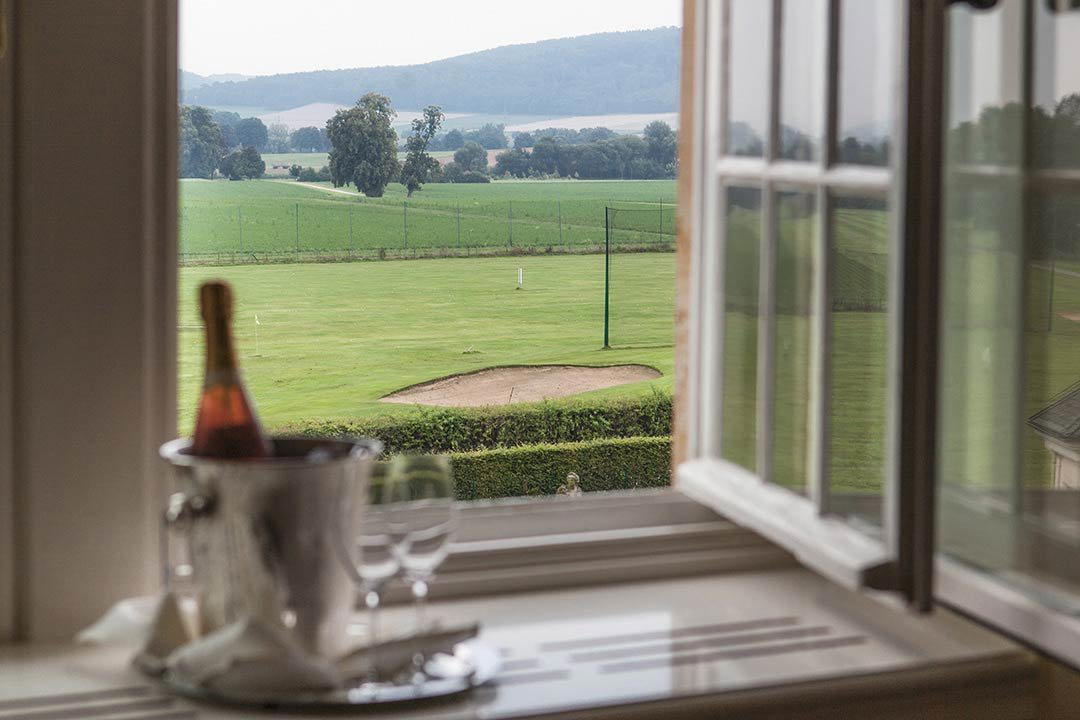
Restaurants in Aerzen
Browse all →
Wineries in Aerzen
Browse all →
At a Glance
- Romantic
- Elegant
- Classic
- Scenic
- Sophisticated
- Ornate
- Romantic Getaway
- Anniversary
- Honeymoon
- Weekend Escape
- Historic Building
- Garden
- Golf Course
- Wi Fi
- Pool
- Spa
- Sauna
- Massage
- Room Service
- Concierge
- Restaurant
- Bar
- Parking
- Garden
- Wi Fi
- Pool
- Spa
- Sauna
- Massage
- Room Service
- Concierge
- Restaurant
- Bar
- Parking
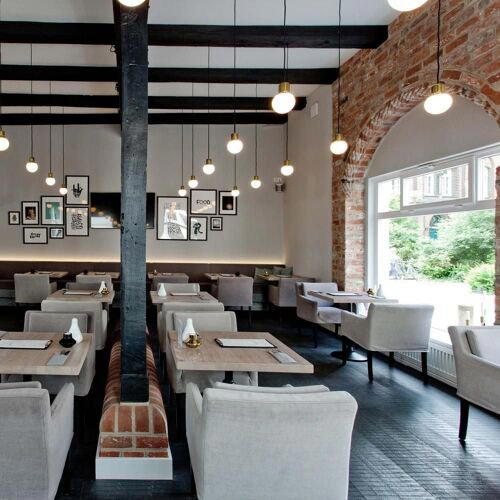
Elegant and serene with vaulted ceilings, parquet floors, and antique furnishings illuminated by natural light in a peaceful castle setting amid pristine forests and gardens.