Our verdict
Open since 1896, Bouillon Chartier is the 9th arrondissement's most enduring argument for French dining without ceremony. The fin-de-siècle dining room — brass rails, hat racks, white-aproned waiters moving at pace — functions as both a working restaurant and a living document of Parisian brasserie culture. Prices remain deliberately accessible in a city that has largely abandoned that contract.

Pearl is the En Primeur Club membership app — saves, bookings, and concierge access live there. Same editors, same standards.
- Address
- 7 Rue du Faubourg Montmartre, 75009 Paris, France
- Phone
- +33147708629
- Hours
- Daily 11:30 AM–12 AM
- Website
- bouillon-chartier.com
- Directions
- Get directions
The menu
What to order
- Steak frites
- Oeuf mayonnaise
- Bœuf bourguignon
- Confit de canard
A Room That Has Not Forgotten What It Is
The bouillon format predates the modern Parisian restaurant by several decades. Emerging in the mid-19th century as a response to urban migration and the need for cheap, sustaining food served quickly to workers, the bouillon was never meant to be charming — it was meant to be functional. Chartier, which opened in 1896 on Rue du Faubourg Montmartre in the 9th arrondissement, is one of the few surviving examples of that original format, and it has retained the logic of the thing even as the city around it has shifted toward tasting menus and natural wine lists with studied informality.
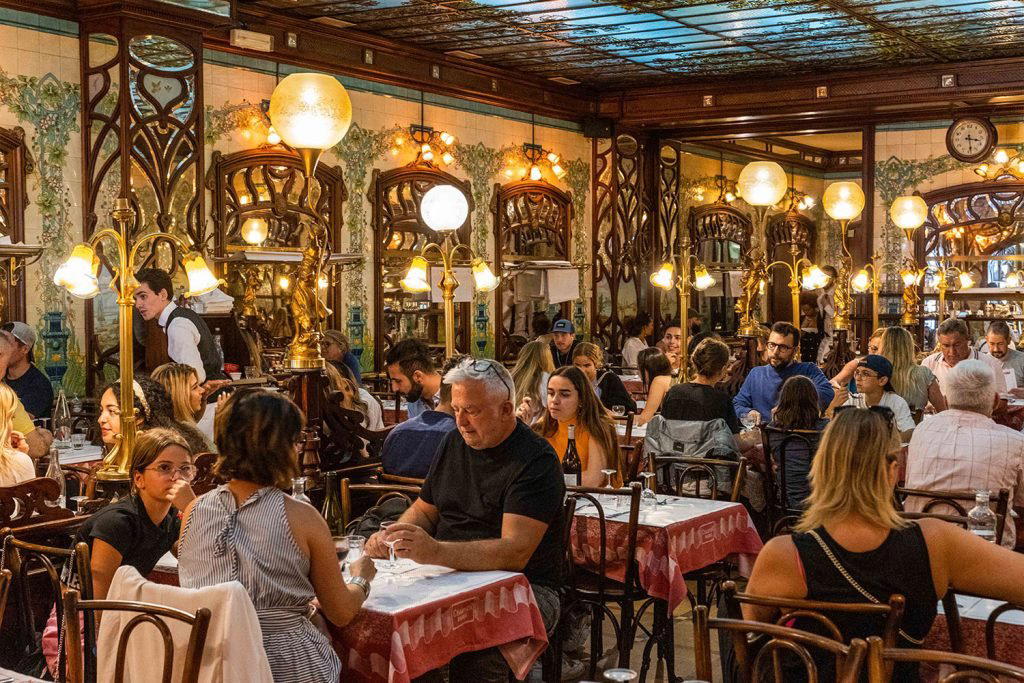
The room itself does most of the editorial work. The 1896 interior — classified as a historic monument by the French state, runs to soaring ceilings, mirrored walls, dark wood partitions, brass luggage racks overhead, and rows of tightly spaced tables that make privacy impossible and conversation with strangers inevitable. The noise level at peak service sits somewhere between a covered market and a busy train station, which is exactly what the format demands. Waiters write orders directly on the paper tablecloth and calculate the bill the same way, a system that functions as both a time-saving mechanism and an unintentional piece of theatre.
For readers accustomed to the calibrated quiet of places like L'Ambroisie or the architectural seriousness of Le Cinq at the Four Seasons George V, Chartier operates on a different register entirely. The comparison is not about quality tiers, it is about what French dining culture has historically contained. The bouillon tradition represents the democratic end of that spectrum, and Chartier is its most visited surviving instance.
What the Room Smells and Sounds Like
The sensory experience at Chartier begins before you sit down. The queue that forms on Rue du Faubourg Montmartre, Chartier does not take reservations for most sittings, and the line can stretch to forty minutes or more at peak hours, gives the dining room time to announce itself through the open door: the smell of beef consommé and warm bread, the clatter of crockery on marble, the particular acoustic signature of a room built for volume rather than intimacy. None of this is curated. It is the byproduct of continuous operation across more than a century.
Inside, the light is warm and slightly insufficient, which softens the edges of a room that could otherwise feel institutional. The mirrors multiply the crowd, making even a quiet Tuesday feel populated. The hat racks above each table, genuinely used in the early 20th century, now largely decorative, remain in place, a detail that only registers if you know to look for it. This is not a museum recreation. The fittings are original, worn to the specific patina that comes from daily use rather than preservation.
The Menu as a Document of Classical French Cooking
The Chartier menu is structured around the French brasserie canon: starters of egg mayonnaise, herring in oil, and celeri remoulade; mains built around roast chicken, steak-frites, and pot-au-feu; desserts that run to profiteroles and île flottante. The prices are low by Paris standards, deliberately so, in the original bouillon spirit, which explains in part why the room turns tables at a pace that would alarm most contemporary restaurateurs.
This is categorically not the cooking found at Arpège, Alléno Paris au Pavillon Ledoyen, or Kei. France's broader dining ambition, evidenced by three-star institutions like Mirazur in Menton, Troisgros in Ouches, and Bras in Laguiole, occupies a different category entirely. Chartier's function is not to compete with that register. It is to demonstrate that French culinary culture has always held multiple simultaneous conversations, and that the one about accessibility and tradition is as legitimate as the one about innovation.
The egg mayonnaise, in particular, has become a minor cause célèbre among food writers who track the dish as an index of classical French cooking standards. When executed correctly, a firm white, a properly emulsified, slightly mustardy mayonnaise, seasoned with restraint, it requires precision without complexity. At Chartier, it arrives as it has for decades, which is either the point or a limitation depending on where you sit on the question of culinary progress.
Context in the Paris Dining Scene
The 9th arrondissement has developed a more considered restaurant scene in the years since Chartier opened, with independent bistros and wine-focused rooms joining the older institutions along its quieter side streets. Chartier sits apart from that evolution, not because it has resisted change, but because its format never required updating. The bouillon model was already optimised for what it was designed to do.
Within Paris's wider dining geography, Chartier functions as a useful counterpoint to the concentration of fine dining in the 1st, 6th, 7th, and 8th arrondissements. The regional French establishments that anchor France's culinary reputation, from Auberge de l'Ill in Illhaeusern to Paul Bocuse in Collonges-au-Mont-d'Or and Assiette Champenoise in Reims, operate on entirely different premises of exclusivity, price, and occasion. Chartier's value in that conversation is precisely its distance from those premises.
For visitors arriving from cities where French cooking is represented primarily by its fine-dining exports, the influence of Le Bernardin in New York, for instance, or the technical ambition of Atomix in a different culinary tradition altogether, Chartier offers a corrective. French cooking's depth comes partly from its high end, and partly from the functional middle that has fed working Parisians for a hundred and thirty years.
Planning Your Visit
Chartier is at 7 Rue du Faubourg Montmartre in the 9th arrondissement, a short walk from the Grands Boulevards metro station. The restaurant operates a walk-in model for most sittings, which means queuing is part of the arrangement, arriving shortly after opening or in the mid-afternoon between services reduces the wait. The pace inside is brisk: tables are needed back, and lingering is gently discouraged. This is not an evening for slow conversation over a second bottle; it is an evening for eating at the speed the kitchen sets. For the full range of Paris dining options across price points and styles, see our full Paris restaurants guide.
Frequently asked questions
What do regulars order at Bouillon Chartier?
The menu at Chartier follows the classical bouillon format, which means the ordering logic is direct: egg mayonnaise or herring as a starter, steak-frites or roast chicken as a main, and île flottante or profiteroles to finish. The egg mayonnaise has particular standing among those who use it as a benchmark for classical French technique. Prices across the menu are set at a level designed to remain accessible, in keeping with the original bouillon contract, a dinner for two with wine sits at a fraction of what comparable coverage of French culinary tradition would cost at a contemporary Paris bistro.
Can I walk in to Bouillon Chartier?
Chartier operates primarily on a walk-in basis, and the queue on Rue du Faubourg Montmartre is a fixed part of the experience rather than an inconvenience to be avoided. Wait times vary by session: lunch midweek is considerably shorter than Friday or Saturday dinner. The 9th arrondissement location is accessible from multiple metro lines, which makes timing your arrival around the opening of a service a practical strategy for reducing the wait without booking ahead.
Why does Bouillon Chartier's interior have historic monument status?
The 1896 dining room is classified as a French historic monument because its original fin-de-siècle fittings, mirrored walls, mahogany partitions, brass luggage racks, and painted ceiling panels, remain largely intact after more than a century of daily operation. This is not a restored or recreated interior; the materials are original and carry the specific wear that comes from continuous use since the Belle Époque. That classification places Chartier in a small category of Paris restaurants where the room itself carries documentary value independent of what is served inside it.
Fast Comparison
Comparable venues nearby, for context on price, style, and recognition.
| Venue | Cuisine | Price | Notes |
|---|---|---|---|
| Bouillon ChartierThis venue — the venue you are viewing | Traditional French Bouillon | $10–20 | Not listed |
| Le Toucan | French Café & Bistro | $10–20 | 11th Arr. - Popincourt |
| Canard et Champagne | Classic French Duck & Champagne Bistro | $30–50 | 2nd arrondissement |
| Bouillon Pigalle | Traditional French Bouillon | $20–30 | Pigalle |
| Strobi | Modern French Bistro | $30–50 | Batignolles |
| Le Bossu | Traditional French Bistro | $30–50 | Île Saint-Louis |
Continue exploring
More in Paris
Restaurants in Paris
Browse all →
Bars in Paris
Browse all →
Hotels in Paris
Browse all →
Details
- Classic
- Lively
- Well Known
- Casual Hangout
- Group Dining
- Historic Building
- A La Carte
Current opening hours
- Monday
- 11:30 AM–12 AM
- Tuesday
- 11:30 AM–12 AM
- Wednesday
- 11:30 AM–12 AM
- Thursday
- 11:30 AM–12 AM
- Friday
- 11:30 AM–12 AM
- Saturday
- 11:30 AM–12 AM
- Sunday
- 11:30 AM–12 AM
Hours can change for holidays and private events. Last verified .
Bustling Belle Epoque dining room with glass-globe fixtures, mirrored walls, ornate woodwork, and lively Parisian energy.