Bar Jamon
Bar Jamon at 125 E 17th St occupies a particular niche in New York's Spanish bar scene: a compact, wine-and-ham-forward room where the distinction between drinking and eating collapses by design. The format draws from the Iberian tradition of standing bars built around cured meat, cheese, and glass pours, translated into a Manhattan side-street setting that shifts character considerably between afternoon and late evening.
Pearl is the En Primeur Club membership app — saves, bookings, and concierge access live there. Same editors, same standards.
- Address
- 125 E 17th St, New York, NY 10003, USA
- Phone
- +1 212 253 2773
- Website
- casamononyc.com
- Directions
- Get directions
 Saves & bookings on Pearl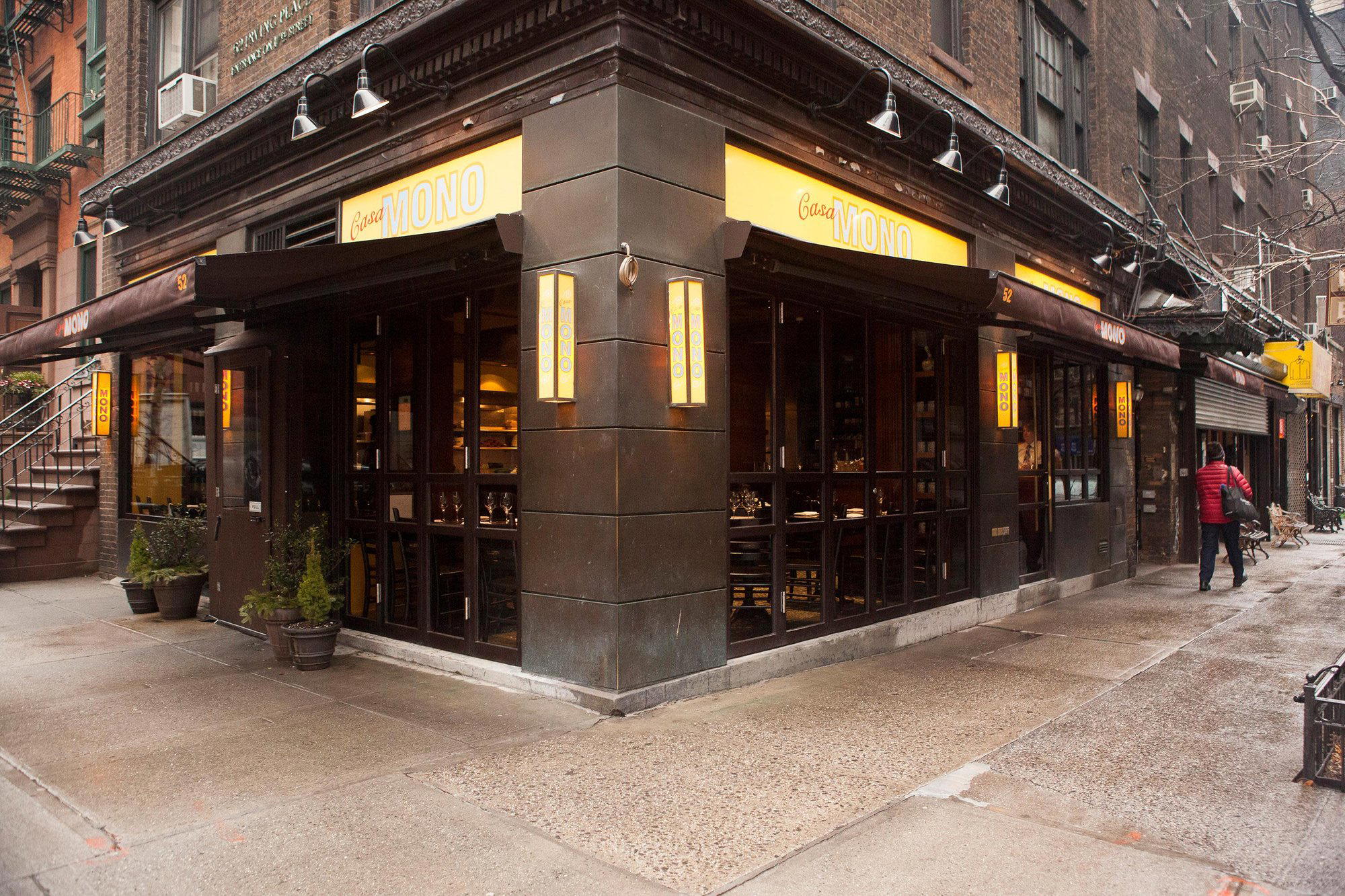
The Room Before the Food
East 17th Street in the Gramercy-adjacent stretch between Union Square and Irving Place holds a particular kind of New York energy: residential enough to feel neighbourhood-scaled, commercial enough to keep foot traffic moving at most hours. Bar Jamon sits within that context as a narrow, stand-or-perch operation built around the logic of the Spanish taberna rather than the American bar-restaurant hybrid. The physical setup signals its intent immediately: cured legs on display, a counter that prioritises closeness over comfort, and a wine list structured around glass pours rather than bottle ceremony. This is eating and drinking treated as a single continuous act, not two separate courses.
That format matters more than any individual item on the menu. New York has long imported European bar traditions and then expanded them into something larger and more formal. Bar Jamon represents the counter-tendency: the deliberate compression of the experience into something closer to its source, where the room itself keeps ambitions appropriately modest and the food does the work without theatrical presentation.
Afternoon Light, Evening Shift: How the Hours Change the Room
The lunch-versus-dinner divide at a standing bar format operates differently than it does at a full-service restaurant. At Bar Jamon, the afternoon service draws a more purposeful crowd: neighbourhood regulars, Union Square-adjacent office workers, and visitors who know that jamón ibérico consumed standing up with a glass of something cold is a reasonable way to spend forty minutes in the middle of the day. The pace is quicker, the light from the street still present, and the transaction feels less loaded with expectation.
By evening, the room accumulates. The counter fills, conversations overlap, and the experience tips from snack-stop toward something more social and drawn-out. This is where the Spanish taberna format earns its keep in a New York context: it accommodates the long, unstructured drink-and-graze pattern that formal dining rooms struggle to support without either rushing tables or padding bills with courses. The restaurant occupies a distinct gap in the city's dining scene: the medium-length, low-formality window that European cities fill naturally with their bar cultures.
The value equation also shifts between services. At lunch, a small number of items alongside a glass of wine functions as a complete meal at a cost well below what the surrounding neighbourhood's restaurants charge for a seated two-course format. Neither service is designed to extract maximum spend per seat; the format simply does not work that way.
Where Bar Jamon Sits in the New York Spanish Tradition
New York's Spanish restaurant scene has historically clustered in two modes: the formal Basque or Catalan restaurants in Midtown and the East Village that built serious wine programs around Spanish regions in the 1990s and 2000s, and the more casual tapas-format rooms that proliferated across the boroughs afterward. The restaurant belongs to neither category cleanly. Its focus on jamón as a centrepiece rather than a supporting player, combined with the standing-bar format, places it closer to the Iberian source than most of its contemporaries in the city.
That positioning matters when comparing it to the broader New York dining conversation. The city's critical attention and booking demand tend to concentrate at the upper end of the market: the Michelin-tracked counters, the tasting-menu rooms, the reservation-scarce chef-driven projects documented in places like Atomix or the seafood-forward precision of Le Bernardin. The restaurant operates at a different register entirely, and that contrast is the point. The same city that produces intense competition at the summit of the market also sustains neighbourhood formats where the ambition is calibrated and the experience is repeatable rather than occasion-specific.
Across American cities, similar patterns hold. In San Francisco, Lazy Bear occupies the high-concept end of the communal format spectrum. In New Orleans, Emeril's anchors a different kind of local institution. In Napa, The French Laundry represents the apex of the destination-dining model. The restaurant does not compete with any of those formats; it serves a different function in the dining ecosystem, one that cities with strong European bar cultures have always understood intuitively.
For readers exploring Chicago's more considered dining rooms like Smyth, or the farm-to-counter precision of Single Thread Farm in Healdsburg, the restaurant is a useful calibration point: a reminder that not every strong dining experience is built around ambition at scale. The same logic applies to Blue Hill at Stone Barns in Tarrytown, Providence in Los Angeles, and the more formal European models like Atelier Moessmer Norbert Niederkofler in Brunico or Dal Pescatore in Runate: each occupies a defined position in the broader dining continuum, and the restaurant's position is the deliberately informal one.
Other high-intention American addresses worth noting in this context include Addison in San Diego, The Inn at Little Washington, and Frasca Food and Wine in Boulder. None of them share the restaurant's format or price register, which underscores how deliberately compressed the restaurant model is within the American fine-casual spectrum.
Know Before You Go
| Address | 125 E 17th St, New York, NY 10003 |
|---|---|
| Neighbourhood | Gramercy / Union Square |
| Format | Standing bar, Spanish taberna-style |
| Leading for | Afternoon drop-in, early evening grazing |
| Booking | Walk-in format; no reservations required |
| Nearest Transit | Union Square (4/5/6/L/N/Q/R/W trains) |
For high-commitment tasting formats in the city, Masa represents the opposite end of the spectrum in both price and structure.
Peers Worth Knowing
Comparable venues nearby, for context on price, style, and recognition.
| Venue | Cuisine | Price | Notes |
|---|---|---|---|
| Bar JamonThis venue — the venue you are viewing | Authentic Spanish Tapas & Jamón Bar | $$$ | Not listed |
| Toledo Restaurant | Classic Spanish | $$$ | Midtown-Times Square |
| Mar at Mercado Little Spain | Modern Spanish Seafood Tapas | $$$ | Chelsea-Hudson Yards |
| Solera | Contemporary Spanish Tapas | $$$ | East Midtown-Turtle Bay |
| Sangarita's | Spanish Tapas & Wine | $$ | Bayside |
| Dishoom | Bombay-inspired Indian café | $$$ | Lower Manhattan |
Continue exploring
More in New York City
Restaurants in New York City
Browse all →
Bars in New York City
Browse all →
Hotels in New York City
Browse all →






At a Glance
- Cozy
- Intimate
- Lively
- Date Night
- Casual Hangout
- Extensive Wine List
Current opening hours
- Monday
- 5 PM–12 AM
- Tuesday
- 5 PM–12 AM
- Wednesday
- 5 PM–12 AM
- Thursday
- 5 PM–12 AM
- Friday
- 5 PM–12 AM
- Saturday
- 5 PM–12 AM
- Sunday
- 5 PM–12 AM
Hours can change for holidays and private events. Last verified .
Casual yet lively with a cozy, cramped Spanish bar atmosphere.