아리랑 Arirang
Our verdict
아리랑 Arirang brings Korean dining to the heart of Samarqand, a city better known for plov and samsa than for Korean barbecue or banchan. The restaurant sits at an unusual crossroads: a Korean culinary tradition transplanted into Central Asia's most historically layered city. For travellers already exploring Samarqand's dining scene, it offers a distinct contrast to the Uzbek-focused establishments that dominate the area.

Pearl is the En Primeur Club membership app, where members save venues, book tables and use the concierge.
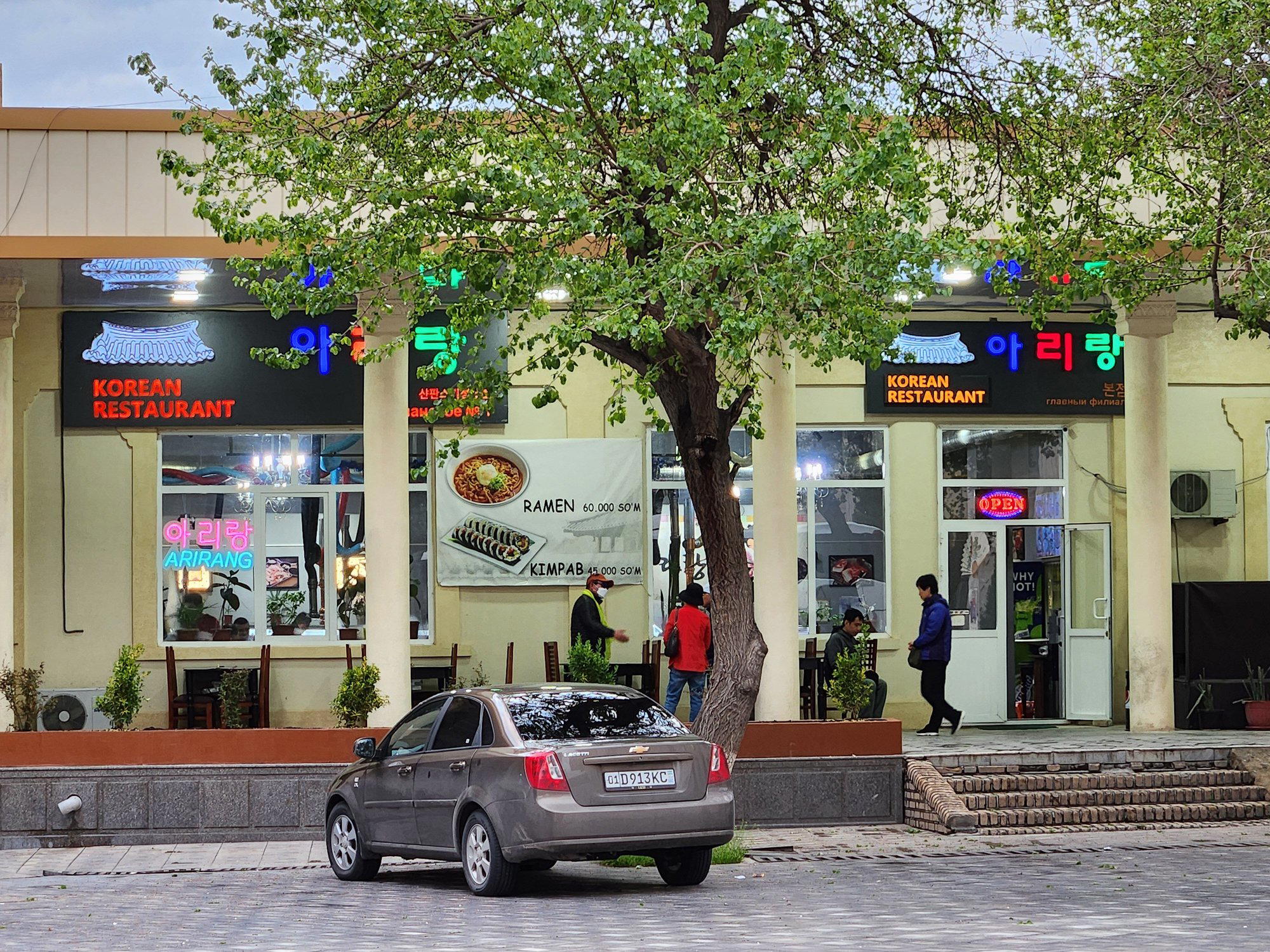
Where the Silk Road Meets the Korean Table
Samarqand has always been a city of convergence. For more than two millennia, it absorbed traders, missionaries, conquerors, and cooks from across Eurasia, and the result is a food culture that quietly holds more foreign influence than its Uzbek identity might suggest. Korean cuisine arriving here is, in that light, less surprising than it first appears. The Korean diaspora across Central Asia, established during the Soviet-era forced relocations of the Koryo-saram in the late 1930s, gave Uzbekistan one of the oldest Korean communities outside the Korean peninsula. That demographic reality means Korean food in Uzbekistan is not a novelty import; it carries a genuine regional history.
아리랑 Arirang occupies that context. In a city where most dining rooms orient their menus around plov, lagman, and kebab, a Korean-named establishment signals a different kind of table altogether. The name itself, drawn from the most widely recognised Korean folk song, carries cultural weight before a single dish arrives. It frames the meal as something deliberate: a preservation of culinary identity in a place that has always been shaped by the meeting of traditions.
The Ritual of the Korean Meal in a Central Asian Setting
Korean dining has its own internal logic, and that logic does not simplify for foreign contexts. The meal is structured around sharing and sequencing rather than individual ordering. Banchan, the small side dishes that arrive before or alongside a main, are not garnishes; they set the texture and flavour range for everything that follows. Fermented, pickled, braised, and raw elements appear together, calibrated against one another. The pace of the table is dictated not by courses in the Western sense but by the rhythm of the grill, the refilling of small plates, and the steady pour of soup or broth.
In Korean barbecue formats, the table itself becomes an instrument. Diners manage their own cooking, wrapping grilled meat in perilla leaves or lettuce with fermented paste, building each bite individually. This is a participatory meal by design, and it asks more of the diner than most restaurant formats do. The etiquette is specific: older diners are served first, glasses are filled by others rather than oneself, and the sharing of food is an act of hospitality rather than an informal arrangement. For travellers arriving from a circuit of Uzbek restaurants where communal bread and plov follow their own ceremonial logic, the shift in ritual at a Korean table is instructive rather than disorienting.
Within Samarqand's dining scene, this kind of structural contrast is worth seeking out. Most of the city's well-regarded restaurants, including Afrosiyob Restaurant and Shokhrukh Nur, orient their format around Uzbek hospitality conventions: large platters, long tables, and menus anchored to the tandoor. A Korean table operates by entirely different principles, and that difference is itself informative for a traveller paying attention to how food culture encodes social values.
Korean Cuisine in Uzbekistan: A Longer History Than Most Expect
The Koryo-saram presence in Uzbekistan reshaped what local markets carried and what home kitchens produced. Fermented vegetables, sesame-seasoned salads, and specific cuts of meat entered Uzbek food markets through Korean neighbours over decades. Some of these influences are so embedded now that their origin is no longer visible. A Korean restaurant in this context is not operating in isolation; it is drawing on a culinary thread that has been woven into the region for nearly a century.
This matters for how you read the menu. Unlike Korean restaurants in cities where the cuisine is purely imported, a Korean establishment in Uzbekistan can source from a local population that maintains genuine familiarity with the flavour profiles. That proximity to an established diaspora community is a different condition than, say, a Korean restaurant in a city with no Korean residential history. Travellers interested in the global Korean dining scene can compare this Silk Road positioning against the very different critical contexts of Atomix in New York City or the precision fine-dining environments of 8 1/2 Otto e Mezzo Bombana in Hong Kong, where the audience and culinary infrastructure are entirely different.
Placing Arirang in Samarqand's Broader Dining Map
Samarqand's restaurant tier is not large. The city draws serious culinary attention primarily through its Uzbek and Central Asian cooking, and most visitors structure their meals accordingly. The arguments for spending an evening at a Korean table here are not about ranking it against the local Uzbek options; they are about what that contrast reveals. A traveller who has eaten at Ayvan Restaurant in Bukhara or Old Bukhara in Buxoro and wants to understand how non-Uzbek culinary traditions operate within this region will find the Korean table a more useful reference point than another plov variation.
Across Uzbekistan, dining in cities like Tashkent offers a wider spread: Jumanji in Tashkent and Khiva Cafe in Toshkent represent the range of what the capital supports. In Samarqand, the restaurant options narrow, and the presence of a Korean name on the list is a signal worth following. For a broader survey of what the city's dining scene offers in full, our full Samarqand restaurants guide maps the complete picture, including venues oriented toward different price points and cuisines.
The regional context extends further: Mirza Bashi in Xiva and Yi Palace in Konigil represent how Uzbekistan's smaller cities are building dining identities of their own. Shayxana Nayman in Kegeyli extends that map into less-visited territory. Against that pattern, a Korean restaurant operating in Samarqand is part of a broader diversification of dining options across cities that have historically offered only a single culinary register.
Planning Your Visit
As with many independent restaurants in Samarqand, the most reliable approach is to ask your hotel concierge for current information or to check locally on arrival. Samarqand's dining scene is active but not uniformly connected to international booking platforms, so on-the-ground enquiry often yields better results than online research. The city's peak tourist season runs from spring through autumn, when the monuments draw the largest crowds and restaurants see their highest volumes. Travelling in shoulder season reduces the likelihood of a full house on short notice.
Frequently asked questions
Where exactly is 아리랑 Arirang?
아리랑 Arirang is located at Samarqand, Samarqand Viloyati, Samarqand.
Is 아리랑 Arirang a good restaurant for travellers curious about Korean-Central Asian food history?
Samarqand sits within a region that has housed one of the world's most distinctive Korean diaspora communities since the late 1930s, making it a rare place where Korean culinary tradition has been shaped by Central Asian ingredients and conditions over multiple generations. Arirang, located in Samarqand city, occupies that historical intersection in a dining context. Travellers with an interest in how migration reshapes cuisine will find the broader food environment here, not just this one venue, worth serious attention.
What's the best thing to order at 아리랑 Arirang?
Korean cuisine in Uzbekistan carries a particular historical layer: the Koryo-saram community, ethnic Koreans deported to Central Asia by Stalin in 1937, shaped local food culture here long before Korean restaurants became a global trend. In that context, fermented and sesame-based preparations are likely to reflect both tradition and local adaptation rather than a straightforward Seoul template.
How far ahead should I plan for 아리랑 Arirang?
Samarqand's independent restaurants generally operate without month-out reservation queues, but Korean dining options in the city are limited enough that turning up without any advance planning carries real risk, particularly during peak tourism months when Silk Road heritage tourism peaks between April and October.
What is 아리랑 Arirang known for?
Arirang is one of the few venues in Samarqand serving Korean cuisine in a city where Uzbek plov, shashlik, and samsa define the dominant restaurant culture. Its significance connects directly to Uzbekistan's Koryo-saram history, a Korean-descended population that has maintained distinct culinary traditions in Central Asia for nearly ninety years. That context gives Korean food in Samarqand a different cultural weight than it carries in, say, a European capital.
Cuisine-First Comparison
| Venue | Cuisine | Price |
|---|---|---|
| 아리랑 ArirangThis venue (the venue you are viewing) | Korean Barbecue | $10–20 |
| Afrosiyob Restaurant | Uzbek / Central Asian | $10–20 |
| Shokhrukh Nur | Traditional Uzbek Shashlik | $1–10 |
| Jumanji | Fusion (European, Asian, Uzbek) | $20–30 |
| Besh Qozon Central Asian Pilaf Centre | Central Asian Plov | $1–10 |
| Old Bukhara | Traditional Uzbek Grill | $10–20 |
Continue exploring
More in Samarkand
Details
- Lively
- Casual Hangout
- Group Dining
- Open Kitchen
- Street Scene
- A La Carte
- Vegan Options
Casual and lively atmosphere focused on interactive grilling and abundant side plates.